- Monday, 11 May 2026

50 Yrs Of Scribing, And Counting

Readers of The Rising Nepal, the country’s first broadsheet English daily, have endured this pen pusher for 50 years this week, just shy of three days from now. They are unlikely to finally find relief from someone with a dogged passion for wielding the nib and minting words. There is ample time and immense opportunity to crack ideas and issues with cutting comments, provided the mandatory minimum personal health conditions do not creak and crack to unsettle the scribing fingers. Of the free press, the only profession mentioned in the US constitution, George Washington, America’s first president, said: “Infamous scribblers.”
“Harmony Between The Young And (The) Old” was my debutant article, which flagged off a relatively long scribing innings. Credit for the heading goes entirely to the Features Section. That was shortly after I joined The Rising Nepal newsroom as a sub-editor. Offers for writing remunerated articles from other media poured in steadily, including about a two-year stint as a weekly “commentator” to Radio Nepal. The short pieces of about 600 words were broadcast next to the prime-time evening news bulletin. The remuneration was a third more than what TRN gave for a 1000-word write-up.
First five decades
The mention of the first five decades should not even hint of an improbable prospect of completing even half of that time ahead. That is the logic of human lifespan as of today. In love with the printed word, I read on an average day one magazine plus four daily newspapers for no less than 35 years. Book reading in-between those sessions was another stint. The quota for reading then fluctuated as my writing pursuits strayed into also book authorship that has to its credit more a score, with a few more either in the pipeline or firmly in the idea bank with ample background material.
New media competitors fielded by the digital age have stilled, stabilised or shipped out printed variety of news. Are the news outlets in print form, therefore, on their way out? At least not yet — not this century. Their numbers in daily and other periodical forms are destined to shrink drastically by the 2030s. Many papers across the world have migrated to outlets of other information and entertainment genres. In Nepal, advertising revenues of dozens of big media houses have fallen rock bottom and rendered them unable to pay the officially stipulated minimum wages on time.
Granted that online news portals and digital newspapers are having their sway. Their contents are mostly event-based or saturated with official briefings. Opinion pieces are garbed as “in-depth news” or interpretive news. Inked words possess the power of attracting concentrated curiosity and, to an exceptional few, a special status of authority and widely acknowledged credibility. The proprietors and editors of printed news channels should work for content credibility based on both professional integrity and quality.
News items likely to be of interest to their readers should be the prime focus. More so in conditions that toss up an array of communication channel choices offering different fares and catering to varied tastes, time and convenience. In Nepal, daily papers wear distinctly thin looks, as the intake of advertising feed steadily declines. Most national dailies have slimmed by four pages, i.e., by one-third their previous girth. Too many news outlets, information packages and entertainment channels deluge the market for attention whereas the advertising supply line does not match the robust demands from the densely crowded field.
Writing is fun of a serious kind. Addiction to this form of expression is a blessing. Some in the tribe of scribes have an unremitting passion for the pen. I would like to single out former TRN chief editor Mana Ranjan Josse, whose flair for writing drove him to come up with a highly readable, breezy column “Kathmandu Kaleidoscope” under the penname Charivari for nearly a decade and a half. In addition, he wrote numerous articles on foreign affairs and world affairs until about the time he struck 80 years and decided to focus more on voracious reading, both fiction and nonfiction.
Josse scribed for more than 50 years even after subtracting his term as Nepal’s Deputy Permanent Resident Representative to the United Nations when Nepal last was a non-permanent member of the Security Council. Also to his illustrious credit are several books on international issues, including those pertaining to Nepal. I consider him, without any hesitation, to be a brilliant pen among Nepalis concentrating on foreign policy and international affairs —a record yet to be surpassed in quality as well as quantity.
Pride of place
Opinion pieces should reflect one’s conviction. Anything else would be farcical or cowardly. And editors should ensure diverse ideas get floated, most of them pertaining to current events and issues. Not that I have not had encounters termed clashes and column stoppages.
Five times I have been interrupted from contributing, including two bouts of one year each in The Rising Nepal itself. The other three times have been with The Kathmandu Post and the now-defunct printed incarnation of The Republica dailies, only to be “rehabilitated” by successor editors. Professional souls among editors, who consider the opinion space a prized and privileged spot, try pooling the best available wordsmiths to contribute to their papers. Some turn green with rabid envy. I have known editors who, scared of rivals alighting in newspaper columns, turned dead against some very meritorious would-be-columnists.
Information helps put things in better perspective in preparation of an appropriate approach to issues, individuals and institutions. Words perform a vital function in informing people, apart from enabling social units to connect with one another. Writing can be full of fun, though it sounds a dauntingly burdensome undertaking to others. If floating one’s byline is the sole intention of churning out write-ups, a scribe could gravely risk being no more than a transparently vulgar charmer than a narrator seriously seeking some substance.
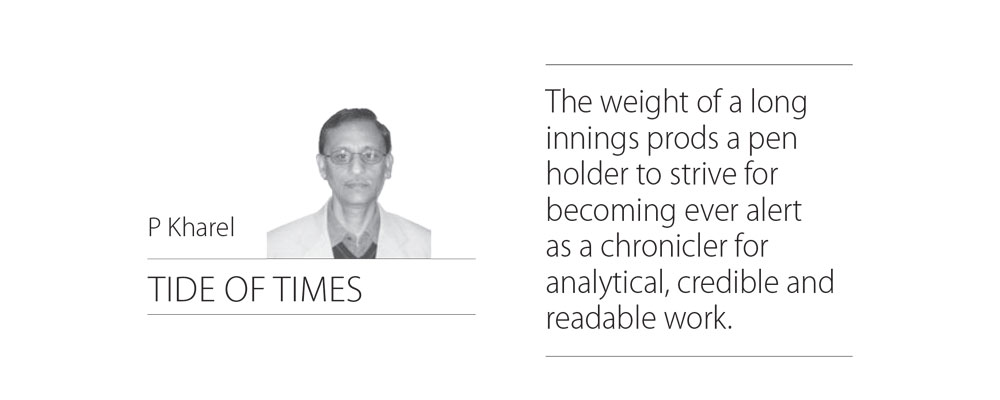
The weight of a long innings prods a pen holder to strive for becoming ever alert as a chronicler for analytical, credible and readable work. Hibernating on the cushion of past glory is a flaw that infects many in multiple fields. The goal post can’t change; one should move forward or summon the courage to call it a day.
(Professor Kharel specialises in political communication.)