- Monday, 8 June 2026

55% farming families unable to feed year-round
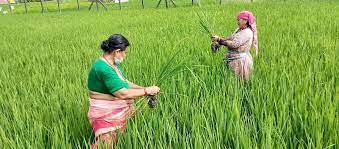

By Laxman Kafle, Kathmandu, Sept. 15: In Nepal, an agricultural country, it has been found that the number of farming families able to eat all the year round from their agricultural income is very low.
According to the National Sample Census of Agriculture 2021/22 made public by the National Statistics Office recently, the number of households engaged in agriculture who are able to eat all the year round with the income from their agriculture products is only 45 per cent.
Out of a total 6.67 million households in the country, around 4.13 million households (62 per cent) are involved in agriculture at present. Of these households, about 3.99 million households are engaged in agriculture and 132,000 households only are in livestock husbandry. The number of households engaged in agriculture was 3.71 million in 2011/12.
The latest census showed that there are 2,274,000 (55 per cent) farming families who are unable to feed their families for the whole year from their agricultural occupation.
According to the Agricultural Census 2011/12, 60 per cent of the farming families did not have enough food for their families throughout the year.
Among the families who did not have enough food, 47 per cent of the farming families said that they did not have enough food for four to six months from the production made by them.
It shows that 24 per cent of the households engaged in agriculture were unable to meet even three months of their consumption needs with their production.
According to the report, 62 per cent of families avoid food shortages by doing wage labour within the country, while 18 per cent of families go outside the country to work.
Likewise, 10 per cent have met their food shortage through their own non-agricultural business and 5 per cent by taking agricultural loans.
Use of agricultural technology increases
The use of agricultural technology has been increasing over the years. In a decade, the number of agricultural households using tractors has doubled.
According to the census, in 2021/22, about 40 per cent of the farming families have been using tractors for agricultural work, while the number of households using tractors in 2011/12 was 22 per cent.
The number of households using tractors for their farming has reached 1.63 million, while in 2011/12, only 845,000 households used tractors for their farming.
According to the census collection day of 2011/12, the number of tractors with the farmers was 37,000 while the number of tractors on the sample collection day of 2021/22, the number of tractors was 58,000.
The agriculture census showed that about 471,000 households (11 per cent) have been using power tillers and mini tillers for their work. The total number of power tillers is 118,000.
According to agricultural census 2021/22, there are 1,175,000 farming families using threshers, while the number of threshers used in agricultural work is 115,000 on the day of the census.
Similarly, the number of farmer families using spray machines and water pumps have increased over the decade.
45 % famers households using pesticides for paddy crops
There has been a rise in the use of modern farming technologies such as improved and hybrid seeds, chemical fertilisers and pesticides.
However, a recent census conducted in 2021/22 shows that more than half (56.3 per cent) of paddy farmers still use local seeds, with only 27.6 per cent using improved seeds and 16.5 per cent using hybrid seeds.
It is worth noting that use of hybrid seeds has increased from 5.4 per cent in the previous census 2011/12 to 16.5 per cent in the 2021/22 census.
The agriculture census also showed that almost half (47.9 per cent) of farmers in Nepal grow vegetables. Out of these vegetable farmers, 26.7 per cent use pesticides, with 53.2 per cent opting of slightly toxic (green) pesticides, 33.2 per cent using moderately toxic (blue) ones, 12.9 per cent using highly toxic pesticides, and only 0.7 per cent using extremely toxic pesticides.
According to the 2021/22 census, approximately 45 per cent of the holdings utilised pesticides for their paddy crops, followed by potatoes at 36 per cent, vegetables at 27 per cent, wheat at 28 per cent and maize at 23 per cent.
Likewise, the use of chemical fertilisers was most prevalent in paddy crops at 76 per cent, followed by wheat at 59 per cent, maize at 49 per cent, potatoes at 44 per cent and vegetables at 23 per cent.
-square-thumb.jpg)





-original-thumb.jpg)

-original-thumb.jpg)