- Tuesday, 2 June 2026

Focus on attaining growth through production boost
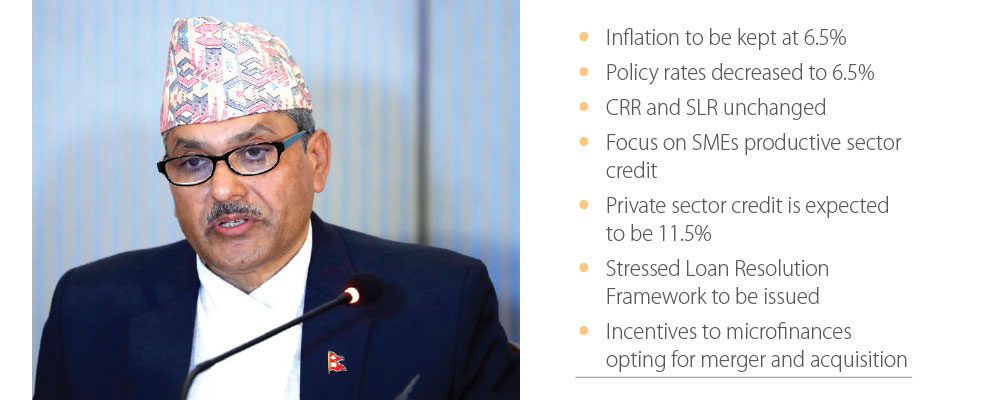

By Laxman Kafle,Kathmandu, July 24: Nepal Rastra Bank has made public monetary policy for the current fiscal year 2023/24 to achieve high economic growth sustainably while maintaining price and external sector stability.
Speaking at a press conference on Sunday, governor of central bank Maha Prasad Adhikari said that a flexible monetary policy has been carefully adopted to keep the economy running while maintaining price and external stability.
He said that the priority of the monetary policy was to increase domestic production capacity by channeling the financial resources to the productive sector.
"Regulatory policies have been formulated to help the monetary policy to make the monitoring, regulation and supervision of large loans effective, to reduce over-centralisation of loans, to give priority to small and medium productive loans and to promote financial stability by increasing the quality and accessibility of loans," he said.
Bank rate unchanged
The NRB reduced the policy rate keeping the bank rate unchanged at 7.5 per cent.
While unveiling the monetary policy for the fiscal year 2023/24, the NRB has announced that the policy rate has been reduced by 50 basis points to 6.5 per cent in view of the internal and external economic scenario.
Similarly, while keeping the bank rate unchanged at 7.5 per cent, the deposit collection action rate has been reduced from 5.5 per cent to 4.5 per cent, according to the NRB.
If the weighted average inter-bank interest rate taken by the NRB as an operational target is higher than the bank rate and lower than the deposit collection rate, the secondary market transaction and deposit collection will be opened.
According to the NRB, the provision of a standing liquidity facility at the bank rate and overnight liquidity facility at the policy rate has been maintained.
In order to make the interest rate corridor effective, arrangements will be made to provide fixed deposit collection facilities at the lower limit of the interest rate corridor, according
to the NRB.
The mandatory cash reserve ratio and statutory liquidity ratio have been kept unchanged.
Focus on productive sector loan
It seems that the growth rate of the potential production capacity of Nepal is around 4.5 per cent.
According to a study conducted by NRB, if the inflation in Nepal remains above 6.5 per cent, it is supposed that it will adversely affect economic growth.
Therefore, to achieve high economic growth sustainably while maintaining price and external sector stability, the policy of increasing production capacity by mobilising financial resources in the areas where capital is created has been prioritised, said Adhikari.
The NRB has stated that the weighted average interest rate of inter-bank transactions of banks and financial institutions has been kept unchanged as the operating target.
The monetary policy has proposed that the policy rate will be determined based on the ability of the foreign exchange reserves to support imports and the annual target inflation.
The goal of monetary policy is to maintain foreign exchange reserves to cover goods and services imports at least for seven months, said the NRB.
In order to keep the inflation within 6.5 per cent, monetary management will be done in such a way that monetary expansion does not put pressure on the prices.
As targeted by the budget statement of the government for the fiscal year 2023/24, the priority is to channel the financial resources towards the productive sector in order to help achieve an economic growth of 6 per cent.
Broad money supply to rise by 12%
In the fiscal year 2023/24, growth rate of broad money supply is projected to be 12.5 per cent and the credit from banks and financial institutions to the private sector is expected to be 11.5 per cent.
Broad money supply was projected to expand by 12 per cent and credit to the private sector by 12.6 per cent in the last fiscal year. Due to the interest rate hikes, the private sector credit could not expand as per the target.
In the last 20 years, credit has expanded by an average of 19.4 per cent from the banking sector.
In addition to the increase in the average ratio between the loans flowing to the private sector and the gross domestic product, the number of large loans has also increased. However, the real sector has not been able to expand in accordance with the expansion of credit.
When the real sector expands, not financial sector alone, there is a risk that the quality of financial assets will weaken and not only affect financial stability, but it will ultimately have an adverse effect on the real sector and government finances in the long term, said governor Adhikari.
Banking offense act to be amended
It is said that the amendment process will be carried forward in the existing Banking Offense and Punishment Act 2064 to help control non-commercial and disorderly activities that affect the stability of the financial sector.
The central bank is about to amend the Banking Offense and Punishment Act to discourage various individuals and communities from continuing chaotic activities in the banking sector, blackmailing bank employees.
According to the NRB, the instructions related to the prevention of money laundering will be issued based on the suggestions received from the mutual evaluation. In addition, it will be facilitated to revise the relevant laws and formulate a national strategy.
According to the central bank, the limit of first residential house loans will be increased from Rs. 15 million to Rs. 20 million.
There is a mention in the monetary policy that the guidelines related to working capital loans will be reviewed based on the suggestions of banks and financial institutions.
The system of giving at least 1 per cent additional interest if remittances are sent by opening remittance accounts in banks and financial institutions has been continued.
It is mentioned in the monetary policy that mergers and acquisitions of microfinance financial institutions will be encouraged so that existing facilities will be available if integrated transactions are conducted by the end of mid-July 2024. In addition, NRB has emphasised the use of the latest equipment and technology in association with international gateways to promote electronic payments.
The existing risk burden provisions of share mortgage loans, real estate loans and hire purchase loans will be reviewed.
Making special arrangements for distressed borrowers
The NRB is going to make special arrangements for the revival of troubled borrowers.
Governor Adhikari said that the Stressed Loan Resolution Framework would be issued to include the measures and procedures to be adopted by banks and financial institutions for the recovery and other management of borrowers who are in trouble due to natural disasters or other special circumstances.
According to the NRB, the guidelines regarding asset quality review of commercial banks and the internal credit risk classification of banks and financial institutions will be formulated and implemented.
The existing system of providing up to USD 1,500 twice a year as a passport facility to Nepali citizens visiting countries other than India will be amended.
The arrangements will be made to provide up to USD 2,500, said the NRB.