- Tuesday, 2 June 2026

Eco-friendly Bardibas house gaining popularity
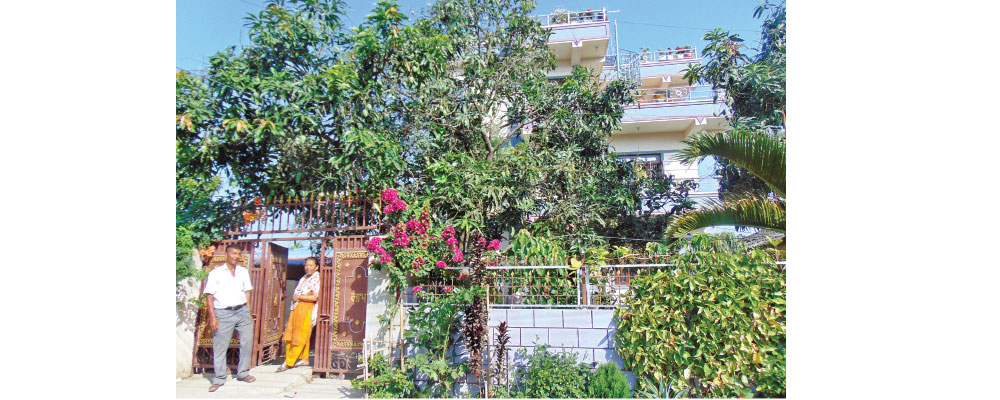

By Rabindra Upreti,Bardibas, June 6: Bardibas, a town losing its originality because of increasing population density and urbaniation, has now become a centre of discussion and attraction with the emergence of an eco-friendly house.
The eco-friendly house, which spans an area of about one and a half Kattha, is a green garden in itself. The courtyard of this beautiful, clean, and neat house is adorned with various fruits and flowering plants.
A total of 136 different species of plants have been planted on the veranda and terrace of this two-story house. The blooming dragon fruit vines at the two corners of the rooftop, along with the chilli plants, have drawn more interest in this house.
Three species of mango plants on the ground floor are giving a lot of fruits. Other fruits such as amala (Indian gooseberry), banana, papaya, and various species of flowers and plants have transformed the house into a garden.
Amidst the disappearing old-style houses and the rising concrete buildings, the eco-friendly house located within the jungle of Bardibas-14 is the creation of Bharat Hamal, 60, and his wife Radhika Hamal. Their love for nature, coupled with Bharat's former position as a ward chairman, makes their endeavour extraordinarily inspiring.
While most people bring new clothes, sweets, jewellery, and other items when they travel, the Hamal couple bring new species of plants and decorate their house yard.
"The plants you see here are indigenous and collected from various places such as Itahari, Pathlaiya, Darjeeling, Babadham, Patna, and New Delhi in India," Hamal said. He revealed that he has paid prices ranging from Rs. 200 to Rs. 8,000 for a single plant.
The Hamal couple has not kept track of the total number of plant species in their garden. Hamal giggled and said, "We don't know the names of all the plants.
There are 10 types of money plants, seven types of Godavari, three types of cacti, bougainvillea, Dutch Rose, Lolina, Musunda, Cycus, Belly, Jasmine, Indrakamal, Sun Kagati, and many more. I can't even recall all their names."
Despite the abundance of plants, the couple themselves take care of their management, maintenance, and well-being. With their grown-up children residing away from the house, only the Hamal couple are now living in the beautiful house. Their lifestyle is also environmentally friendly, and the house remains free of waste. Everywhere you look, it is clean, beautiful, and harmonious.
They dedicate two to three hours each morning and evening to the garden. Hamal also shared that through their regular care of nature, service, and connection, they experience a sense of familial affection, a healthy life, and mental and spiritual peace. "These plants make us proud of our house," Radhika added.
According to Birat Panthi, an environmental campaigner from the Lyric Project in Mahottari, an environmentally friendly house is an inspiring and exemplary structure in itself.
He said that such houses contribute to stemming the pace of climate change. These motivational and exemplary efforts serve as examples that families can also play a role in environmental protection.


-square-thumb.jpg)