- Wednesday, 27 May 2026

Ensure Safe Drinking Water

Safe drinking water is crucial for our health but many people do not have access to and consume enough water each day. The safety and accessibility of safe drinking water are major concerns around the globe. The incidence of waterborne diseases shows clear seasonality with outbreaks each year at the beginning of the monsoon in Nepal. Many of the waterborne diseases such as cholera are endemic to many parts of the country, including the Kathmandu Valley.
It has been estimated that around 785 million people globally are lacking of a basic drinking water service and about 144 million depend on surface water. The World Health Organization (2019) has estimated that around at least 2 billion people globally use unsafe drinking water sources contaminated with faeces. There are numerous preventable diseases associated with the use of unsafe and often contaminated water. Many waterborne diseases such as cholera, diarrhea, dysentery, hepatitis A, typhoid, and polio are linked to contaminated water and poor sanitation.
Growing need
Nearly 70 per cent of the earth's surface is covered by water. However, the freshwater required to sustain and improve human life is only 2.5 per cent of the total water available, and a significant portion of this water is tied up in glaciers and permanent snow cover leaving a meagre one per cent to supply the growing water needs around the globe. The available water source is also contaminated in many places throughout the world. Water contaminants can be microbiological, chemical, radiological, and physical. Pathogens such as bacteria, viruses, protozoa, and helminths can contaminate water sources.
Microbiological contamination poses the greatest risk to public health as they have the ability to cause diseases with small infectious doses and can spread and contaminate the source rapidly. There is no unanimous definition of safe drinking water. However, the most agreed definition of safe drinking water is water that does not pose any significant risk to health over a lifetime of consumption. Each year, waterborne diseases affect millions of people living primarily to places in developing countries where safe, and accessible water is limited.
It has been found that diarrhoea is the second leading cause of death for children below the age of five, accounting for more childhood deaths than malaria, AIDS, and measles combined. The microscopic organisms such as bacteria and viruses that contaminate water are responsible for water-borne diseases. Diarrhoea is the leading cause of mortality and morbidity among water-borne diseases.
Every year more than 800,000 people die of diarrhoea and most of them are from developing countries. Moreover, most of those deaths can be prevented with the improvement of the drinking water source.
About 88 per cent of diarrheal deaths are implicated in unsafe drinking water, inadequate availability of water for hygiene, and lack of access to sanitation. Cholera is an acute diarrheal infection that if left untreated can be fatal within hours. It has been estimated that 1.4 to 4 million cases of cholera occurred every year, and over 100,000 deaths worldwide are associated to cholera (WHO, 2022).
The growing water scarcity has been seen in many urban as well as most of the rural parts of the country which has led people to use unsafe water for drinking and for other household chores. Often unplanned and faulty sewage contaminates the drinking water supply system in our country. The contamination can be correlated with the growing number of patients admitted to healthcare facilities during monsoons in our country. It has been estimated that water, sanitation, and hygiene practice has the potential to decrease the global disease burden and about 6.3 per cent of all deaths. Improvement in drinking-water quality alone can lead to a 45 per cent reduction in diarrhoea episodes (CDC, 2016).
Safe drinking water supply involves decreasing the amount of contamination entering the water stream and importantly creating barriers to keep contamination from entering the water supply. It is, therefore, important to decrease the number of contaminants entering the water stream which can be achieved by improving sanitation practices and ensuring source water is of acceptable quality. Furthermore, drinking water should be properly stored and handled to keep it safe.
Prevention
Many health-related organisations have been advocating frequent hand washing with soap and water as one of the ways to reduce infection risk. Frequent and regular hand washing is an effective method to reduce the risk of waterborne diseases as our hands touch different surfaces that support the growth of microorganisms. The dirt in our hands often contains microbes such as viruses and bacteria. Clean water or warm water only helps reduce the number of microbes but cannot remove most of the viruses and bacteria completely. Therefore, washing hands with soap and water prevents many infections that include infections due to waterborne diseases.
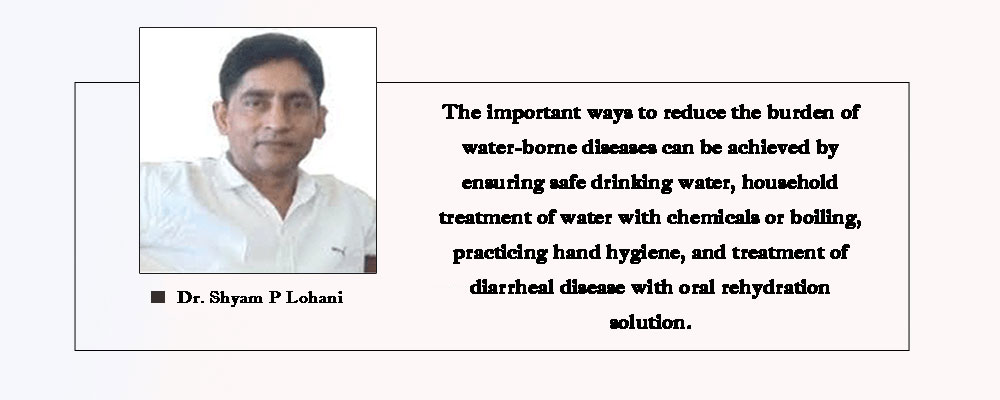
The important ways to reduce the burden of water-borne diseases can be achieved by ensuring safe drinking water, household treatment of water with chemicals or boiling, practicing hand hygiene, and treatment of diarrheal disease with oral rehydration solution.
Thus, a large-scale awareness program is needed on the importance of safe drinking water for human life, methods to disinfect water from unreliable sources, and the use of oral rehydration solutions for childhood diarrhea.
(Dr. Lohani is the clinical director at the Nepal Drug and Poison Information Centre. lohanis@gmail.com)