- Friday, 5 June 2026

Tackling Winter Pollution In Kathmandu

The Kathmandu Valley wakes up with a thick blanket of smog, not to fresh air, every winter as the sun rises above the hills. The crisis is deepening every year, and it is a contradiction of the hope of a peaceful and refreshing morning next year. Pollution during winter months has now become a daunting issue for public health and has posed critical environmental challenges, particularly in the morning. This issue should be dealt with through collaborative efforts from all stakeholders, from the government to non-government to the valley residents, not merely left as inevitable.
Several factors contribute to the pollution, and it should be noted that it is not an accident. The most important reason is the temperature inversion phenomenon that traps pollution close to the ground. In the winter, as the cool air stays near the ground and warm air sits above it like a lid that prohibits warm air from dispersing pollutants. This causes no escape of smoke, dust, and vehicular emissions from near the surface.
Geography
Another reason is the geography of the valley, as it is a bowl-shaped shaped that traps pollutants. The surrounding hills act as a barrier that stops polluted air from dispersing. Lastly, human activities aggravate the situation. The vehicular movements, household burning of firewood, emissions from brick kilns, and other industrial activities contribute to the rising level of pollution in the valley. The combined activities produce toxic pollutions that remain even after the morning has passed.
The growing level of pollution is not just an environmental problem but has become a public health emergency. The air that we breathe is filled with fine particulate matter (PM 2.5) that enters our lungs and then goes to the bloodstream. The PM 2.5 that we breathe is responsible for respiratory diseases such as asthma, chronic bronchitis, and COPD. Several studies have shown it is rising at an alarming rate, even among young people.
During winter, due to this pollution, allergic reactions, eye irritation, and persistent cough have become common. Long-term exposure has been associated with increased heart disease, neurological disorders, and even lung cancer. The most at-risk populations are children and the elderly. The physical activity in the morning becomes dangerous due to pollution. The very activities that are considered healthy lifestyles are turning into harmful ones, and placing people at risk of numerous diseases.
The pollution is slowly eroding the valley's identity as a rich cultural heritage, vibrant ethnicity, and beautiful surroundings. During winter, visibility drops, affecting traffic, delaying travel, and increasing the atmosphere of gloom. Tourism is severely affected as it hides clear Himalayan views, and oftentimes the effects remain for several days. The reputation is slowly shifting to a polluted basin. The pollution is also affecting mental well-being by making the environment suffocating that hampers mood, productivity, and urge to start fresh. It is a well-known fact that environment shapes our emotional health.
This environmental issue is not the act of one sector, but rather arises from multiple sources. In recent years, the number of vehicles has dramatically increased. Old or poorly maintained motorbikes, cars, and public vehicles has significantly contributed to this growing level of pollution. Rapid urbanisation has also share in the pollution, as most of the works are done without proper dust control measures. Similarly old brick kilns still operate inside the valley without modern technologies. Household burning of firewood or coal, waste burning also produces toxic smoke.
The general public is not aware of its health risks and existing policy and regulations to reduce air pollution are rarely implemented, but collectively, we can drastically minimise it. The first and most important is to strengthen public transport system. By improving public transport system, we can minimise dependence on private vehicles. Therefore, it is essential to encourage electric vehicles, develop reliable routes, and safer travel conditions that get people to use public transport.
The government needs to enforce emission standards by imposing strict penalties for high-emission vehicles and industries. At the same time, it is necessary to promote clean energy for households by subsidizing electric heaters, induction stoves, and solar cookers. Similarly, cleaner technologies such as vertical shaft kilns should be made mandatory. In order to control dust generation from construction sites, sites must be made responsible to use barriers, water sprinkling, and proper waste management.
Green spaces
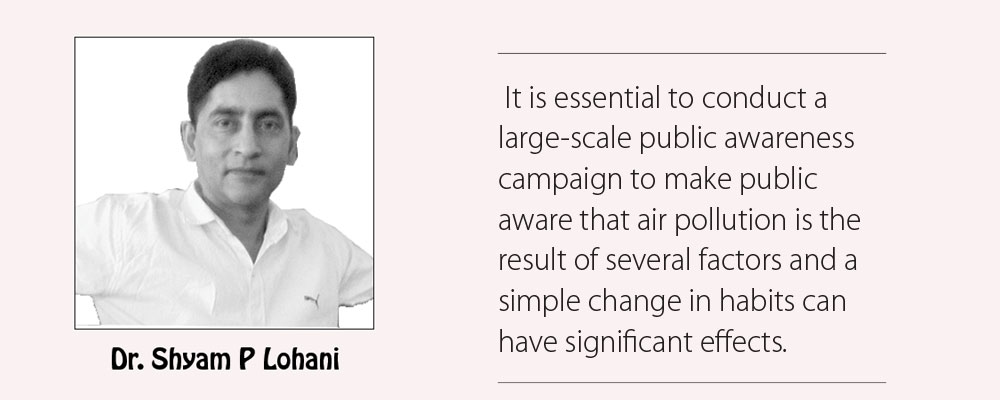
Trees are natural air purifiers. Therefore, increasing green spaces can help lower dust and improve the air quality. It is essential to conduct a large-scale public awareness campaign to make public aware that air pollution is the result of several factors and a simple change in habits can have significant effects. Raising awareness that habits such as avoiding waste burning and maintaining private vehicles can contribute for better-quality air.
F many years now, winter mornings are becoming suffocating for valley residents. The people at risk are finding it difficult to start their morning activities as they need to wear masks. Those with respiratory ailments struggle with breathing. It is time to raise awareness that our environment needs to be improved with immediate attention and action. Although the pollution in the winter is seasonal but health impacts last long. The problem is complex, but the solutions are within reach. Let us work collectively to make clearer skies and a future where fresh air is not a luxury.
(Dr. Lohani is the clinical director at the Nepal Poison Information Centre. lohanis@gmail.com)