- Thursday, 11 June 2026

Launching Decisive Fight Against Graft

Tackling corruption in Nepal has been one of the major challenges facing anti-corruption bodies like the Commission for Investigation of the Abuse of Authority (CIAA) and the Office of the Auditor General (OAG). Their reports show that bribery and misappropriation of public funds have been widespread, with a significant surge in corruption cases annually. Legal gaps, a lack of proper implementation of the prevailing laws, and political patronage given to corrupt individuals are some of the key factors leading to the worsening corruption scenario in the country. The level of prestige that the corrupt gain in society is another reason for the thriving of this social anomaly. The menace of corruption has not only emerged as an obstacle to the country’s socio-economic development process but also hindered service delivery.
Corruption is the abuse of power and authority for private gain. Apart from obstructing economic growth, corruption erodes public trust in public institutions, increases inequality, weakens democracy and disrupts essential services such as health and education. In a corrupt society, political parties and their leaders can buy votes. This makes them unaccountable to the people. When leaders start serving their own interests alone, it results in utter frustration among citizens. Ultimately, this gives rise to protests and even violence.
Election gimmick
However, containing corruption appears to have been high on the agenda of all the political parties. They often come up with an election gimmick of ‘zero tolerance on corruption’ to woo voters. But they are mostly found failing to keep their promises. Instead, they are seen making all possible effort to protect their supporters and aides by any means. Corruption thrives in public offices mainly due to collusion among employees, middlemen and politicians. That some ministers and lawmakers, representing different political parties, and bureaucrats have been indicted in corruption and other criminal charges indicates that the country is in dire need of much tougher measures to root out corruption.
In the Corruption Perception Index 2024, Nepal ranked 107th out of 180 countries and territories. The country got a score of 34 out of 100. The document highlighted a rising level of corruption and irregularities in import and export, public services, tax payments and contracts. With corruption rampant in all three tiers of government, citizens are bound to go through numerous hurdles while receiving services. It is, however, notable that the country was able to make minor progress in areas of government accountability and resource management. But the report showed that bribery in business and contracts worsened further. Offices concerning taxation, land revenue, and transport are considered the most corrupt ones. Despite concerns raised by citizens frequently, no significant reforms have so far been made in such offices.
Being a party to the United Nations Convention against Corruption (UNCAC), Nepal is obliged to take more effective anti-corruption measures and introduce tougher laws to cope with emerging challenges. In 2003, the United Nations (UN) established International Anti-Corruption Day to be observed annually on December 9th. The event aims to raise awareness about corruption, its devastating effects, and how to fight it, promoting integrity and accountability with the UNCAC as its framework. The day calls for joint action from governments, civil society, youth, and the private sector to build transparent, corruption-free societies. The day was observed this year with the theme of ‘Uniting with Youth Against Corruption: Shaping Tomorrow's Integrity’. The theme is relevant in Nepal’s context, too. Fighting corruption was one of the main agendas raised by the September 8-9 Gen Z movement in the country.
The day is an opportunity for the country to reiterate its commitment to advancing the anti-corruption campaign and review the measures taken so far in this connection. As per the global body’s call, it is essential for countries like Nepal to mobilise youths and utilise new technologies for the fight against the scourge of corruption. The country has signed the UNCAC unconditionally and vowed to expedite efforts to combat corruption. A policy-level corruption can be more harmful than bribery. There is a conflict of interest in policy-level corruption. So, the country must have stronger laws to deal with such types of corruption.
Institutional development
Nepal appears to have come a long way when it comes to institutional development in the fight against corruption. Besides CIAA and OAG, there are several other institutions involved in the anti-graft drive. They include the National Vigilance Centre, Revenue Investigation Department, Public Procurement Monitoring Office, and Department of Money Laundering Investigation. The Special Court has been assigned to deal with only corruption cases. But, as mentioned above, the implementation of laws and policies is not so effective. All the anti-corruption bodies, law enforcement agencies, civil society, youth, and other stakeholders must join forces to contain corruption.
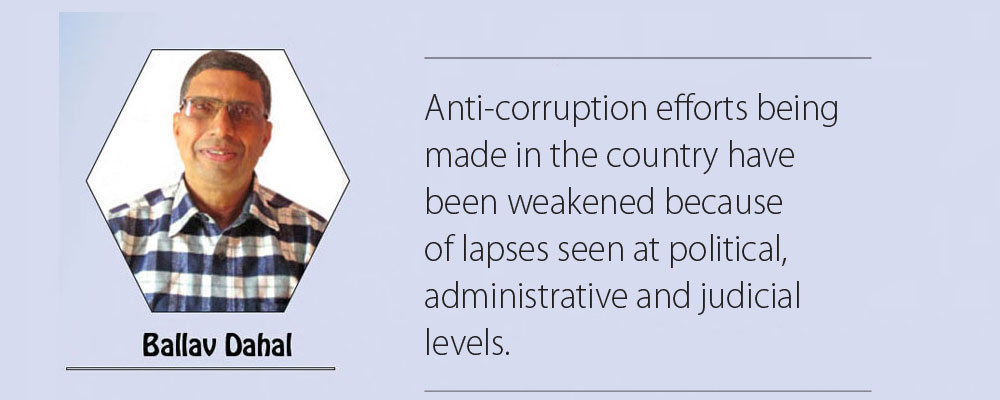
There is no doubt that the anti-corruption efforts being made in the country have been weakened because of lapses seen at political, administrative and judicial levels. As the political parties are now in the process of nominating their candidates for the impending March 5 elections to the House of Representatives, they must select only those who have good track records. Visionary, honest and dedicated lawmakers alone may help formulate better laws to fight corruption and help create a better society. There are also rising concerns over political financing and electoral spending. As they are likely to fuel corruption, the Election Commission (EC) must remain vigilant against such practices.
(The author is a former deputy executive editor of this daily.)
Must Read