- Monday, 8 June 2026

Finance Minister, private sector representatives dwell on economy
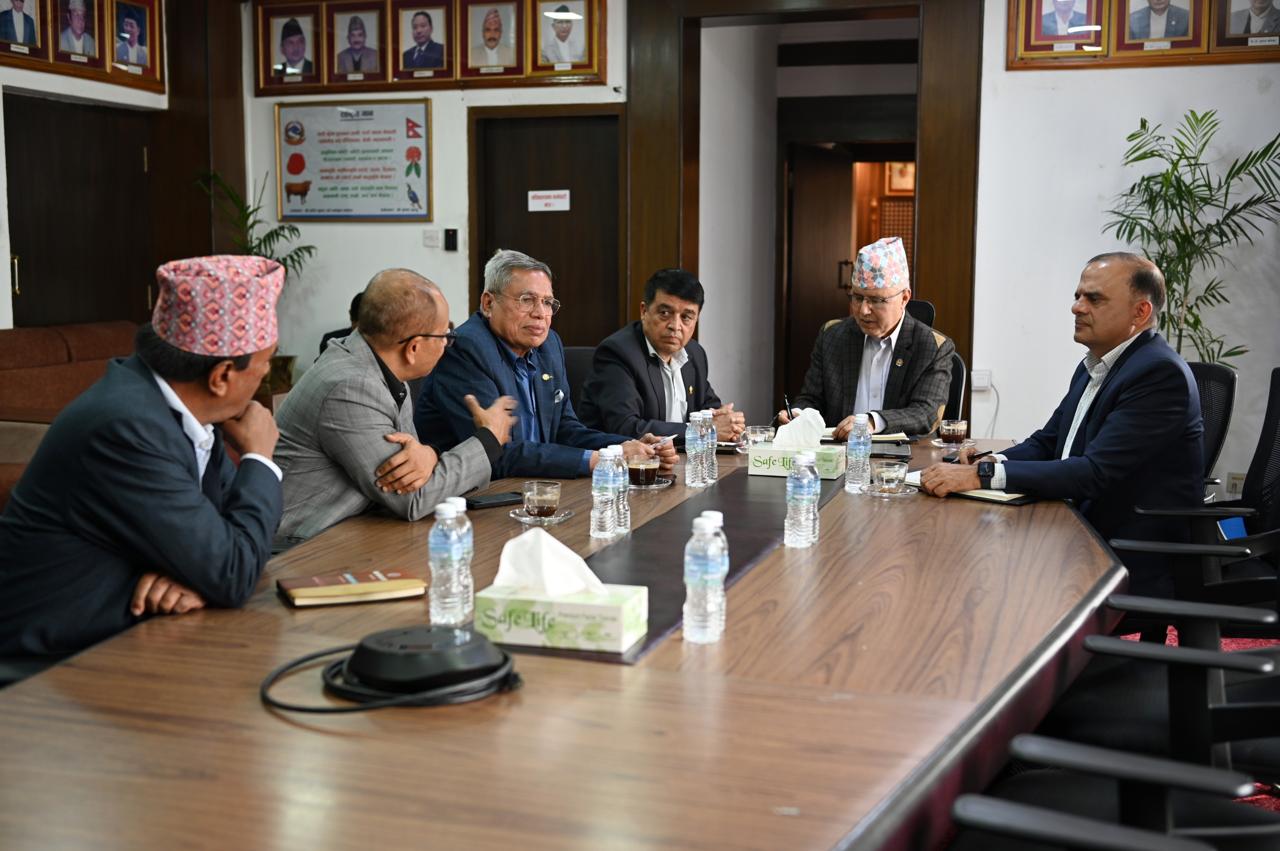
Finance Minister Rameshore Prasad Khanal meeting with private sector representatives

Kathmandu, March 12: Finance Minister Rameshore Prasad Khanal held a meeting with the private sector representatives today to discuss contemporary economic issues.
During the meeting at the Ministry of Finance, the minister acknowledged the cooperation and feedback received from the private sector during his tenure.
He said that one of the primary challenges of his term was to restore the business environment that had been disrupted during the September 8–9 Gen Z movement and to rebuild the morale of the private sector. “Through collective efforts, the situation has now improved,” he said.
According to information shared with RSS by Ministry Spokesperson Tanka Prasad Pandey, the discussion mainly focused on achieving economic stability, creating an investment-friendly environment, promoting trade while protecting cottage industries, strengthening the capital market, and improving economic governance.
The meeting was attended by Federation of Nepalese Chambers of Commerce and Industry (FNCCI) President Chandra Prasad Dhakal, Nepal Chambers of Commerce President Kamalesh Kumar Agrawal, Confederation of Nepalese Industries (CNI) President Birendra Raj Pandey, and Federation of Nepalese Industries and Commerce Chair Khemraj Bhandari.
The minister added that several concerns raised by the private sector had been addressed during his tenure, while the remaining issues which as he said could not be addressed due to policy complexities would be handed over to the next finance minister.
Private sector representatives thanked the minister for prioritizing private sector concerns.
They also emphasized the need for political stability to achieve national development and prosperity and expressed a positive response to the results of the recent House of Representatives elections.
Among their recommendations were implementing a multi-rate VAT system, introducing a two-tier difference in import duties between raw materials and finished goods, promoting exports, evaluating the effectiveness of regulatory bodies, and reducing the currently high excise duty rates.(RSS)