- Saturday, 6 June 2026

Oli-Pokhrel Contest
Outcome Is A Cliffhanger

On Saturday, the CPN-UML's 11th convention got underway in Bhaktpur, at a time when the party is grappling with serious troubles in the wake of the Gen Z movement. The party has been forced to hold its summit gathering a year ahead of schedule after the government, led by its chair KP Sharma Oli, was overthrown by a youth uprising in September. The country’s largest communist force is under pressure to regain strength and confidence, while assuring the disappointed cadres. The national conclave holds a special significance ahead of the general elections slated for March next year, for it is still non-committal for the fresh mandate.
What is more intriguing is that incumbent chair Oli is facing a monumental challenge from senior vice chair Ishwar Pokhrel in the top post. Just a few months earlier, it was unimaginable that any UML leader would challenge Oli, who had been in the post for more than a decade. The leaders who stood against Oli were compelled to quit the party, allowing him to have a field day. However, Pokhrel is in a better position to wrest the chairmanship from Oli. Known for his sharp tongue and demeaning remarks against his critics and rivals, Oli is now on the defensive inside and outside the party.
Twilight of his career
Deflated and deposed by the Gen Z movement, Oli is now in the twilight of his political career. The UML rank and file have been fed up with Oli's overbearing attitude and behaviour. Though he still holds a grip on the party’s organisation, the mixed results of the election of convention delegates have put him on edge. This has also made the contest for the chairman, office-bearers and central committee members a cliffhanger. Oli’s weakened position can be gauged from the withdrawal of the proposal to increase the number of office-bearers from 15 to 19 and central committee members from 251 to 301. After vice chairs and secretaries close to Pokhrel objected to it, Oli backed down from his attempts to amend the party statute.
He has been under pressure to manage an increasing number of aspirants for the office-bearers. Failure to take all loyalists into confidence will dent his bid for the third term as chairman. Deputy general secretary Pradeep Gyawali and secretary Prithvi Subba Gurung are setting their sights on the post of general secretary. But Oli cannot afford to deny this post to incumbent Shankar Pokhrel, who has been with him through thick and thin. Gyawali has reportedly mustered the support of vice chair Bishnu Poudel, who considers Shankar Pokhrel a bete noire within the party’s internal politics. The Bishnu-Shankar rivalry often gives Oli a headache. If the situation does not go in his favour, his followers might switch allegiance, bolstering Ishwar’s position.
Pokhrel is now emboldened by the backing of former president Bidya Devi Bhandari. Bhandari herself wanted to join the party and fight for the post of chairman but Oli blocked her entry in a move to nip any potential threat to his supremacy in the bud. Bhandari was supposed to lead an anti-establishment faction within the party, but her exclusion from joining the party generated dissension among the functionaries, who are now throwing their weight behind Pokhrel.
The convention is all set to discuss Pokhrel’s concept paper that heavily comes down on Oli’s ‘autocratic’ nature. Pokhrel argues that discussions, debates, criticisms and self-criticisms have not received due space within the party’s forums and those expressing different opinions suffer intolerant treatment and sometimes vendetta. Interestingly, Pokhrel has exposed the shrinking inner-party democracy. “A cabal of leaders makes decisions and committee meetings are held only to formalise them. This undemocratic practice has led to the weak implementation of decisions, while leaders have failed to discharge their responsibility,” he states.
According to him, the party’s public prestige has suffered a blow as it is unable to form unified views through collective discussion. The UML has been credited with democratising its internal structures and inspiring other parties to follow suit but Pokhrel, who became its general secretary twice and senior vice chair once, lashed out at the current leadership for not creating an atmosphere for ideological debate. "The entire party risks being transformed into the one to run on the NGO structure, not on the political and ideological basis,” he claims. Sharpening his criticisms of Oli, Pokhrel has even said that Oli must be responsible for the fatalities during the Gen Z revolt and should appear before a high-level panel to record his statement regarding the loss of lives and properties.
Full-time cadre
Pokhrel, who has been siding with the establishment since the birth of CPN-ML, the precursor to UML, took a plunge into communist politics as a full-time cadre 50 years ago. Now he has taken a political gamble by challenging Oli. The outcome of their contest will seal the political fate of both. Nonetheless, the party will breathe in a fresh democratic air if it picks a new leadership in view of the changed political scenario.
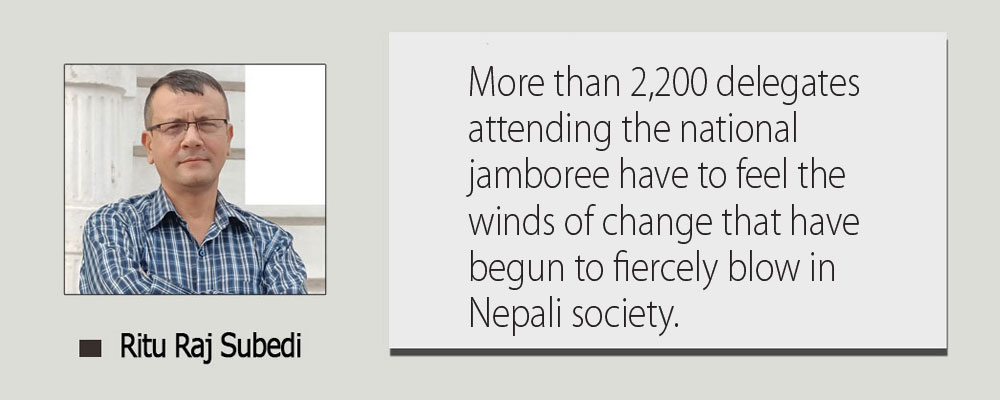
In their conventions, the communist parties often debate their ideology, policy and strategies but this time UML is unlikely to brainstorm its ideology and programmes. Focus will be solely on the leadership election. However, more than 2,200 delegates attending the national jamboree have to feel the winds of change that have begun to fiercely blow in Nepali society. Their inability to read writing on the wall will further debilitate the party.
(The author is Deputy Executive Editor of this daily.)