- Tuesday, 2 June 2026

Self-Reflections Of A Senior Bureaucrat
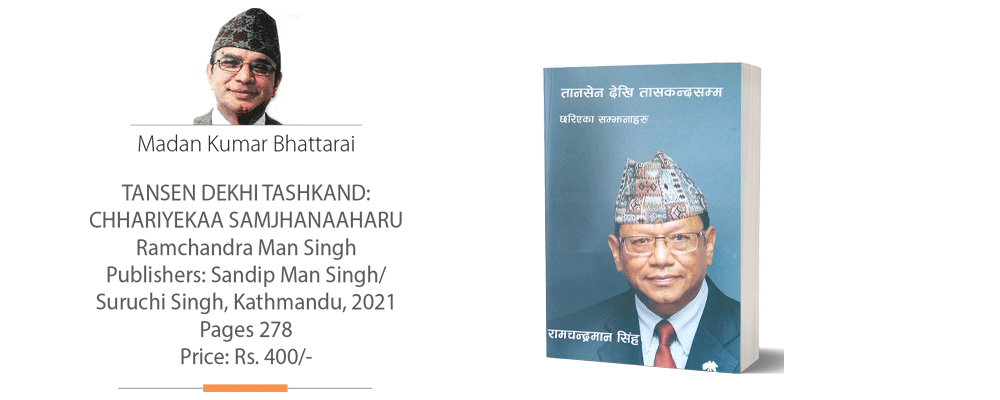

Close friend Ramchandra Man Singh served as Secretary to the Government of Nepal before retiring from civil service after completing five years as Secretary. Taken among senior bureaucrats as having an academic bent of mind and characteristically low profile, Singh was born on Ramnavami, the day Maryada Purushottam Lord Ram took his incarnation, and represents modesty and down-to-earth simplicity.
Another happy coincidence is that he is the son of Dasarath and Mithila. A man of moral vision and religious bent of mind, he displays a strong attachment for his parents and family as reflected in chapter 38 where he pays glowingly touching tributes to his father on his demise while nearing a century.
While in all civil services including that of India, there is a trend that science, medical, engineering and management graduates steal the limelight in competitive examinations. In our case, the case is a bit different in the sense that graduates in technical streams are at a distinct disadvantage in comparison to their counterparts in other disciplines as the curriculum is particularly favourable to the latter.
However, we find examples of the outstanding success of science products through their sheer intelligence, hard work and concentration. A student of Botany at his MSc level, a batch that produced senior administrators like Sushil Jung Bahadur Rana and Avanindra Kumar Shrestha, Ramchandra Man Singh comes from a family that has made contributions in diverse fields as it first migrated from Bhaktapur to Pokhara before settling in Palpa.
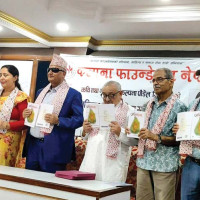
The book has an interesting title, TANSEN DEKHI TASHKAND: CHHARIYEKAA SAMJHANAAHARU that can roughly be translated as Tansen to Tashkent: Random Recollections, somewhat like the title chosen by a top Indian diplomat, From Bandung to Tashkent, and is divided into seven parts and forty chapters. While Tansen happens to be his birthplace, the writer has given reference to Tashkent, the capital of Uzbekistan, that he visited in 2000 to take part in a seminar but retains the memory of the place that caught headlines as Indian Prime Minister Lal Bahadur Shastri died there on January 11, 1966, soon after India-Pakistan Summit.
This is the fourth book penned or edited by Singh. Earlier publications include a volume to observe the Diamond Jubilee of the wedding of his parents, Customs Administration: Theory and Practice, and memorial work in honour of his father, Kabiraj Dasarath Man Singh.
As he is a strongly attached and devoted family man, it may be appropriate to discuss the last chapter (40) first. It not only reflects acute personal ordeals during the COVID-19 pandemic with severe pains and problems for his spouse, Dhenu Singh but also reflects a state of virtual disarray in Nepal's healthcare system during the peak of the crisis. First three chapters under part 1 deal with the birth, childhood and school experiences and, in essence, a bird's eye view of Tansen and its geography, history, heritage and culture. Likewise, four to six chapters under part two depict local tours in and around Tansen, visits to Banaras and internal trips to Butwal and Pokhara.
Part three consists of five chapters relating to the author's first arrival in Kathmandu and experience of Tribhuvan Rajpath, the status of the capital city with its defining attributes, admission into Public Science College whose nomenclature was changed in honour of its founder and Professor of Chemistry Amrit Prasad Pradhan after his demise in an air crash and, last but not least, the demise of King Mahendra.
It may be recalled that Amrit Science College, once a top institution in respect of scientific study, was started by intellectuals like Pradhan and Professor Yadunath Khanal from the building of Trichandra College and later shifted to the present location. It is better not to talk of the sheer ignominy that this institute has suffered in recent years. Singh terms the coronation of King Birendra and the spruced-up status of Kathmandu as the most memorable aspect of his student life and adequately displays his love for lyrics, music and culture. Likewise, he has devoted a separate chapter (18) to depict the consternation, both at home and abroad, over the royal palace massacre involving King Birendra and his family.
He also recounts a first-hand account of a massive fire that engulfed Singha Durbar's central secretariat possibly never expecting that he would one day be asked to preside over the administrative machinery of several ministries and organizations of the government.
Part four is the only section that has one chapter (12) dealing with a remote village in Kalikot district where the author was deputed under the National Development Service program of Tribhuvan University. The description is beautifully interesting as it is divided into 13 different sub-chapters.
Two special highlights may be noted. The first is the coincidence of two students serving in the same village and later became Secretary to the government on the same day. The other was Chuman Singh Basnet. The second aspect of the interesting odyssey of a remote part of the country was the special moral advice of Singh's mother Mithila Devi Singh to desist from falling into the likely trap of girls during his stay there.
Chapters 13, 14 and 15 under part five are especially worth reading as the author switched from teaching to administration rather hesitantly. Singh puts Secretary Bhuban Man Singh Pradhan on possibly the topmost pedestal among secretaries in terms of simplicity, efficiency, honesty and overall contribution to the institutional development of the Public Service Commission.
Part six of the book is the longest in content with a maximum number of chapters (16 to 31) making the section the virtual core of the book. These include foreign official travels and experiences acquired by the author including chapter 21 which pays special compliments to Ambassador Narayan Shumshere Thapa for unexpected hospitality. The section has a wider range from paying tributes to Krishna Mohan Shrestha and his spouse Nudup Shrestha who was murdered in late January 2003, to action taken by the government against 22 senior revenue officers in 2002. The last part (seven) has nine chapters throwing light on individual and family remembrances including the experience of the mega earthquake of April 2015. Despite some minor weaknesses of proof mistakes and random treatment of subject matters, Singh deserves accolades for bringing out a volume that is sure to find a place of status in the field of memoirs by civil servants. I congratulate him on his endeavours.
(Dr. Bhattarai is a former foreign secretary, ambassador and author.)