- Tuesday, 2 June 2026

Close Gap Between High, Low Performing Students

According to Oxford Royal, Finland’s education system is ranked as the best in the world. In most countries children have difficulties with maths, science and language skills. In Finland, children consistently ranked as highest achievers in mathematics, reading and science. Finland achieved this impressive result through major educational reforms forty years ago and in the process has demonstrated that they actually spent 30 per cent less per student as compared to the US. Finland has a 100 per cent state-funded system. It goes against rigorous education systems that are centred around evaluations and frequent testing of students.
People in our part of the world will be surprised to learn that Finnish children don’t start formal education until they are seven years old. They do not get homework or exams until they reach their teens. They are not at all tested for their first six years of schooling. The focus is how to learn rather than how to pass exams which prevents competition and academic pressure. The only mandatory test Finnish children take is at the end of their secondary school that is at the age of 16.
No discrimination
The other very important fact is that children of all abilities in Finland are taught in the same class so that there is no discrimination between the children with different capacities. This allows less academically gifted children to learn from the brighter ones. This has facilitated Finland to have the gap between highest and lowest performers to be the smallest in the world. Finland has the smallest science class with 16 students in one so all students get a chance to perform scientific experiences and learn in their own capacity. In Finland 66 per cent students go on to college, which is ranked as the highest in Europe.
As the Nepali New Year nears every year, on the last month of the outgoing year that is Chaitra, and the first month of the incoming year Baishakh, parents are desperate to find suitable, competitive schools for their children. One interesting phenomenon in the Kathmandu valley these days is the search of “boarding schools”. Parents who have migrated from rural parts of the country for employment and have jobs including driving, office help or similar positions in different institutions that give them salary to barely fulfil their basic needs and are staying in rented places or rooms allocated by families where they work as household helpers look for schools which are labelled as “boarding schools”.
The label of boarding schools is associated with English medium schools all over the country where parents want to enrol their children, but mainly sons. The question here is, has Nepal addressed the issues related to proper education of its children? The so-called boarding schools are categorised as “A”, “B” and “C” and their school entrance fees, monthly charges, examination fees and other fees are charged as per that categorisation depending on their operation costs, which are usually way higher than what the general Nepali population can afford. In the Kathmandu Valley there are private schools where children as small as 3 years old till they are teenagers go to schools which charge them enormous fees, sometimes to the tune of six digits.
Not only parents from well-off families but those who are migrants from different parts outside of the Valley, as mentioned above, are also in the race to enrol their children in these “boarding schools”. On the other hand, the government schools, which are free, have low enrolment rates. Most of our grandparents and parents went to government schools from all over the country. Majority from these two generations went on to become successful in their professions. The education system during their time was governed by different Universities from India, including Banaras, Patna and Lucknow Universities. While reviewing their Nepali and English language expertise it will not be an exaggeration to say that today’s generation may have difficulties competing with their mastery over the languages.
It is a shame that most of the children who go to the English boarding schools have no mastery over either the English or the Nepali language. There is a general trend that most of these students actually cannot read or write Nepali well! During the last two decades, I have been involved in the informal and formal education systems and have travelled extensively especially related to my work with formal and informal education of girls and women. There is miniscule improvement in education standards in the government and community schools where most of the students are girls.
Girls’ education
After the 1990’s people’s movement and the re-establishment of democracy, there has been a lot of focus on strengthening girls’ education. As sons were shifted to private boarding English schools, the girls’ enrolment in government schools has increased. As female students are more disciplined and hard-working, their high school performance improved. In the Kathmandu Valley, there has been a stark improvement in education standards in a few government schools like Ratna Rajya School at Baneshwor, Bijay Memorial and Padma Kanya at Dillibazaar, Bhanubhakta at Ratna Park and Bajrabarahi in Lalitpur. Students from these schools have been improving their educational skills and academic grades.
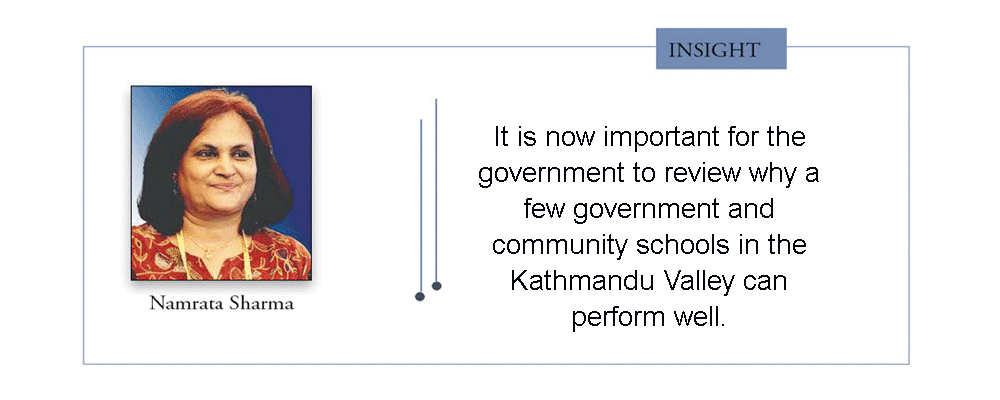
It is now important for the government to review why a few government and community schools in the Kathmandu Valley can perform well and why government schools all over the country can help girls in rural parts increase their education As the new government starts operation, it is advisable to review what Finland has achieved and take steps to adopt systems in order to make our future generation better educated.
(Namrata Sharma is a journalist and women rights advocate namrata1964@yahoo.com Twitter handle: @NamrataSharmaP )