- Thursday, 28 May 2026

Eating out growing popular among youths
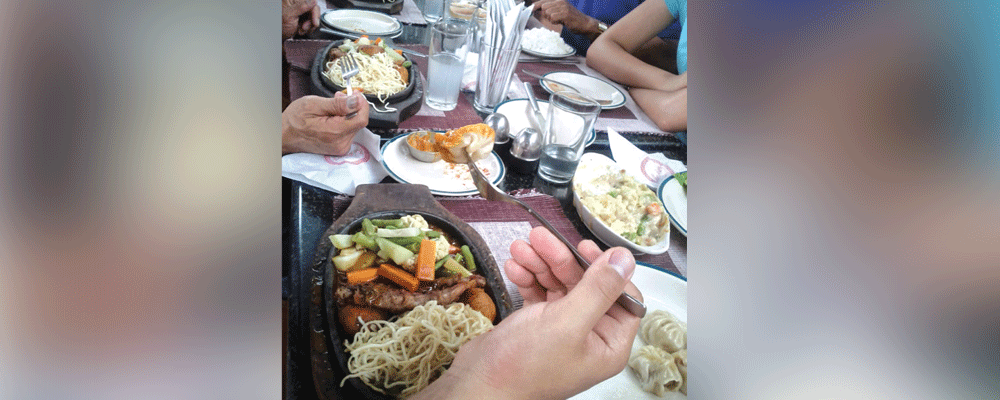

By Shreya Yonjan,Kathmandu, Feb. 2: These days, going out has become synonymous with eating out in a restaurant among the younger population. There are new eateries popping up at a pace like no other. The uncanny boom of particular fast-food chains like the Burger House feels belligerent to say the least.
Similarly, it’s hard for the emergence of even smaller scale cafes and restaurants mushrooming in major cities to go unnoticed. It leads to a question whether the frenzy emergence of cafés and restaurants means that restaurant-going culture is the norm for today’s youngsters in the capital.
Parvat Dong, who owns one of the popular chain restaurants in Kathmandu, says that the people who frequent his restaurant are in fact youngsters, specifically couples. He says that it’s the convenience of the affordability and ambience they provide at such an affordable cost.
Dong adds, “We also click pictures of our customers which they can easily retrieve from our social media page. It’s becoming essential to provide pictures to the customers, so we have hired an in-house photographer in each outlet.”
What he says is confirmed by a quick glance around chain restaurants of Kathmandu which is peopled by youths enjoying their food and beverage, and having a generally good time. At a time when a lot of similar businesses seem to struggle in the market place, Dong, when asked about the popularity of the particular chain restaurant he owns, says that the taste of food in his eatery is customised according to “Nepali taste buds” that favours moderately oily and mildly spicy delicacies.
Supriya, a customer who frequents a local café at Bansbari, says that meeting her friends at a restaurant or a café after a busy day is how she unwinds.
Sipping a coffee while chatting with her friends, Supriya, a 24-year-old, says, “There seems to be no other option. Going out with friends, and eating out has become an integral part of our meet ups. It’s how me and my friends bond, and I’m sure it is like that for many others from our age group.”
This is suggestive that social relationships are maintained by hanging out in cafés and restaurants and how the newly emerging cafes and restaurants have become a hub for the youths to come together with their social circle.
“It’s not even about the timeliness or the taste but rather the time spent together while food and beverages are shared between people you like,” adds Supriya. Anuj Pradhan, a 21-year-old student shares a similar experience as Supriya. According to him, going out to cafés on a daily basis is a “no-brainer” to him and his friends.
“Although only beverages are enjoyed on most days, it’s the time spent with friends that matters,” says Pradhan.
However, time spent in cafés and restaurants is definitely significant within group of friends who are under mid-20s.
Citing how the characters in popular TV sitcoms, like F.R.I.E.N.D.S and How I Met Your Mother, meet up after their work in a café with their friends, Pradhan, light-heartedly makes a remark, “It’s just like that, but with my friends.”
Pradhan’s remark suggests that a romantic string is attached to the whole idea of café and restaurant-going culture among youths residing in the Kathmandu Valley.
Speaking on the increasing number of young people frequenting restaurants and café, Dr. Krishna Poudel, a sociologist, says, “One of the contributing factors is remittance which makes up to 26 per cent of the national economy. Previously, restaurants were deemed as luxury and accessible to only the upper class of Nepali society; however, with a disposable income through remittance, restaurants have now become accessible to middle-class people living in the cities.”
In addition, people are eager to show extravagance than ever before in the history of mankind, and social media seems to have made it easier.
People want to show off, and visiting extravagant restaurants and posting photos or videos have been a way of doing it, says Dr. Poudel, adding, “Eating out in restaurants is viewed as something associated with luxury. Therefore, this norm is mostly popular among youths of a certain class who do not have to worry about the amount they are spending.”
Shiva Adhikari, director at the Revenue and Tax Department of the Kathmandu Metropolitan City (KMC), says that around 10,000 restaurants and cafés are operating inside the valley. While not every business operating locally is registered, Adhikari says that there is noticeable rise in restaurant and café businesses.
Although there seems to be no concrete reports or statistics on the numbers of restaurants and cafes in Kathmandu and other major cities, Restaurant and Bar Association Nepal’s (ReBAN) chief secretary Ram Gurung said that fine dining restaurants are currently increasing at a rate of 10 per cent annually, whereas- chain fast food eateries have risen in number by almost 50 per cent over the past five years.
Currently, there are 72 fine dining restaurants within the Kathmandu Metropolitan City under ReBAN, which Gurung says is not the proportionate representation of the actual number of restaurants within the Valley. However, he said that there is no availability of statistics of restaurants and cafes in absence of one door policy.The growing number of restaurants in the Valley is definitely a tell-tale sign of the equally growing consumers within the city.
-original-thumb.jpg)


-original-thumb.jpg)
-square-thumb.jpg)