- Wednesday, 27 May 2026

A Wholesome Narrative On Indian Political History
Madan Kumar Bhattarai
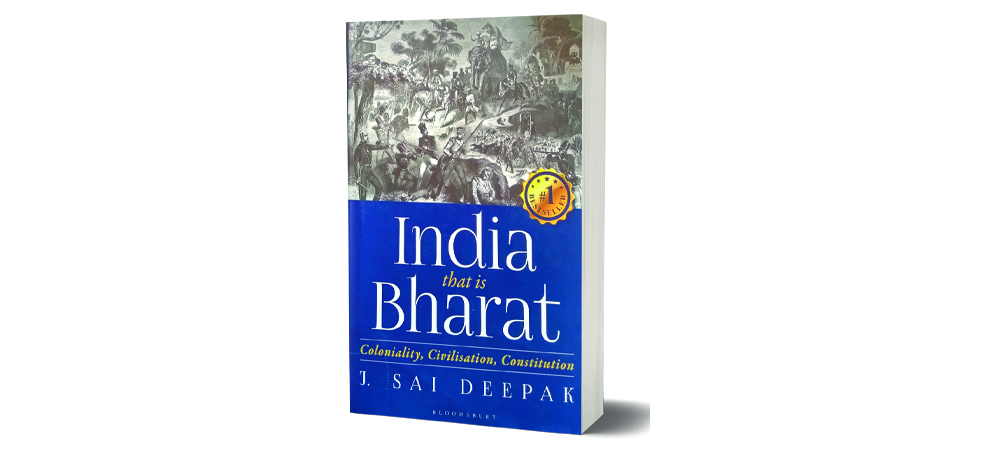
Before attempting a review of the book with the most comprehensive title being borrowed from the opening Article of the world's longest constitution, it may be appropriate to go into the author's uniquely bright academic and professional records. J. Sai Deepak holds unusually envious academic background that he prefers to address the learning curve, as diverse as Mechanical Engineering from Anna University and a legal degree from one of the top-most elite institutions of India more known for its engineering excellence, Kharagpur-based Indian Institute of Technology's Law School.
A practising lawyer skilfully handling some of the landmark cases of public importance that attract headline news in the media, and prolific writer, the author prefers to call himself a litigator as he has solidly established his reputation as a learned counsel in both Delhi High Court and Supreme Court of India. A scholar who wrote foreword for the wonderful book extolls his contributions in masterfully digging out the innate significance of India or Bharat that possibly renders a wider meaning, and prefers to classify his academic forays into different disciplines as merely accidental.
The best-selling book uses both names for the country, India and Bharat, possibly with no comparison with any other country in terms of using two official names with so much wider meaning, even extending prevailing political boundaries.
Article 1 clause 1 of the Indian Constitution that came into force as of January 26, 1950, defines the country as "India, that is Bharat, shall be a Union of States," making the country a union of states instead of outright federation making it a quasi-federation in its current political shape. There is a third name, Hindustan, is used in common parlance to designate the two territories, Hindustan and Pakistan, after partition of India on the eve of actual decolonization of the Indian Sub-continent in 1947.
The book intends to examine India as a colossal whole from all possible aspects in an analytical prism of trilogy of coloniality, civilisation and constitution. The venture though a starter for the author in the form of a book and a product of nine months of hard schedule, is a must-read work both in terms of lucidity and flair of the language as well as enormous mine of information on trilogical break-up of his composite subject. The
author gives utmost credit to the Supreme Consciousness or the divinity for the publication, with gratefulness to his family, teachers, mentors and friends.
Though divided into three broad domains, Coloniality, Civilisation and Constitution as per the very title of the book, coloniality and its antonym, decoloniality, in all their forms and manifestations, are writ large in all chapters. Discussions on coloniality and civilisation are rather more historical and provide settings for the ultimate emergence of India as an independent sovereign country wedded to the Commonwealth of Nations that comprises former colonies of the East India Company that was liquidated after few years of the takeover by the British Crown in 1858.
The dissection of the Indian Constitution is especially significant in the sense that it encompasses a summary of the whole book in terms of scrupulously scrutinizing the impact of European coloniality and essentially its bye-product, colonial consciousness on Bharat's march towards constitutionalism from its innate status as an indigenous civilisation. This is also the natural culmination of the first two issues, coloniality and the constitution, a crucial object of the study made in the most innovative way.
Some of the postulates advanced by the writer include his forceful assertion that coloniality has cast long-term repercussions and continues to dominate the psyche of Indians even after the end of colonial rule and India's emergence with Prime Minister Pandit Jawaharlal Nehru's midnight Tryst with Destiny speech on India's independence.
Another point that the book highlights is the Indian consciousness that remained largely intact even during British colonial yoke despite having been bruised and moulded, if not torn apart and asunder, from the shackles of foreign rulers.
The book is neatly divided into eleven convenient chapters. It is also noteworthy that perceptibly inter-connected chapters debunk belief in a large section of India as if imperial history alone was the history of humanity.
It asserts at the same time that the evolution of the civilizational state of India had taken shape or in a way remained strong even before the defining year of 1858 when the British Crown formally took over the reign of leadership of India eclipsing the East India Company that had started its work with the Royal Charter issued by Queen Elizabeth I in 1600 for trading purpose but chose to remain a territorial power.
This seemingly exhaustive analysis in the book makes a thorough diagnosis of various instruments, pacts, accords and acts passed by the British Parliament that may conveniently be taken as transitional to the evolution of the Constitution of India as the longest such fundamental law of the world through the medium of Constituent Assembly.
The book creates a threadbare discussion on pros and cons of the various Government of India Acts, beginning with the first such enactment of the British Parliament dating back to 1858.
While all chapters are compact and thought-provoking, the concluding chapter has a very interesting mix-up, The Standard of Civilisation, the League of Nations and Government of India Act, 1919 in the sense that India though a colony was an anomalous configuration, with its full membership of the League of Nations that existed in the inter-war period.
The time also concurred with India's move for real independence and Purna Swaraj through different political and independence movements seen earlier in the form of Home Rule, Quit India Movement, etc.
In a nutshell, the wonderful book, written with an out-of-box and non-conventional approach, seeks marvellously synthesise different streams at work in India for a long time that made profound impact on the country's evolution as a proud, sovereign country with a republican setup but preferring to continue the umbilical chord of British linkage in the form of the Commonwealth of the Nations.
(Dr. Bhattarai is a former foreign secretary, ambassador and author. kutniti@gmail.com.)
How did you feel after reading this news?





-original-thumb.jpg)