- Wednesday, 27 May 2026

Assault On Political Aberration

Narayan Prasad Ghimire
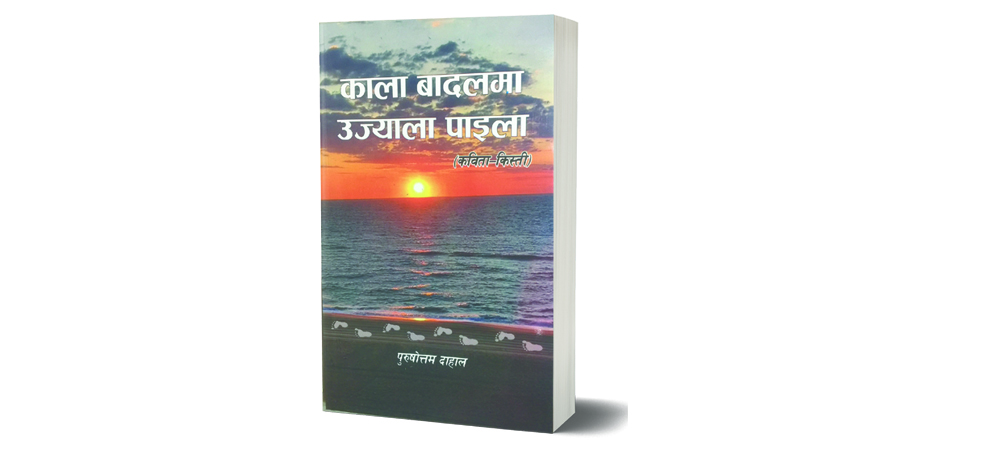
Noted journalist and professor Purushottam Dahal has come up with yet another literary creation- an anthology of poems. The anthology of poems, 'Kala Badalma Ujyala Paila' (Silver lining in the dark cloud) is a collection of forty poems written with the themes of politics and power, political aberration and anomalies, ideological digression and deviation, love, lure and lust for power, nature, culture, youth and life, revolution, development, migration and employment etc. Some poems are written in verse while some are in free verse. As a longtime journalist and political science professor, Dahal's poems focus mainly on national politics. He is worried much over the anomalies in politics.
What's the politics for individual gain and party interests, public service, or national development? Is it merely a sale of dreams and slogans? How long do people get enticed by political dreams and slogans? Aren't the political parties in need to correct their behaviour? How up to the mark they are to deliver the promises they make before the people? These are some of the questions raised vociferously in the poems Dahal has written.
The poet, who is also involved in various movements for the cause of democracy in the country, assaults the trend to deviate from political ideologies and the continuous erosion of morality and trust in Nepali politics. He finds aberration caused by polluted politics everywhere. The coterie, collusion, chaos and conflict curated by petty politics is a cause for concern as the poems insinuate.
He vents his ire on the entrenched nepotism which he argues has sidelined the meritocracy in politics and political parties. The deprivation of thoughts is killing parties and pushing democratic principles and values to a tailspin. 'Laganghanto' (nuptial knot) is one of the poems bearing this theme. This poem is a castigation of the uncultured and unprincipled trend emerged lately in politics.
Like metaphysical poetry where dissimilar objects and forces are forcefully yoked together, the poet finds the electoral alliance formed between Nepali Congress and CPN (Maoist Centre) the same. He writes- 'The name is: Nuptial knot! Principles perish in womb/Thoughts die/Policy vanishes/And after these meet untimely death/There is a gender-less birth craving for power and petty interest/And, now it is evolving as a nuptial knot.'
Similarly, another poem about the gross disregard for competence is reflected in the poem, 'What about merit now'? A poet wails over the death of 'ism' in Nepali politics. Nepotism irrespective of merit and competence has plagued parties that poet Dahal calls a tumour!
The relatives picket party leaders and chase away qualified supporters and well-wishers, resulting the party into a coterie. It fails to cater service and justice to the people, to the voters. The layers and layers of sycophants are prepared to protect those in power and to bait and distance others. Interestingly, the leadership is also enjoying stooges because there is no criticism but only panegyric.
Another poem, 'Dandan Damaru Dhandhan Bhakari' also exposes the social ills, immorality, miasma of decay and crime. He sympathises with the poor Loktantra! The exploiters' class is getting robust while the exploited ones are being further exploited and impoverished. What an irony that looters are lauded and legitimised.
Loots and enslavement are going unabated, he concludes. The contradiction in Nepal's politics is meticulously mirrored by this poem. 'Farak Rahar' (Different interest) is another poem that speaks loudly against the ill will of esurient party leaders. 'Bichar Bechneharu Badhe' (Rise of the Salesmen of Ideas) is a poem that shows how the arriviste and cunning cabals are reaping benefits from the system while those devoting their lives are deserted.
'Neta Sadhai Malik' (Leader always a lord) also portrays the culture and characteristics of Nepali political leaders from the Rana regime to the present system, which is enslaving cadres and well-wishers. The system is nurtured with collective efforts, and movements are launched with massive participation. But why do the leaders continue barring lower rank and distance those who sacrificed their time and youth? It is the follower who is sacrificed, it is the leader who reaps the benefit.
The inheritance of engrained hypocrisy and hierarchy is not broken despite the many struggles the country waged in the name of liberating people and freedoms. Isn't it a reflection of the harrowing condition that warrants immediate address?
Corruption, bad governance, tragedy brought forth by the global crisis of Coronavirus are also included in the anthology.
'James Nadiko Prasna' (As James River questions) leaves poet Dahal in bewilderment. The poem, composed after being influenced by a large statue on the bank of the James River in Virginia, US during his visit, urges him to ponder much on his country, independence, freedom, strength and assets, poverty and backwardness.
The questions here are the cogitation of why the poet's motherland despite being the country of superlatives failed to make progress. In the poem, some questions are: 'Why the beauty eludes in your land? The independent territory which never saw the dominance of any outsider is still undeveloped?!' Here, seeing the utmost development abroad, the poet ruminates why his country did not see development despite being an independent country for centuries. The contradiction beleaguers poet Dahal.
Interestingly, as most of the poems express dissatisfaction, dejection, despair, and destruction and warrant correction and reform, the anthology begins with wonder, creation, hope, happiness and heaven. These issues are beautifully signalled with fine words and echo in the very first poem, 'U muskurauda' (When he smiles').
The new creation is the new generation; it is as delicate as a rose. The poet wonders how the new creation will flourish and whether it inherits the culture or not. He finds it a whole with Satyam, Shivam and Sundaram, a complete being, a world in itself. Overall, the anthology can be dubbed political poetry. The book is published by Shikha Books and costs Rs 360.
(The author is a journalist at RSS)
How did you feel after reading this news?





-original-thumb.jpg)