- Thursday, 28 May 2026

Homestay Tourism In Nepal

Prativa Bhattarai
Over the past two decades, homestay tourism has played a prominent role in the development of Nepal's tourism sector.
According to the Nepal government's tourism statistics in 2019 around 1.2 million foreigners visited Nepal, and in the year 2019 as compared to the previous year the flow of tourists had increased by 25 per cent which demonstrates the positive response of tourists towards our country Nepal.
In 2020, Nepal targeted to welcome 2 million foreigners in Nepal Tourism Year 2020. Alas, the whole world was hit by a pandemic called "coronavirus" (Covid-19) which has severely affected the tourism sector.
When the first wave of Covid-19 slowed down, the hope of the tourism industry seemed to have improved and this has raised the spirits everywhere. However, no one knew that this wave was only the starting wave and the more dangerous wave was on the way to attack the world again and again.
It devastated our tourism. Now, in 2022, tourism is gradually recovering despite Covid-19's 4th wave.
According to Homestay Tourism expert Chet Nath Kanel, "Homestay is now in developing trend in almost all parts of Nepal".
He further laments, "As soon as one community or village establishes a homestay, another community or village also shows interest in opening a homestay. But opening does not mean that homestays will be available everywhere. It will take some time for the homestay tourism community to establish itself and move forward commercially."
Citing an example from Rasuwa (Buddhism), it can be said that the newly developed homestay sites would require at least three to four years to get promoted well.
There, 'Rural Community Homestay' was launched in 2003 under the joint facilitation of the Tourism for Poverty Alleviation Programme (TRPAP) and the then-District Development Committee, which took more than three years to move forward satisfactorily.
Generally, the villagers have come to understand that homestay is a system of keeping guests in their own homes with money. Despite the low or high understanding of the phenomena, homestay business is no longer new even in the Chepang area, Lepcha area, Musahar area, Dhimal area, Majhi-Darai area, and so on.
The speciality of homestay is the accommodation arrangement with 'cultural identity. "That is why homestay tourism has gained momentum in the areas inhabited by Limbu, Lepcha, Rai, Sherpa, Gurung, Tamang, Magar, Newar, Thakali, Tharu, Raji and other many castes/ethnicities", says Kane.
The National Tourism Statistics 2019 states that there are at least 245 legally registered communities and 79 private homestays in 13 different districts offering at least 597 rooms and 1006 beds. Homestay culture and regulations are different in various places in Nepal.
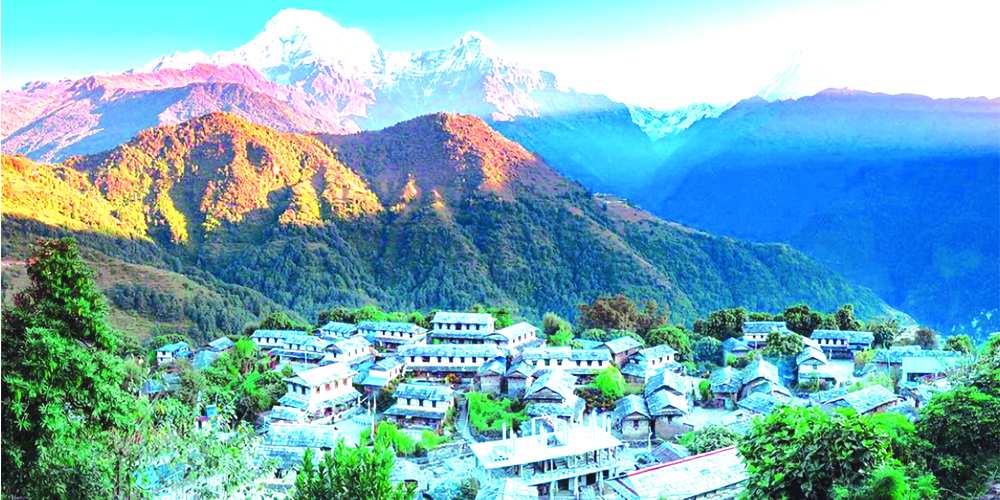
For example, the homestays in Ghandruk and the homestays in Chitlang are different and peculiar in their ways. Ghandruk is popular for indigenous Gurung culture whereas Chitlang is famous for local Newari culture.
Women's Roles
Homestay business is highly dependent upon women. Be it from welcoming their guests to preparing authentic food, from wearing cultural attire to promoting local festivals, from cultural heritage preservation to bidding goodbye, women are the most. No activity can be performed without them. So, it is very important to empower women who are engaged in the homestay business.
Homestay business is a seed for the rise of women's entrepreneurship. It helps in generating employment opportunities. Those women who are involved in this business can easily uplift their living standards.
From my own experience in one of the homestays of Ghale Gaun, I met a 55-year-old lady. When I interacted with her, she told me that previously she was unable to send her children to school due to a lack of finances. But when she got involved in the homestay business as a 'chef' she was able to send her children to school and now she could also easily fulfil the family's basic needs.
Similarly, the poverty rate of the homestay destination, even of the non-participating households, can be reduced as they can gain an extra source of income by participating in different tourism activities.
For them, selling local produce, taking part in cultural programmes, guiding, jungle safari, jeep safari, cycling, hiking and handicrafts selling, among others, can generate a good income.
The youths are also motivated to engage in homestay and, additionally, do something in their area rather than going to cities or abroad in search of employment opportunities and better living standards.
Likewise, due to homestay business, the culture and tradition of the particular community are preserved as they are involved in presenting their culture through different cultural programmes, dances and attire to their guests. The exchange of the culture between different ethnic groups also makes the local culture and traditions alive.
Encouraging and educating women on entrepreneurship and increasing the trend of homestays in our country can help in boosting our culture, society, and tradition all over the world.
Pre-vocational training on tourism and hospitality services should be provided to them so that women can easily address the needs of their guests and deliver accordingly.
Similarly, providing up-to-date knowledge and skills, opportunities for observation visits, enhancing linguistic capacity, enhancing contacts, assisting in the expansion of modern information and communication technology, and integrating every homestay destination into the provincial and national information systems are important needs now.
Homestays can only be sustainable if there is an environment of cooperation, understanding and proportional sharing of benefits between the middle class, the rich and the poor in the community.
Homestays can provide ample indirect benefits to the rich and the poor. But those things should be planned and adjusted in the homestay development plan or programme.
Furthermore, Nepal offers multicultural tourism, which is rare in the world.
According to the National Population Census 2078, there are 127 caste/ethnic groups which means there is a potential to create 127 different homestay types as special cultural destinations in Nepal.
Sustainable Management
It is also important that the homestay operators in their locality form a management committee regarding home stay tourism's sustainability.
It is also crucial that a certain amount from their incomes be contributed and utilised in making the houses more traditional architect-friendly and culturally as well as naturally attractive.
Also, some per cent of homestay incomes should be utilised in organising the vocational and business management-oriented training programmes relating to hospitality and homestay giving high priority to women.
To conclude, homestay businesses have ample opportunities for generating women's entrepreneurship and fostering the nation's tourism sector. It will make a huge impact on the nation's economy.
(Bhattarai is currently associated with Media House Kupandole)
How did you feel after reading this news?
-original-thumb.jpg)