- Friday, 10 April 2026

Making Independence Day Inclusive
Freedom and democracy are paramount for citizens of a country to live in dignity. As India celebrated its 75th year of independence from the British rule, along with the celebrations there have been serious questions as to what India has actually achieved. So why should we Nepalis or citizens of the other South Asian (SA) countries observe how India is celebrating its 75th year of Independence? Nepal is the only SA country that was never colonised.
The separation of Pakistan from India and Bangladesh from Pakistan created a vacuum in the lives of families who were separated but still have families on both sides of the border. While many countries celebrate their Independence Day, there are many questions that still need answers because of the various restrictions imposed by the physical borders between the countries that curtail the basic rights of families to meet each other for family ties and well-being.
The happiness of the people is directly related to the freedom of the press in that country and the development indicators. Looking at the majority of the SA countries, it can be said without exaggeration that be it after independence from the colonised situation or absolute monarchy, the lives of the general citizens are still difficult. Majority of the people in SA still need to find means of basic survival like managing food for the family.
Patriotism
On 15th August, India, like every other year since 1947, celebrated its 75th Independence Day with great celebrations and fanfare. Being in India during the eve of the Independence Day, one could get caught by the overwhelming atmosphere of patriotism that was being spread by the government with the Prime Minister Narendra Modi leading the campaign. Although Indian citizens are known for their patriotism and love for their country, there was a sense of suffocation by many who were not able to voice their concerns on how the “celebration” was being orchestrated. Was it actually embracing the whole population or just ones with the haves?
According to the Reporters without Borders, India ranks at 142nd position among 180 countries in the World Freedom Index. According to the UNDP Human Development Index 2020, India ranks 139th out of 189 countries. Similarly, according to the UN World Happiness Report 2021, India ranks 139 out of 149 countries. Looking at the global peace Index 2021 report, released by the Institute of Economics and Peace, India has ranked 135 out of 163 countries, which specifies the Low State of Peace. And if we come to the foreign policy, it is not an exaggeration to say that in the last 75 years the neighbourly friendships between countries have been threatened from time to time by the big brotherly approach rather than of equity from the powerful country.
India is often acclaimed for its economic growth and is acknowledged to have made progress in its GDP growth. The number of rich Indians both within the country and globally have increased but the question repeatedly comes as to how has the richness and the vast middle-class Indians been able to pull the poor out of poverty in the quest of developing the country. The sustainable establishment of health and education and livelihoods is still a far cry for the majority of the people.
During an interaction with academicians and different professional in India recently, opinion that voiced support for India being independent from colonisation was very important and a fact of pride for them could be heard everywhere. However, all felt that while the celebrations were on, it was important to reflect on what had India actually achieved in the name of liberalisation. With the advancement on technology and the climbing GDP, there was also increase of corruption, frauds and various scams in which the most powerful in the country, including the politicians and the business communities, were mostly involved.
Cases of the innocent people being victimised and intellectuals who refused to stay quiet, especially journalists, being harassed, imprisoned and arrested were increasing. The fear factor promulgated in the name of democracy quietened the non-aligned journalists. There is a growing group of media who have been silenced and are nodding to the whims of the haves and discarding the needs of the have-nots. Those who refuse to join the band wagon of lapdog journalism are targeted and often face various forms of harassment.
Another milestone in the establishment of human rights was reached when India became a republic state with a constitution prepared by Ambedkar who belonged to the Dalit community. This constitution addressed the needs of the most marginalised in the country. However, even after 75 years of independence, the Scheduled Casts (SCs), Scheduled Tribes (STs) and the Muslims are probably marginalised more.
Sign of progress
Another sign of progress in a country are the health and education indicators. According to the report titled India Inequality Report 2021: India’s Unequal Healthcare Story the SCs, STs and the Muslims are still lagging behind the people under the general category, Hindus and the rich. It also gives evidence that men are better off than women and people in the urban areas are better off than those in the rural parts of India regarding most health determinants, interventions and indicators. According to an October 2020 Oxfam Report, India’s health budget is the fourth lowest in the world.
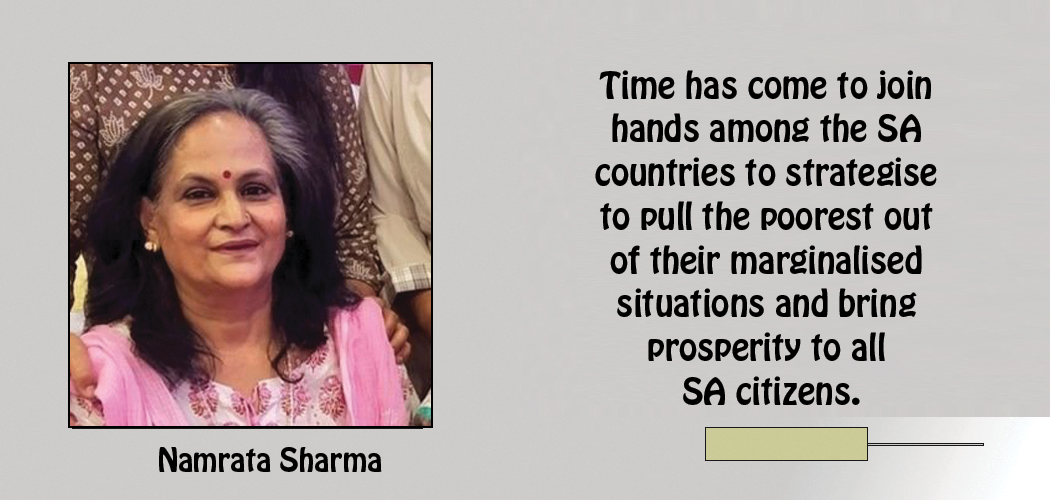
India’s progress can actually boost the progress of the SA region. However, if there are such huge inequalities within the country how can they be a leader to drive poverty out of the region? Time has come to join hands among the SA countries to strategise to pull the poorest out of their marginalised situations and bring prosperity to all SA citizens.
(Namrata Sharma is a journalist and women rights advocate.namrata1964@yahoo.com Twitter handle: @NamrataSharmaP )

-original-thumb.jpg)