- Tuesday, 5 May 2026

Mayor at forefront to cater to thirsty Dharan folks, but can he deliver?
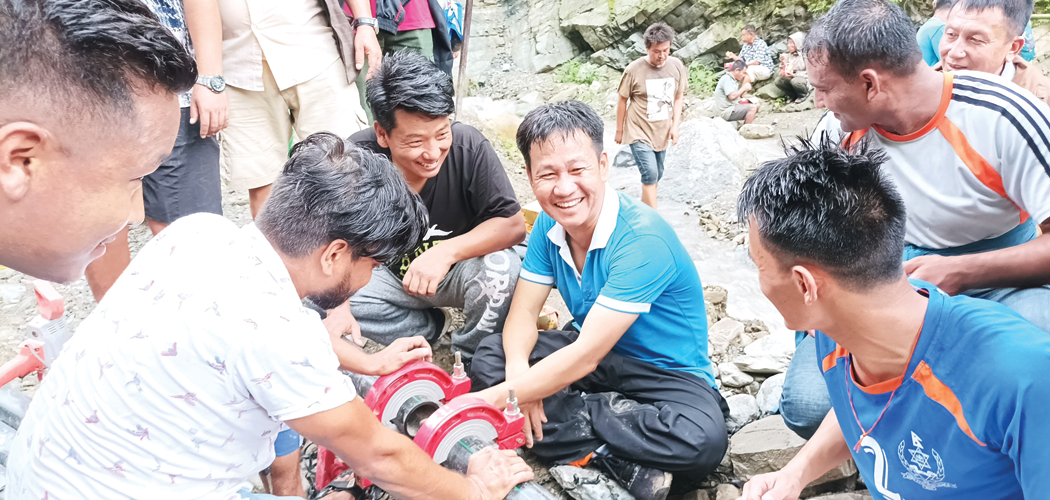

Dharan, Aug 2: Harka Raj Rai (Sampang) surprised many by winning a mayoral post in Dharan Sub Metropolitan City in the recently held local election.
But, behind his success, there was the longstanding aspiration of local people, who were otherwise weary of empty and
shallow promises given time and again by mainstream political parties, for
positive changes, and for getting their day-to-day problems resolved
practically. They were desperately searching for the right candidate who could
understand their problems and resolve them practically. So, Sampang was a
perfect fit for this effect.
Unlike other candidates from
different political parties, Sampang, an independent candidate, was a lone
campaigner. In the first place, he seemed not to impress voters as he did not
get his election campaign organised extravagantly, and he campaigned
alone.
It seemed that he was a neglected
candidate. But deep down, he was a social worker, who previously (still now)
worked together with local people for raising voices against social injustices
and forgetting their problems resolved and development activities had carried
a strong agenda for resolving the drinking water problem, a pertinent issue that
residents of Dharan have been demanding for its resolution for long, that impressed
the voters and they in return silently made him win the position.
Following his election as the
mayor, Sampang is working day and night to execute the promises he made during
the poll. With the support of local people, he has launched a campaign to drain
and supply drinking water in the city from various small streams in the
surrounding.
As part of the campaign, the
project in the local Pakuwa river has been completed wherein water from the river has
been tapped and supplied to the city through water tanks set up at various
areas in Dharan. For the construction, donations were collected at home and
abroad through Facebook and other social sites while some residents of Dharan
donated labour.
Sampang himself joined workers in the field during public holidays when his official duty is off. The project cost approximately Rs 7 million, say technicians.
Following this, he has currently
been at work to drain and supply water from another local Nishane river at
Dharan-4 along the Dharan-Dhankute section of the Koshi Highway. He through
social sites has urged people to join him in this initiative.
He however sees a sustainable
solution to the perennial drinking water issue facing residents of the city by tapping and supplying water from the Saptakoshi river, approximately
15 km away.
A study for the project is being
carried out and he has a concept of generating energy from the river too by
constructing a big reservoir, he said. For constructing a reservoir,
technicians and engineers have carried out a study in the proposed area.
Engineers at the Purbanchal Engineering Campus have suggested that a soil test
in the project area is required.
According to them, 40 kilowatts of electricity could be generated from the local Khardu river during monsoon and
around six kilowatts during winter, says Sampang.
Water pumping machines that are
used to drain underground water in forests have broken down two or three times
a month in general, and it required at least Rs 200,000 each for a repair, he
says. So, tapping and supplying water from rivers and streams during monsoon
would save extra expenses on repairing pumping machines and electricity used
for the purpose, he adds.
Besides, he has launched various
campaigns in different fields. Sometimes, he has been seen planting tree
saplings while in others, he has been spotted in the chocks of the city with
placards against drug abuses in his hands.
Destruction of wildlife and
human-wildlife conflict have taken place due to deforestation, he
believes.
He relays the progress of his
official and personal work to general people through his Facebook page.
Providing access to public information and updating general people about
government works is the right of people and it must be implemented, he is of the
view.
People have supported mayor Sampang
in his initiatives for positive changes in the city, says Hari Shrestha, one of
the members of his campaign.
In the past, people's
representatives did not focus on the drinking water issue in Dharan housing
around 300,000 population.
So, people of the city elected an independent
candidate this time, he puts his view.
Nowadays, mayor Sampang has spent
most of his time on resolving drinking water issue, says local people. Voters
have been happy as they have been updated (through Sampang's Facebook page)
about what people's representatives are doing for the development of the city,
according to a local Bishnu Limbu of Dharan-15. "People have reached out
to help their representatives with development activities acting on the
information," he says.
Initiatives in distributing
drinking water to the residents of Dharan started back during Rana regime.
In 1995, the then Prime Minister
Juddha Shumsher Rana directed construction of a water tank at Phurse in
Dharan-13. Water was tapped from local streams including Sardu-Khardu wetland
area and distributed to the local people. The wetland area has been protected
by relocating around 300 houses from the area in 2034 BS at the direction of
then King Birendra Shah.
Following an increment in the
population of the city, the then Dharan Town Panchayat in 2034 BS had got the
responsibility to distribute water. The same year, the Nepal Water Supply
Corporation was established in Dharan.
The Town Panchyat started
distributing water in 2035 BS at the fees of Rs 11 per tap.
In 2045 BS, the Corporation with
loans and grants from the World Bank expanded a ductile pipeline to meet
increasing demand for drinking water. It also constructed deep tube wells in
the forest in the south after water collected from the Sardu-Khardu wetland
area did not suffice increasing demand, say local people.
Shortage of drinking water hit
Dharan since 2045 BS, they say. Until the Corporation handed over its
properties and responsibilities to the Drinking Water Management Board in 2078
BS, approximately 16,000 consumers of 19 wards of the then Dharan Municipality
got access to pipeline water. But it was not enough.
On May 8, 2012, the Government of
Nepal reached a 22 million USD deal with the Asian Development Bank to launch a
water project. The Dharan Drinking Water (Restoration, Upgradation and
Development) Sub Project was a part of the government's integrated urban
development project.
The project contract was awarded to Tianjin Tundi JV and the Wielding Design Authority prepared the detailed project report. To extract underground water, 11 deep tube wells at seven places in the forest were dug.
The project aimed to distribute
water to 28,841 houses and increase it to 30,000 by 2030. But, by mid-2022, the
number of consumers has reached 28,000.
So far, 95 percent of the project
work has been completed. But the contracting company relieved itself from the
responsibility of testing and operating the project by handing over it to the
Board earlier ending it up without expected results. The project deadline also
expired on December 31, 2021.
The Board Managing Director
engineer Raju Pokharel blames water leakages for its failure to resolve water
problem in the city. At present, over 25 million liters water is in demand on a
daily basis, he says. "During winter, around 18 million liters water has
been produced from 11 tube wells and the Sardu-Khardu wetland area.
Of the 11 tube wells constructed, currently 10 are functioning well as one has broken down. This has also led to low production of water," he says. During monsoon, 20 million liter water will be produced, according to a projection.
Old and rusted pipelines, water
pumps and generators have contributed to problems in water distribution, he is
of the view.
Who is Sampang
Born in Khartamchha in Khotang
district on 27 February, 1983, Sampang later in
2056 BS moved to Dharan to pursue
higher education. He was a SLC graduate from local Shukrabare Secondary School.
He got his Bachelor's degree in politics and sociology from the Mahendra
Multiple Campus, Dharan. He also taught English language at a local institute.
He spent six years at foreign jobs (in Afghanistan and Iraq).
However, driven by patriotism and zeal to serve at home country, he returned Nepal from foreign jobs and started off as a social worker and a campaigner.
He has been speaking up for
development, justice and freedom. Determined and dedicated, he involved himself
in the campaign that spoke for the local people affected by the Madan Bhandari
Highway that goes through the Dhankute Highway in Dharan. For him, this
incident was a turning point to become popular among local people.
Since then, he started gaining
popularity among local people as one who spoke for common people. He has raised
his voice against corruption, anomalies, inflection and Sardu watershed
encroachment and for issues like drinking water and unplanned excavation of the
Sardu river. He has protested 'corruption' in the B.P. Koirala Institute of
Health Sciences and anomalies in the drinking water project in Dharan.
'Janasarokar Manch', a local social
organisation, under the leadership of one Krishna Narayan Palikhe had led a
campaign against land mafias who tried to take public lands at the Sardu
wetland area. Sampang later joined the campaign. After death of Palikhe, he
took over the leadership.
Before being elected as the sub
metropolis mayor, he earlier fought for the deputy mayor position in the sub
metropolis as an independent candidate in the previous local poll. But he lost.
It did not deter him however.
"For the holistic development
of the country, political parties and leaders should correct themselves and
corruption and commission system should come to an end," he stresses. (RSS)
-original-thumb.jpg)
-square-thumb.jpg)

-original-thumb.jpg)
-original-thumb.jpg)