- Thursday, 28 May 2026

Promote Social Entrepreneurship

Namrata Sharma
With the increase of educational institutions in Nepal, there is now a rapid group of educated youth keen on getting employed. At the same time there is also a trend among some youth who have been educated in other countries, especially in the Western countries, of returning back after education with the hope of doing something worthwhile. Although the brain drain from Nepal is a reality, there is a group of youth who have chosen to return and work here. There are examples of Nepali experts in different sectors, including engineering, medicine, information technology and media, among others, who have excelled in their fields abroad and have decided to return to their country in middle age or retirement age to invest and to start successful entrepreneurial activities.
The other important fact is that the major foreign currency earners - the migrant workers - who go to several countries for both skilled and unskilled work are also returning to initiate innovative activities, mainly in agriculture and livestock, to sustain their families in Nepal. These steps are very positive. Therefore, the time has now come for policy makers, private sector, Non-Governmental Organisations (NGOs) and the general public to reflect and plan on how we can capture and create conducive atmosphere where these individuals can give back to the society and set up initiatives to benefit their motherland and get the support required to fulfill their dreams.
Development model
This is where Social Entrepreneurship (SE) - a development model - can play a significant role in helping the youth to give back to the society. SE is a tool that helps in carrying out their business for a social cause. It is also referred to as altruistic entrepreneurship as it does not measure their success in terms of profit alone. The main objective of SE is to improve the world in whatever sector they choose to set up their enterprise. The main objective of the private sector is defined by the three Ps: Profit, Profit and Profit but three Ps of SE are Profit, People and Planet. This makes it a big change in the profit-orientation of a business setup.
There is also a difference between SE and charity. SE is definitely not a charity organisation. It has to have all the setups and principles of a business house and the private sector enterprise. There has to be a business planning of the enterprise which has a solid financial planning that will steer them towards making profit to sustain all their activities. However, there also has to be a strong section in the SE business plan to improve the society where it is established and also the overall climate and environment of that area.
While making the profit the SE has to be set up in the community with an agreement with them to include their participation fully in the enterprise both to do the work and to invest whatever amount they profit. While the profit of the private sector goes to the proprietors and owners of the company, the SE’s profit has to go back to the society. It cannot go to make only certain individuals rich. Also a certain section of the profit needs to go to the protection and prevention of the climate and environment of the area. In this way SE fulfills its three P mission of making profit and serving the people and the planet.
There have been some exemplary works on SE globally. As Mayor Balen is focused on improving the public toilet facility in Kathmandu, one example he and the public of Kathmandu should explore is the exemplary work done by a youth with government support in Kenya. David Kuria of Kenya, founder of IkoToilet, is an exemplary social entrepreneur. Kuria built hygienic and affordable toilets for one million slum dwellers of Kibera (a district of Nairobi, Kenya) but found that government regulations would make it difficult to expand his efforts. So he put the City Council of Nairobi’s logo on all Ikotoilets he constructed, which made people feel like the government was responding to their needs. The government was happy to take the credit and became very supportive of Kuria’s Ikotoilet, lifting barriers for expansion.
Nepal can learn from one of the globally- recognised SEs from our neighbor down south. Amul, which was founded in 1946, was established initially as a reaction to unfair milk trade practices in India, inspiring local and marginalised farmers to form cooperatives independent from trade cartels. With the notable help of Tribhuvandas Patel and Verghese Kurien, the Amul cooperative model became so successful that it was eventually replicated all over India in 1965. Amul has since produced excellent value for money food products for customers and a lucrative source of income for local dairy farmers in India.
Core values
Nepal still does not have a well-established system of SE, as the laws are still ambiguous. There are initiatives by the NGOs and the private sector but the core values of SE need to be strengthened and promoted. Some examples in Nepal include Anthropos - an eye company - that sponsors a free cataract surgery for every ten pairs of sunglasses they sell. Associate for Craft Producers is a not-for-profit Fair Trade organisation that provides a variety of services to craft producers mainly women. Bhattedanda Women Farmer’s Cooperative was established by Fulmaya Tamang to provide loans to female farmers who want to start-up enterprises in the agricultural sector.
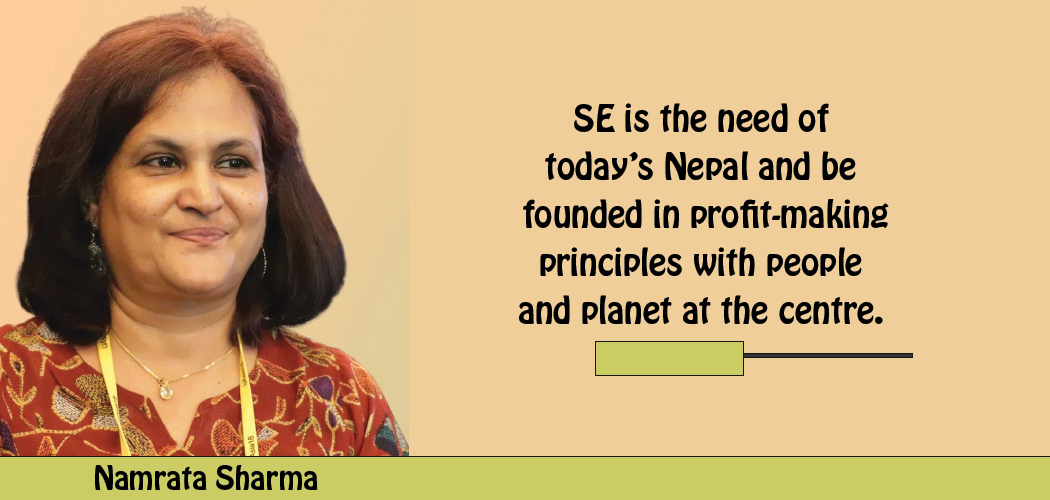
Bahini Social Venture offers innovative and diverse services and activities to promote a society inclusive of elders. Café with No Name is situated in Thamel and gives 100 per cent of its profits to projects supporting street children in Nepal. Chhahari Services caters to women with no skills to generate income by empowering them through capacity building and income generation training. SE is the need of today’s Nepal and be founded in profit-making principles with people and planet at the centre. The laws need to be developed in such a way that they are suitable for these structures.
(Namrata Sharma is a journalist and women rights advocate. namrata1964@yahoo.com Twitter handle: @NamrataSharmaP )