- Friday, 5 June 2026

Agro experts suggest avoiding banned seeds
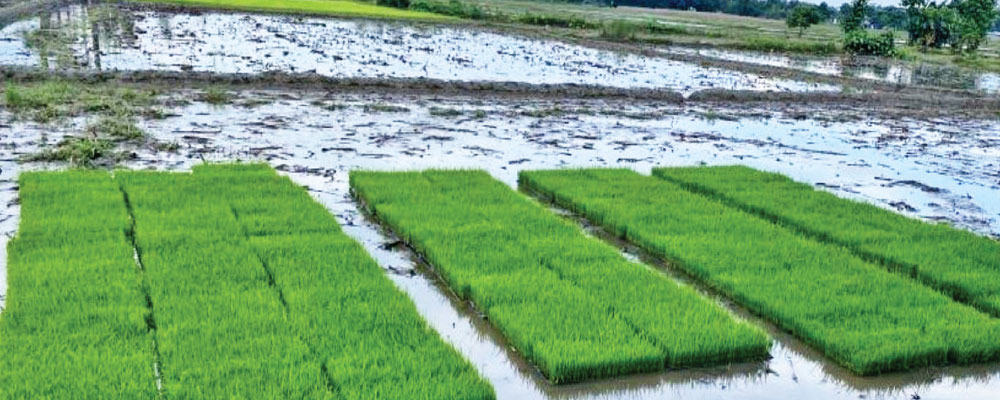
Photo: TRN Morang Urlabari farmer's paddy plants ready for plantation.

By Hari Prasad Koirala, Uralabari, June 5: Despite the provincial government’s continued investment in improving domestic paddy seed production, Koshi Province is still able to fulfill only about 22 per cent of its total paddy seed demand through local production.
Farmers, however, tend to seek high-yield hybrid seeds without understanding soil fertility, which has resulted in domestically produced seeds remaining unsold in storage.
To reduce seed dependency, the Koshi provincial government, with support from the government of Japan, is providing subsidies to 38 seed-producing institutions at government, private, and community levels. Among them, 11 are in Jhapa, 14 in Sunsari, four in Morang, and four in Udayapur.
According to Prakash Kumar Dangi, Acting Chief of the Directorate of Agriculture Development, Koshi Province, government-level seed production farms are operating in Chandragadhi of Jhapa and Jhumka Seed Production Farm in Sunsari.
The directorate said that paddy is cultivated in 276,386 hectares of land in Koshi Province. The annual seed requirement is 18,819 tonnes across 14 districts of Koshi Province. Of this, domestic production meets only 22 per cent demand.
Traditional farmer-saved seeds account for about 5 per cent, while the remaining demand is met through imports from India and other countries. Dangi said that more than 70 per cent of seed demand in Koshi is still unmet locally. He added that although Nepali seeds are of good quality, farmers are not attracted to them due to lack of awareness.
He said, “The seeds we produce are suitable for our soil and climate. They do not introduce new diseases, and if any problem arises, it can be managed. However, farmers do not seem to understand this.”
Around 25 paddy varieties are cultivated in Koshi Province. These include Lalka Basmati, Sawa Mansuli Sub-1, Hardinath-1 and 6, Bahuguni-2, Swarna Sub-1, Radha-4 and 12, Kalo Nunia, Ramdhan, Tarahara-2, among others.
Similarly, Shuddhodhan Kalonamk, Ranjit, Ganga Sagar, Makwanpur-1, Khumal 4, 6, 8, 10, 11, Kancha Mansuli, and Chaite 2 and 5 are also widely grown varieties in the province.
Although quality seeds produced by the government, private sector, and communities are available in sufficient quantity in the market, farmers still prefer Indian varieties such as Ranjit, BB 11, and Sworna. The government has banned these varieties in Nepal.
Farmers in border areas reportedly bring seeds illegally from Indian traders. Although the government has tightened border checkpoints, border police reportedly do not stop paddy and maize seed imports as strictly as other food items and edible oils.
According to agro-vet operators in the southern border areas, paddy seeds are frequently smuggled daily from municipalities such as Ratuwamai, Sunawarshi, Rangeli Municipality, Biratnagar Metropolitan City, and Dhanpalthan and Jahada rural municipalities of Morang.
Dangi also said that seeds coming from India and Bangladesh often bring diseases along with them. “Those seeds are not suitable for our soil. We have not been able to properly raise awareness among farmers. It takes 3–4 years of investment to develop a single variety of seed,” he said, adding that imported seeds also contribute to the spread of pests.
Ambika Prasad Luitel, Chief of the Agriculture Branch of Urlabari Municipality, said farmers themselves are becoming too confident, which is creating problems. He explained that varieties like Ranjit, Sworna, and BB 11 grow deeper into the soil and absorb more nutrients, leading to higher yields. However, continued use of these seeds may increase fertiliser requirements for the following crops.
He also said that, farmers in the Urlabari area are using seeds like Ranjit brought from India instead of subsidised local seeds for preparing nurseries.
Rojina Bhattarai, Chief of the Agriculture Branch of Kanepokhari Rural Municipality, said that they imported only 5,700 kg of paddy seed based on farmers’ demand this year. As previously supplied subsidised seeds had to be returned, she said that the supply is now demand-based.
Kanepokhari is a major rice-producing area in Morang, where on average 30 kg of seed is required per bigha of land. The subsidised seed provided by the municipality is sufficient for about 190 bighas of land. Less than 1 per cent of farmers in the municipality use government-recommended seeds.