- Friday, 5 June 2026

Promoting Inclusive Health Policies

Health is a basic need and human right. There are consistent efforts to enhance equity in health and wellbeing within and across countries. This will be achieved through education, community action and healthy public policy. Envisioning a world where all people achieve optimal health and well-being is a welcome reminder of supportive actions to empower people to control their own health and promote healthy societies.
According to World Health Organisation (WHO), health promotion is the process of enabling people to increase control over, and to improve their health. The first International Conference on Health Promotion was held in Ottawa in 1986. This was a major milestone in terms of timely response to growing expectations of public health movement around the world. Afterwards, the relevance and scope of health promotion have widened its socio-political horizon in the larger context of global health.
Advocacy
Despite advocacy and social movements, existing efforts are still inadequate to elevate interventions to new levels. Our scholarship has grossly failed to examine important and timely issues about community health and implement cost-effective interventions to improve health outcomes. Based on lessons learned, multi-sector engagement is crucial for bold policy making in health promotion that aims to embrace equity and wellbeing. Health promotion is a profound concern for policy makers, health workers, civil society, communities, media and private sectors.
The complexities and scales of inclusive policies for health are evidently vast to our ecosystems. Framing and scoping health promotion is necessary amid climate change and ecological disruptions, non-communicable diseases, indigenous health, geopolitical shifts, political unrest and many more. From worldviews, the classical divides between North and South, decolonising practices, policies and knowledge systems reveal that we can imagine a resilient and healthy future by building on health promotion legacies at large.
Considering evolving challenges in our changing world, while socio-economic disparities grow, health inequalities further deepen. And the burden of poor health is more profound in low-and middle-income countries. Tackling wider determinants of health requires our approaches beyond health. Of course, the multi-pronged approaches of health promotions are closely related to Sustainable Development Goals (SDGs). In Nepal, there are a few important initiatives for promoting inclusive policies for health. Health in all policies is gaining momentum, but not in scale and pace. Therefore, effective coordination with other sectors such as education, agriculture, food safety, environment, urban planning, transportation, water and sanitation is crucially needed to achieve the targets of health- related SDGs.
Nepal’s health policy, 2019 has ambitiously highlighted multi-sector approach to meet the health care needs of people who are poor, socio-politically and culturally marginalised in the communities. Furthermore, health sector strategies have explicitly pointed out the equity dimensions of health care services. In alignment with the health policy, Gender and Social Inclusion Strategy (GESI) for the health sector aims to enhance the health status of all individuals by providing equitable health services.
The GESI strategy is largely aligned with rights enshrined in the constitution and Nepal’s commitment to universal declaration of human rights. In this spirit, Nepal has shown a sustained focus on inclusive policies for health. However, there are increasing priorities to mainstream the GESI into health policies, institutional structures and systems of federal, provincial and local governments. Indeed, this approach is instrumental in designing and implementing targeted interventions to meet specific health care needs of vulnerable and socially excluded groups for ensuring their easy access to basic health care services.
Again, cities have crucial role to play in promoting good health. The concept of smart cities is a new beginning. Dhulikhel municipality, for example, has expressed strong commitment to develop it as healthy city. Their vision strategy 2030 frames health, education, water, sanitation and environment protection as key components of urban well-being. Similarly, Bagmati province has recently started ‘One District: One Healthy City’ campaign across the districts. By creating walkable cities, reducing air and water pollution, wearing of seatbelts and helmets, urban life becomes safer and healthier.
Despite innovative social and environmental interventions, the implementation part is often challenging due to limited resources and capacity of local governments. Building partnerships and meaningful engagement with other relevant sectors not only provide opportunities to leverage resources, but also yield profound impacts on social determinants of health and equity. This illustrates how a strong political mandate coupled with evidence-informed culturally sensitive policies and participatory governance supports a strategic and sustained approach to ensure health for all.
Community engagement
More importantly, community engagement and participatory processes in planning, implementation, monitoring and evaluation are key features of healthy city agenda that primarily aims to enhance local ownership and sustainability. Towards this end, Nepal’s Female Community Health Volunteers (FCHVs) are recognised for their crucial role in improving maternal and child health, nutrition, immunisation, family planning, HIV/TB prevention, disease outbreaks and many more. Because of their enormous contributions in the communities, the FCHVs won WHO’s public health champion award last year. Despite noted progress, health promotion initiatives in rural and urban areas need stronger focus on primary health care.
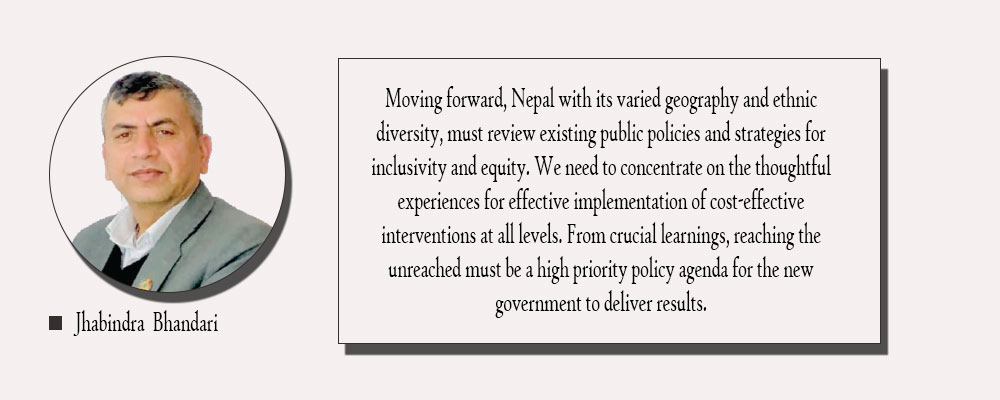
Moving forward, Nepal with its varied geography and ethnic diversity, must review existing public policies and strategies for inclusivity and equity. We need to concentrate on the thoughtful experiences for effective implementation of cost-effective interventions at all levels. From crucial learnings, reaching the unreached must be a high priority policy agenda for the new government to deliver results.
(Bhandari is a health policy analyst interested in anthropology.)