- Wednesday, 29 April 2026

Resource shortage cripples Gurukuls
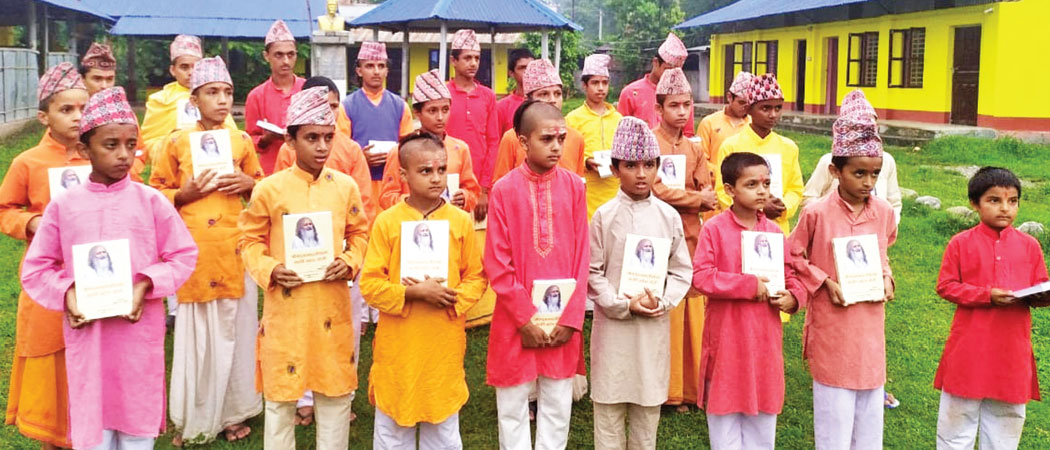
Photo: Hari Prasad Koirala Group photo of students studying in Gurukul

By Hari Prasad Koirala,Urlabari, Apr. 29: With a shortage of priests in rural areas, the younger generation has recently shown increasing interest in Gurukul education. However, as per Vedic tradition, Gurukul education is meant to be free, making it difficult to meet the expenses required to run such institutions.
A total of 22 children from the Brahmin community are currently receiving Gurukul education at Baijnath Adhikari Prambhik Sanskrit School, located in Letang-9, Morang.
Students studying at the school, which operates without government support, often leave their studies midway to become professional priests. Although the school has received approval to provide formal education up to Grade 5, it also teaches Chandi, Rudri, Vedas, and Gita alongside the formal curriculum.
Eakraj Bhattari, principal of the school, said that the institution came into operation on land donated by local education enthusiasts, totaling six kattas.
According to Somnath Niraula, chairman of the school’s Board of Directors, a Mahayagya was organised in 2066 by locals to mark the centenary of human settlement in the area.
During the Mahayagya, land and cash donations were collected. Initially, locals proposed building a temple with the funds. However, a scholar of oriental studies, Khemraj Keshavsharan, suggested establishing a Gurukul instead of a temple.
Following this, Keshavsharan offered free Purana recitations, which helped collect one and a half bighas of land and Rs. 1.3 million. With these resources, both a temple and the Gurukul were constructed, fulfilling both the locals’ wishes and Keshavsharan’s vision, said landowner Ambika Prasad Adhikari.
Students receive basic Sanskrit education in a residential setting, with four small buildings constructed on about 10 katthas of land. A board member stated, “Donations from locals are sufficient to provide food.”
However, there is a constant shortage of funds to pay teachers. The lack of resources to provide regular salaries to two teachers and one staff member has limited the school’s ability to increase student enrollment.
Letang Municipality provides annual support of Rs. 300,000 to run the Gurukul. Similarly, the Maharishi Foundation covers the expenses of one teacher. However, this support is not sufficient.Chairman Niraula said that, like technical education, Sanskrit studies can produce skilled manpower. He added that with proper government support, students would not need to go to India to study Sanskrit.
He further stated that despite Sanskrit being considered the mother of many languages, it has not received adequate importance in Nepal’s education system.
Due to limited resources, the school cannot admit all interested students. All enrolled students receive free food, accommodation, and uniforms. Locals also contribute by donating money and rice, especially during winter.