- Thursday, 21 May 2026

Bring Geographical Indications Into Focus


A simple branding faux pas in Nepal ended up doing what few marketing mistakes do: becoming a case study for business and law scholars and ultimately a Supreme Court precedent. After eight years of litigation, the court’s August 19, 2025, verdict upheld the lower courts, affirming Scotch Whisky’s Geographical Indication (GI) status and leaving the company Mohini Hygiene Products with no ownership claim over the product. The case originated when the Scotch Whisky Association, in October 2017, filed a complaint against a product that included the phrase “Finest Rare Scotch Whisky.” It became controversial as it had the potential to mislead consumers. This undermined the reputation and integrity of the GI to which the product was entitled.
The author recalls his early days when his grandmother would narrate stories about harvesting quintals of Basmati rice from the field and how its distinctive aroma and quality would often attract vendors from the city and nearby markets. These anecdotes were repeated over time, garnering a wide range of narratives during his upbringing. This propelled a sense of ownership towards Basmati rice, similar to that associated with Khukuri, Palpali Dhaka, Timmur, etc. However, Basmati rice is subject to competing ownership claims. Both Pakistan and India hold the GI tag over Basmati rice, and the tussle continues. Meanwhile, Nepal, once closely associated with the product, watches from the sidelines as an outsider.
Nonetheless, Nepal has lodged a counterclaim at the European Union. Had the importance of GI been recognised by the government much earlier, Nepal could have established a specific sui generis GI Act, similar to that of India, and avoided the current predicament. Likewise, Nepal no longer retains ownership over Birenun, which is widely marketed internationally as “Himalayan Pink Salt” by Pakistan. Studies indicate that Nepal is losing millions due to the absence of strong GI compliance, as products continue to be sold as unbranded commodities.
Opportunity
Strolling through 7th Avenue in Manhattan, the aroma of freshly brewed coffee spills into the street, functioning as a subtle sensory marketing strategy. It sparks impulse stops, quietly converting passing foot traffic into paying customers through a subliminal effect. The author recognises that beyond Mount Everest and Lord Buddha, ‘Himalayan Specialty Nepal Coffee’ represents a valuable national identity. The author finds in it a subtle opportunity to boast during coffeehouse tête-à-têtes with Ivy League scholars across the East Coast. Even so, this recognition is not without basis, as Nepal’s tea and coffee received acknowledgment from the European Union Intellectual Property Office (EUIPO) in 2013, owing to the efforts of the National Tea and Coffee Development Board.
Concerning product ownership, Nepal holds significant potential in claiming GI across several commodities. Identifying these commodities is straightforward, as one only needs to visualise the well-known products associated with their home district. For instance: Dhaka from Palpa, Lokta paper from Baglung and Parbat, Timmur from Salyan and Pyuthan, Khukuri from Bhojpur, Yarshagumba from Darchula, Juju Dhau from Bhaktapur, Ghiu Simi and Marsi rice from Jumla, Aaloo from Mude, etc. While these represent strong opportunities, they remain vulnerable in the absence of strong regulatory protection.
In terms of Intellectual Property (IP) protection, Nepal does have the presence of compliance frameworks such as the Patent, Design and Trademark Act, 2022, the Copyright Act, 2059, and a few precedents. In terms of patents, Nepal has not been able to achieve as much as it could to protect a substantial number of inventors due to its complex registration and administrative hassles. The registration and enforcement of patents in Nepal are extremely weak. Nonetheless, trademarks have comparatively firm procedures that Nepal can leverage.
Although the PDTA, 2022, lacks provisions on GI, the Consumer Protection Act, 2075, and IP Policy, 2073, do not explicitly support GI protection, highlighting the authenticity of products and ultimately benefiting consumers. Several companies have started to apply for Collective Trademarks despite the prolonged duration of claims. A few of them have received certificates, for instance, Himalayan Nepalese Carpet by the Nepal Carpet Manufacturers and Exporters Association (NCMEA). However, GI is more important as it addresses the product of a geographic place as a whole.
Agriculture sector
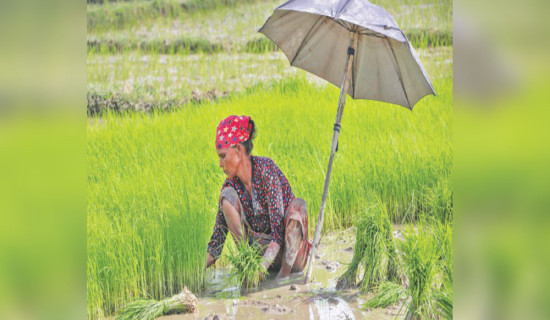
The new government aims to promote technology, digitisation, and innovation in Nepal. The goal is to achieve a USD 100 billion economy, raise per capita income to around USD 3,000, and create over one million jobs. Key economic indicators show that the agriculture sector currently accounts for 25.16 per cent of total GDP, industry for 12.83 per cent, and the service sector for 62.01 per cent. As most of the potential GI commodities belong to agricultural products, there should be a strong focus on promoting the agri sector. Manufacturing capital-intensive goods in Nepal is not encouraged by different studies, as it causes extensive cash outflows while procuring such goods and is difficult to sustain with existing human capital.
While Nepal is scheduled to graduate from LDC to a developing economy in 2026, the transition might cause Nepal’s exports to decline between 2.5 per cent and 4.3 per cent, as per reports from the International Labour Organisation. Nepal’s informal economy remains a predominant aspect, accounting for approximately 41 per cent of GDP. A large share remains unregistered, and transactions are predominantly cash-based, especially in agriculture, real estate, retail, and small services. Promoting entrepreneurs and businesses with IP and GI compliance protection will encourage them and contribute to the economy, as WIPO states that commodities with GI sell at a premium in the market. The government could also widen the tax bracket and reduce taxes and export duties on local products. These strategies will help adjust prices following Nepal’s graduation from LDC. At the same time, it is a prime time to introduce a GI Act to protect the peculiar commodities of Nepal that are not found elsewhere.
(Mr. Sharma is a certified alumnus of Harvard Kennedy School Executive Education in AI and Policy.sharmaroveen@gmail.com)

-square-thumb.jpg)