- Wednesday, 27 May 2026

Call for 20% budget in education
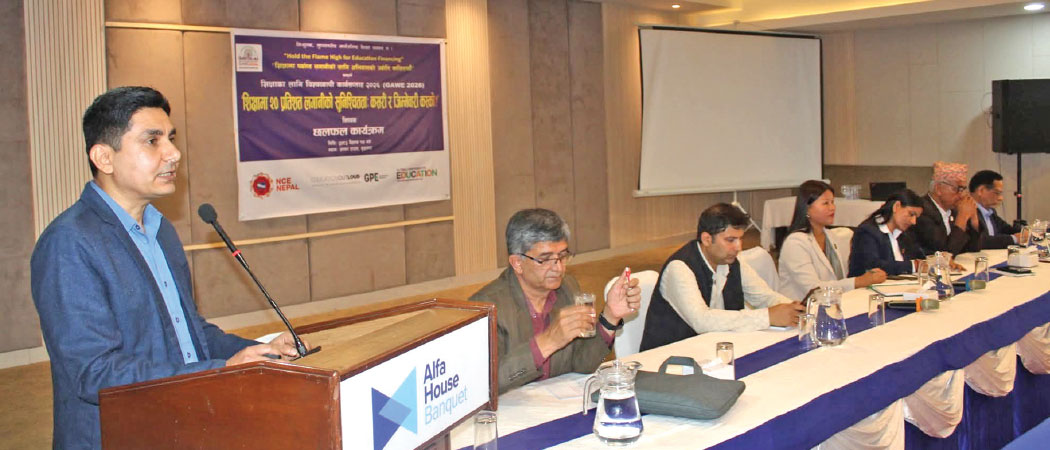

By A Staff Reporter,Kathmandu, Apr. 8: Stakeholders in the education sector have urged the government to allocate 20 per cent of the total budget to education in the upcoming fiscal year.
During an interaction programme organised by the National Campaign for Education (NCE) Nepal on Monday, concerned stakeholders stated that the current budget allocation for education is insufficient to the realisation of fundamental educational rights and to meet international commitments.
The participants called for a minimum allocation of 20 percent of the total budget to education.
NCE Nepal Chair Lab Raj Oli appealed to the current government to prioritise the education sector in their forthcoming budget.
Hari Lamsal, a former secretary of the Government of Nepal, emphasised that investment in education yields long-term results, thus, budget allocations at the local government level should be part of a conditional planning approach.
NCE has been advocating for increased budgets to support free tuition, availability of school mid-day meals, scholarships, first aid facilities, and the management of educational materials, which are essential to implementing compulsory and free education.
Toshima Karki, a member of the Education, Health, and Information Technology Committee of Parliament, remarked that increasing funding alone does not guarantee quality education. She further noted that schools must be insulated from partisan politics to ensure quality education, though she affirmed their intention to pursue an increase in the education budget.
Krishna Prasad Sharma, Undersecretary at the Ministry of Finance, stated that it is not feasible to allocate 20 per cent of the budget immediately; consequently, the budget will be increased gradually over time.
Sarita Devi Sharma, Undersecretary at the Ministry of Education, Science, and Technology, said that current investments are inadequate for providing quality education.
Kritika Dhital, General Secretary of the National Adolescent Girl's Network, highlighted that resources alone are insufficient without equipping teachers with necessary skills. She added that many projectors, smartboards, laptops, and bicycles are underutilised in community schools because teachers and students lack the necessary skills.