- Sunday, 24 May 2026

China's Whole-Process People’s Democracy

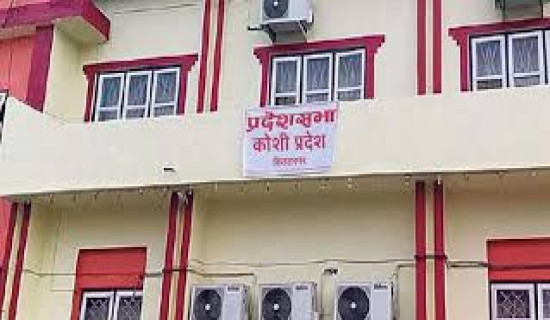
On March 5, 2026, Nepal successfully held elections to the House of Representatives (HoR) of the Federal Parliament. More than 11 million Nepali voters cast their ballots, electing new members of the House of Representatives. The Rastriya Swatantra Party (RSP) secured nearly two-thirds of the seats. On March 27, 2026, senior leader of the RSP, Balendra Shah, assumed office as Prime Minister and formed a new government. This represents the latest practice of parliamentary democracy in Nepal, and has drawn wide attention.
In the same spring of 2026, China completed a major democratic practice bearing on the well-being of its 1.4 billion people. On March 11, 2026, the Fourth Session of the 14th National People’s Congress adopted the Outline of the 15th Five-Year Plan for National Economic and Social Development of the People’s Republic of China, setting forth the development blueprint for 2026–2030. At the initial stage of drafting the Plan, more than 200 research institutions were organised to produce nearly 200 reports. Throughout the drafting process, China followed a people-centered approach and kept its doors open to solicit ideas. General Secretary Xi Jinping of the Communist Party of China (CPC), personally presided over 7 symposiums; more than 3 million suggestions were solicited from netizens; and around 66,000 targeted inputs were gathered from 11 specific groups.
Public consultations
In October 2025, the Fourth Plenary Session of the 20th CPC Central Committee deliberated and adopted the recommendations for formulating the 15th Five-Year Plan. During the consultation process, a total of 2,112 comments and suggestions were received, of which 452 were adopted. From preliminary research to public consultation, from deliberation at the plenary session to adoption by the National People’s Congress, whole-process people’s democracy was practiced throughout, fully demonstrating the scientific approach and the people-centred nature of Chinese democracy.
As is widely recognised, democracy is a shared value of all humanity. There is no one-size-fits-all model of democracy. The key to judging whether a system is truly democratic lies in whether the voices of the people are earnestly heard, whether their demands are actively addressed, and whether their fundamental interests are genuinely safeguarded. In China, whole-process people’s democracy provides a powerful answer to the question of what constitutes true democracy. It breaks free from the constraints of the “voting is democracy” mindset, emphasizing the uninterrupted nature of democracy and its commitment to putting the people first.
Rooted in China's national conditions, this form of democracy is built on three core pillars—the leadership of the Communist Party of China (CPC), the people running the country, and law-based governance. It ensures that the people remain front and centre in the political process, making democracy tangible and accessible. Moreover, it offers a new perspective for the advancement of democracy worldwide.
The leadership of the CPC serves as the fundamental guarantee for whole-process people’s democracy, addressing the critical challenge of “who should implement democracy.” The orderly development of democracy cannot be achieved without strong organisational leadership and sound institutional safeguards. The CPC always represents the fundamental interests of the vast majority of the people, providing them with a broad platform for participation and a reliable institutional framework for realising their position as masters of the country. From community councils to national legislative outreach stations, the CPC has built comprehensive, multilevel, and wide-ranging channels for democratic participation, standardising procedures and coordinating interests to ensure that democracy never becomes a loose “talking shop.”
At present, China has more than 2.62 million deputies to people’s congresses at all levels nationwide (including 2,977 deputies to the 14th National People’s Congress). Ninety-four percent of deputies at the county and township levels are directly elected by voters, enabling them to stay rooted at the grassroots level and listen to the voices of the people. The 14th National Committee of the Chinese People’s Political Consultative Conference CPPCC)has 2,169 members covering 34 sectors, representing the interests and appeals of different social groups and ensuring that public opinion is smoothly conveyed and effectively translated into policy outcomes.
The people running the country lies at the very essence of whole-process people's democracy, answering the question of our time: “who democracy is for.” China is a vast country with 56 ethnic groups and a population of over 1.4 billion, where development is uneven and the interests of different groups diverge. If decisions were driven solely by simple majority rule, the reasonable rights and interests of minority groups would inevitably be compromised, leading to social tensions and even fragmentation. Whole-process people's democracy navigates this challenge by integrating democratic consultation at every stage, establishing “deliberation before decision-making and reaching consensus before acting” as standard practice.
Inclusiveness
The National Committee of the Chinese People's Political Consultative Conference (CPPCC) conducts nearly a hundred consultation sessions each year, bringing together representatives from all sectors to discuss state affairs. Meanwhile, community councils and villagers’ representative meetings have been established nationwide, allowing people to sit together and solve common problems. This practice of widely soliciting opinions gives different stakeholders equal opportunities to voice their views, seek common ground while respecting differences, and build the broadest possible consensus. It turns the people running the country from an ideal into a daily reality, highlighting the inclusiveness and scientific nature of China’s democracy.
Exercising law-based governance is the essential path for whole-process people’s democracy, providing the institutional foundation for the orderly operation of democracy. This practice has consistently taken Xi Jinping Thought on the Rule of Law as its fundamental guideline and guide to action. Xi Jinping Thought on the Rule of Law expounds the principle of upholding a people-centred approach in the rule of law, emphasising that the protection of the people’s interests must be incorporated into all areas of advancing law-based governance in all respects, and providing scientific guidance for promoting the unity of democracy and the rule of law.
With the Constitution as the core, China has established a legal system safeguarding democratic rights, consisting of more than 300 laws currently in force, over 600 administrative regulations, and more than 12,000 local regulations, ensuring that people’s participation has a legal basis. China has also set up more than 5,500 grassroots legislative outreach offices, which have collected more than 300,000 comments and suggestions from the public over the past five years. A large number of valuable grassroots proposals have been incorporated into laws, turning the idea that “people’s voices matter” from a slogan into practice and demonstrating the authenticity and effectiveness of China’s democracy.
Democratic elections, democratic consultation, democratic decision-making, democratic management, and democratic oversight are closely interconnected and organically integrated, forming a complete closed loop of whole-process people’s democracy in China and ensuring that democracy runs through the entire process of national governance. In China, oversight is never a periodic test that takes place once every four or five years; rather, it is a normal practice that runs through the whole process of the exercise of power. Deputies to people’s congresses regularly report on their performance of duties to voters in their constituencies and take the initiative to accept public supervision.
Government budgets are made public throughout the entire process, subject to review by the people’s congresses and oversight from society, so that the flow of every fund is clearly traceable from beginning to end. Village (community) affairs disclosure boards provide detailed information on collective assets, the use of funds benefiting the people, and project construction, ensuring that grassroots power is exercised in the sunshine. Every year, millions of deputies to people’s congresses, members of CPPCC committees, and grassroots citizens participate in oversight through various channels, forming an all-round and multilevel oversight system. This ensures that democracy does not become a mere formality but delivers real results, truly fulfilling the principle of “Acting on what the people call for and responding to what they ask for.”
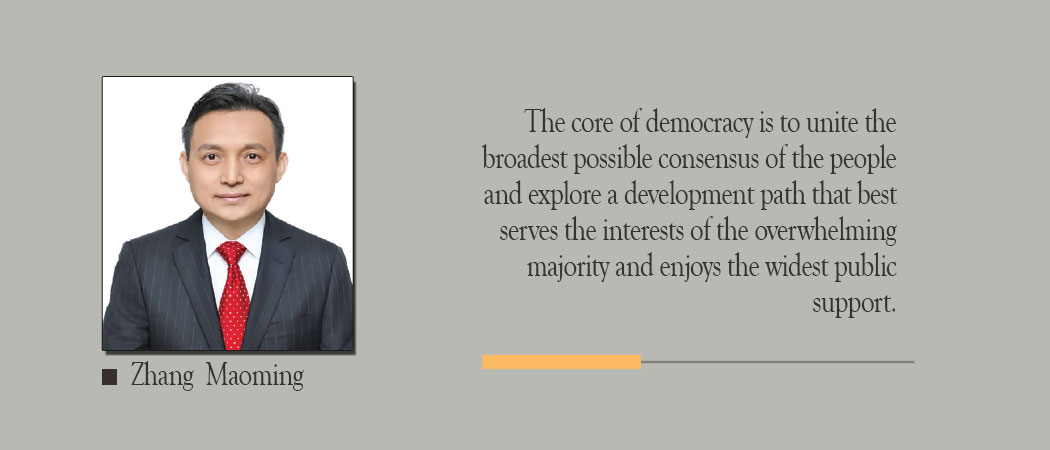
The core of democracy is to unite the broadest possible consensus of the people and explore a development path that best serves the interests of the overwhelming majority and enjoys the widest public support. Otherwise, democracy will degenerate into the tyranny of the majority over the minority, and of opinion leaders over the silent majority. In such case, it will not bridge social divisions; rather, it will intensify internal contradictions and even tear society apart. Whole-process people’s democracy achieves an organic unity of process and outcome, procedural democracy and substantive democracy.
Public participation
It remains consistently oriented toward addressing the people’s urgent difficulties and pressing concerns, and toward improving governance effectiveness, so that the fruits of development benefit all the people more broadly and more fairly. In this way, it demonstrates strong vitality and distinct advantages. It shows the world that democracy is not a rigid template, but a vivid practice grounded in a country’s own conditions and responsive to the people’s expectations; it is not an inaccessible statue, but a round table where every member of the public can speak freely and participate
This new form of democracy, whole-process people’s democracy, has taken root in China and responds to the people’s aspirations. It highlights the notable strengths of the socialist system with Chinese characteristics and stands as a great creation of the Chinese people in the history of human political institutions. It will certainly provide sustained momentum for advancing Chinese modernisation, and it will also offer useful insights for countries around the world as they explore democratic paths suited to their own conditions and promote the progress of human political civilization.
We look forward to strengthening exchange of experience in party governance and state administration with political parties and friends from all sectors in Nepal, learning from each other, and working together to follow our respective paths of democratic politics and modernization, thereby contributing to building a community with a shared future for mankind.
(The author is the Chinese ambassador to Nepal.)