- Wednesday, 22 April 2026

Babai Irrigation Project cost nearly doubles
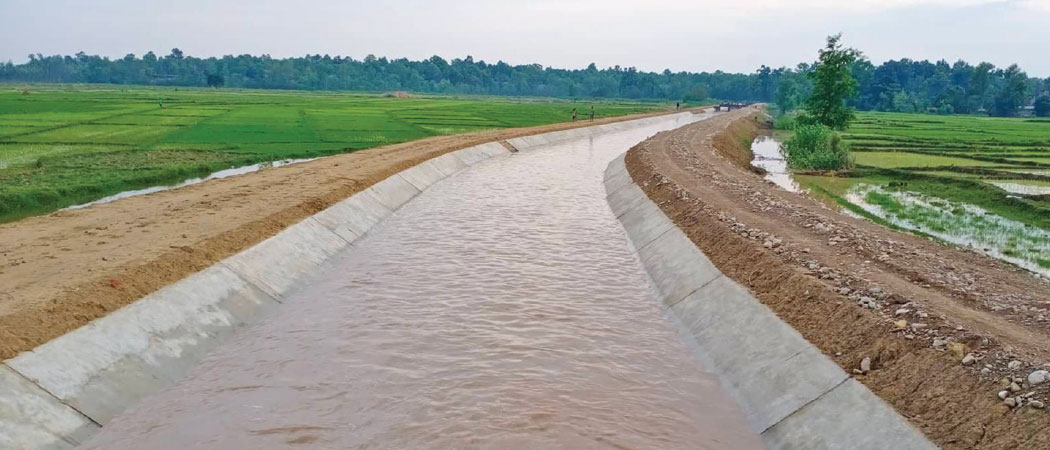

By Our Correspondent,Gulariya, Apr. 22: The long-awaited Babai Irrigation Project in Bardiya has seen its cost nearly double due to time overrun.
Initially estimated at Rs. 16.43 billion, the project is now expected to cost around Rs. 33.19 billion.
The project, whose study began in 1967, has yet to be fully completed by 2025. The cost has continued to rise due to construction delays, design changes, flood-related damage, and challenges in financial management.
The project aims to provide irrigation facilities to around 36,000 hectares of land and is expected to boost agricultural production in Bardiya district. Earlier studies had identified approximately 40,000 hectares as irrigable, but subsequent assessments reduced the area to 36,000 hectares.
Under the first phase, a dam was constructed in 1992 for Rs. 679.5 million. Following this, a 5.5-km main canal was built, extending irrigation services to around 4,000 hectares of land.
In the second phase, construction of siphons, link canals, and other infrastructure began. However, flood damage in 2014 necessitated reconstruction, further delaying the project and increasing costs.
According to the approved master plan (2018), the project is now targeted for completion within the fiscal year 2025/26. Project Director Gopal Sharma said that more than Rs. 12.28 billion has already been spent.
He added that the project requires the construction of 91 km of main canals—34 km on the eastern side and 41 km on the western side—along with additional sections. Furthermore, 313 km of branch, sub-branch, and tertiary canals, as well as various structures, drainage systems, and service roads, remain to be completed.
The related Bheri–Babai Diversion Multipurpose Project aims to divert water from the Bheri River into the Babai River to irrigate 51,000 hectares of land in Bardiya and Banke districts, while also generating 48 megawatts of electricity.
However, delays in completing such national pride projects have led to repeated cost escalations. Similar issues have been observed in other major projects, including the Rani Jamara–Kulariya Irrigation Project, the Sunkoshi–Marin Diversion Project, and the Mahakali Irrigation Project.
Stakeholders note that delays not only postpone returns on state investment but also undermine the effective utilisation of taxpayers’ money.