- Tuesday, 5 May 2026

Night bus service begins in Kathmandu
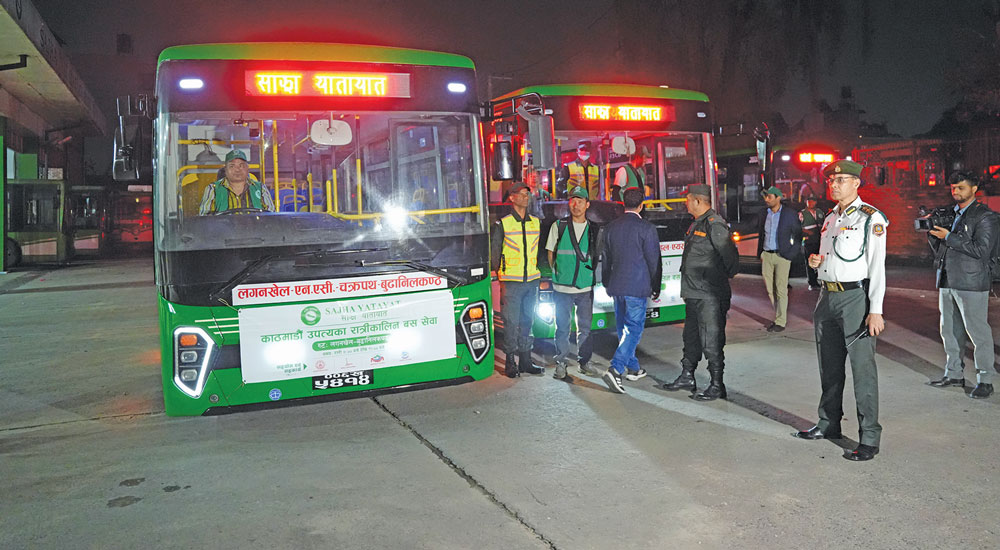

Kathmandu, Apr. 15: For years, the capital’s streets have grown quieter after 8 pm, but not for those still on the move. Office workers finishing late shifts, students leaving evening classes, and shop employees closing their day have long shared a common struggle: finding affordable and safe transport home.
On Tuesday, Kathmandu Metropolitan City (KMC) attempted to respond to that gap with the launch of a night-time public transport service equipped with free Wi-Fi, aiming to improve mobility and enhance safety for late-evening commuters across the Valley.
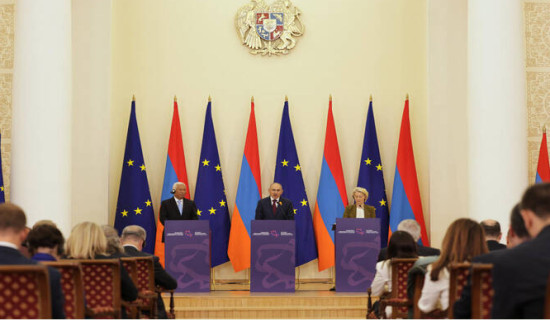
The service, introduced in collaboration with Sajha Yatayat, was jointly inaugurated following the signing of a memorandum of understanding by KMC Acting Mayor Sunita Dangol, Lalitpur Metropolitan City Mayor Chiri Babu Maharjan, Chandragiri Mayor Ghanshyam Giri, and Budhanilkantha Municipality Mayor Mitharam Adhikari at the Sajha Petrol Pump in Pulchowk. The initiative connects four local levels: Kathmandu, Lalitpur, Chandragiri, and Budhanilkantha.
Speaking at the inauguration, Acting Mayor Dangol said the city aims to make the night service sustainable and expand it to include early morning operations. “With the New Year, we have implemented an important decision focused on efficient, quality service rather than profit. A cost-sharing model with local governments will support long-term operations,” she said.
Lalitpur Mayor Maharjan said there is consensus among local governments regarding the operation of the service. “Shared financial participation is key to sustaining the service, which will benefit many citizens,” he said.
Chandragiri Mayor Giri stated that around 50,000 people pass through the Thankot entry point daily. “Improved connectivity will make it easier to access Chandragiri’s tourist areas and contribute to economic and social activities,” he said.
Meanwhile, Sajha Yatayat Chairperson Sushil Raj Pyakurel said the organisation will bear operational costs until mid-July, after which local governments are expected to share expenses based on a cost analysis.
According to KMC Spokesperson Nabin Manandhar, the buses will operate from 8 pm to 11 pm at 20-minute intervals along designated routes. He said the initiative addresses the long-standing shortage of public transport after 8 pm, which has forced commuters to rely on expensive alternatives.
“To ensure passenger safety, each bus is equipped with CCTV cameras, and a city police officer is deployed onboard,” he said. “All vehicles are GPS-tracked and monitored.”
Although similar services were attempted in the past, they were discontinued due to low passenger turnout and high operating costs. This time, the metropolis has introduced electric buses and reduced fares in a bid to ensure sustainability.
Manandhar expressed confidence in the service’s success, stating that the routes have been strategically designed to pass through major commercial hubs, hospitals, and the airport. Passengers can also track buses in real time using the ‘Sajha Plus’ mobile application.
The service currently operates with seven electric buses on two main routes. Each bus carries four CCTV cameras, covering the front view, driver, and passenger areas, with live footage monitored from a control room to ensure immediate response to any security issues.
The north–south route runs from Lagankhel to Budhanilkantha, passing through key locations including Patan Hospital, Norvic Hospital, Bir Hospital, Kanti Children’s Hospital, TU Teaching Hospital, and Shahid Gangalal National Heart Centre. The 16-kilometre route connects major medical and urban centres.
Similarly, the east–west route stretches from Thankot to Tribhuvan International Airport via Satungal, Kalanki, Tripureshwor, Maitighar Mandala, Baneshwor, and Tinkune, covering approximately 20 kilometres.
Meanwhile, commuters have welcomed the move, expressing hope that the service will be consistent and reliable.
“I often struggle to find an affordable ride after evening classes and end up paying double the fare,” said Ramesh Shrestha, a college student in Baneshwor. “If this service runs regularly, it will make a big difference for students like us.”
Another commuter, Sita Tamang, who works at a shop in New Road and travels to Maharajgunj, said the service could improve safety for women. “We finish work late at night, and public transport is almost unavailable. Having a monitored bus service with city police on board makes me feel much safer,” she said. “However, safety remains a concern as I still have to walk around 10 minutes to reach home.”
Sanu Sharma, a resident of Sano Thimi who works in New Road area, said the initiative would particularly benefit daily wage earners.
Recalling past difficulties, she said, “During the recent election period, I could not find public transport even around 7 pm. I was with my son, and after waiting for 15 to 20 minutes without any option, I had to take a taxi from New Road to Bhaktapur, which cost Rs. 750. For a daily wage earner like me, that is almost equal to a day’s income.”
-original-thumb.jpg)
-square-thumb.jpg)