- Tuesday, 5 May 2026

KMC intensifies daily cleaning of Bishnumati, expands work to rivulets
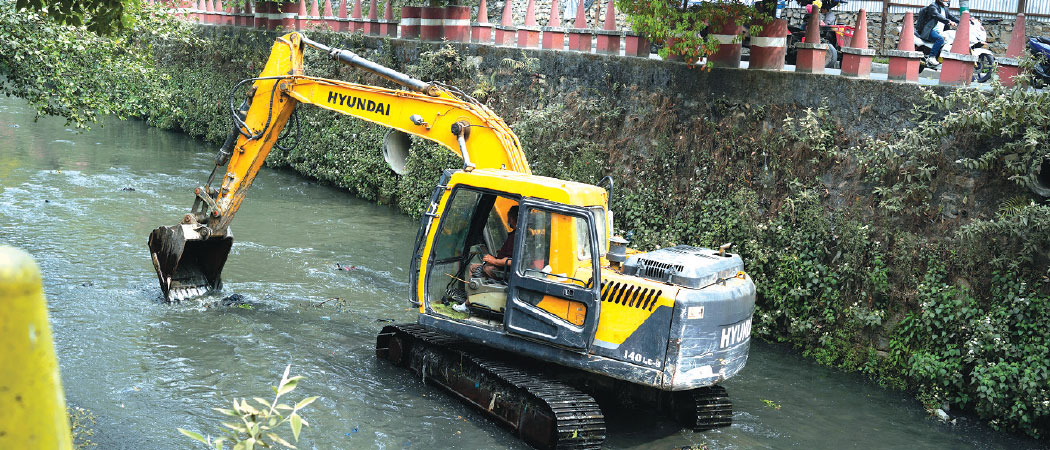

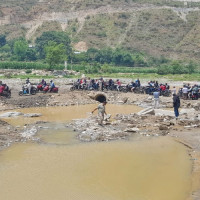
Kathmandu, Apr. 4: Sanitation workers continue to remove sludge, plastic waste and debris from the Bishnumati River and its rivulets, as the Kathmandu Metropolitan City (KMC) steps up daily efforts to clean one of the capital’s most polluted rivers.
The metropolis has, over the past two years, turned its focus to the regular cleanup of Bishnumati and its network of tributaries, marking a shift toward continuous river management rather than periodic cleanup campaigns.
According to Sarita Rai, chief of KMC’s Environment Department, the work is now part of the city’s routine operations. This is not just a campaign, it is our regular work,” she said. “We have a dedicated river-cleaning unit, and cleaning is carried out daily.”
KMC has deployed at least 36 sanitation workers inside river channels and a similar number along the banks. The teams remove accumulated mud, plastic waste, vegetation and other debris, while dozers are used in heavily clogged sections. The focus on Bishnumati has also expanded to include smaller rivers and rivulets such as Dhobi Khola, Tukucha River, Balkhu River, Bachha Khusi, Rudramati, Manamati and Samakhusi areas, often blamed for blocking water flow and worsening urban flooding.
According to the KMC, the work is carried out systematically, starting from upstream sections and moving downstream, with priority given to areas where debris accumulation has raised riverbeds. Currently, it is cleaning the Dhobi Khola areas.
“The main issue is debris carried during the monsoon, which increases the riverbed level and raises flood risk,” Rai said. “We remove such materials regularly to maintain flow capacity.” To intercept floating waste, KMC has installed trash barriers at 11 locations along Bishnumati and Dhobi Khola, where collected garbage is periodically removed.
Midway through its river management work, KMC also coordinates with efforts on the Bagmati River, although it does not lead that campaign.
“We have not been leading the Bagmati cleaning campaign,” Rai said. “That responsibility lies with the Bagmati Civilisation Integrated Development Committee. We coordinate and support them, mainly in waste collection and disposal.”
She added that the metropolis has even expressed willingness to take over Bagmati cleaning if required, though the river falls under a different jurisdiction.
Residents living along Bishnumati said the increased frequency of cleaning has brought some improvement, but challenges remain.
“The river used to be completely clogged, and the smell was unbearable,” said Rajeev Shrestha, a shopkeeper in the Balkhu area. “Now they clean it regularly, which has helped. But people still dump waste, so the problem continues. Additionally, during the dry season, the foul smell becomes stronger due to the drop in water levels.”
Sita Tamang, a resident near the river corridor in Chamati of Ward No. 15, said concerns about flooding persist. “Cleaning is good, but till sewage and drainage are properly managed, the river will not improve much,” she said.
“Floodwater enters the settlement every monsoon. I request the concerned authorities to take the matter seriously and come up with proper planning beyond cleaning campaigns.”
Managing the waste collected from the river has also required coordination beyond the city. KMC has signed an agreement with Dakshinkali Municipality to dispose of debris.
The collected sludge is transported about 26 kilometres to Ward No. 7 of the municipality, where it is used to fill a landslide-prone pit as part of land stabilisation.
Despite continuous efforts, officials acknowledge that river cleaning alone cannot fully address flooding and pollution challenges in Kathmandu.
“Last year, flood damage was comparatively less, but that cannot be attributed to a single factor,” Rai said, citing rapid urbanisation, inadequate drainage systems and reduced groundwater recharge.
-original-thumb.jpg)