- Monday, 8 June 2026

Nepal Railway risks being derailed as spending triples income
By Ajay Sah
Mahottari, Apr. 13: Nepal Railway Company Limited, the country’s only railway service operator, has been facing persistent financial losses.
Data from the past five years show that the company’s expenditure is nearly three times higher than its income, indicating that the service is being pushed towards long-term financial instability.
According to the company’s Business Plan 2025/26, between the fiscal years 2019/20 and 2023/24, the company earned Rs. 192.1 million while expenses totaled Rs. 673.7 million. During this period, it incurred a total loss of Rs. 481.58 million.
In the fiscal year 2023/24 alone, the company generated Rs. 85 million in revenue against an expenditure of Rs. 262.7 million.
Currently, the monthly income stands at around Rs. 7.5 million, whereas expenses reach approximately Rs. 12.9 million.
As revenue has been insufficient to cover costs, the company has been operating through loans guaranteed by the government.
By mid-July 2024, the total loan liability, including principal and interest, had exceeded Rs. 790 million, adding further financial pressure.
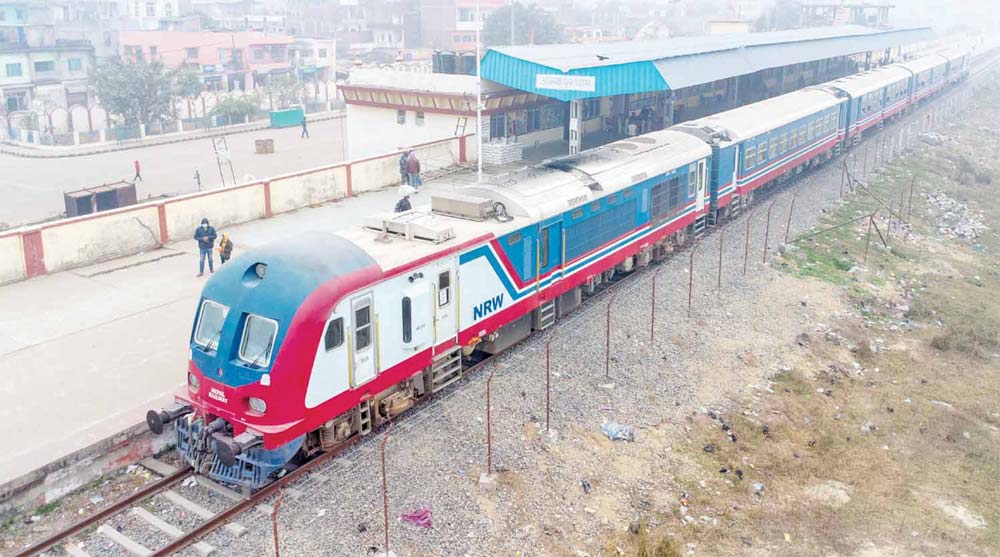
In terms of passenger services, however, the railway is considered effective. The train service, operating from Jaynagar in India to Bijalpura in Mahottari via Janakpurdham, runs three times daily.
According to 55-year-old Upendra Thakur of Khajuri, Dhanusha, the railway has made daily life more convenient. A
journey that takes an hour by motorcycle can be completed in just 15 minutes by train, he added.
Despite increasing passenger convenience, the company’s financial condition continues to weaken.
One of the major reasons for the losses is the high cost of employing Indian technical staff.
Currently, 17 Indian personnel are employed, for whom the company pays approximately Rs. 11.2 million per month to India’s Konkan Railway Corporation.
In contrast, the total salary for 103 Nepali employees amounts to only Rs 1.7 million.
The company has also cited the lack of permanent technical manpower, absence of workshops, shortage of trained Nepali drivers and station masters, lack of a fuelling station, and dependence on fuel imports from India as factors increasing operational costs.
Additionally, the company has been without a Managing Director for a prolonged period, weakening its management.
The railway service, originally launched in 1937, was shut down in 2013 for broad-gauge expansion and resumed operations on April 2, 2022. It has now been extended to cover 52 kilometres.
To increase revenue and move towards self-sustainability, the company has proposed several measures.
Leasing 28 acres of land in Raxaul is expected to generate approximately Rs. 80 million annually. There is also a plan to establish a railway museum using old narrow-gauge coal engines and related artefacts to boost tourism income.
Local traders have emphasised the need to expand freight services alongside passenger services, arguing that profitability cannot be achieved through passenger transport alone.
Former Managing Director Niranjan Jha informed that introducing cargo railway services as soon as possible is essential to transform the company into a commercially viable and profit-oriented entity.
He added that discussions had been held during his tenure on operating cargo services either by adding wagons to existing trains or introducing new ones.
Businesspersons in the Janakpur region have long demanded cargo rail services to facilitate cheaper transportation of goods from Kolkata Port in India, but the service has yet to be implemented.
Local trader Nirmal Chaudhary noted that such a service would make goods transportation easier and more affordable.
If timely improvements in management, development of domestic skilled manpower, expansion of freight services, and proper loan management are ensured, the railway service could become profitable.
Otherwise, the growing debt is likely to push Nepal’s only railway service into deeper crisis.




-original-thumb.jpg)