- Monday, 25 May 2026

Nepal's Carbon Trade Potential
With more than 46 per cent of the area covered by forests and wetland, bushes and shrubland ecologies, Nepal can boast of its role as an important natural carbon sink. Such a status, built through ecological richness, biological diversity and conservation efforts, can do wonders as a natural buffer against temperature rise that invites devastating consequences in the existing weather patterns and climatic balance.
In a world beset by adverse impacts of climate change, Nepal's carbon-absorbing capacities deserve due compensation and financial rewards that encourage further betterment of a clean environment and green economy.
Trade deal
In this context, embracing the deal of carbon trade can be deservingly beneficial for this country. The rewards should come in the form of finances, technology transfer, clean energy projects, and immediate support for communities suffering under the adverse impacts of climate change.
Carbon trade is a market-based mechanism aimed at mitigating the greenhouse gas emissions that cause the world's temperatures to rise, triggering climate change. Carbon is a key substance present in greenhouse gases that traps heat in the atmosphere. Burning of fossil fuels is the main source of greenhouse gas emissions. Works done to reduce carbon dioxide emissions or to absorb the carbon already present in the atmosphere are the contributions generating carbon credits that can be sold in the market. Individuals and companies that have exceeded the permissible level of emissions can buy the carbon credits to compensate for their excess emissions. In a carbon trade market, a business entity earning more income through more emissions is facilitated to trade off the pollution by purchasing carbon credits. In this deal, GHG emitters can clean up their carbon footprints through a market-based payment system.
The door to the concept and mechanism of carbon trade was opened by the Kyoto Protocol adopted in December 1997 under the United Nations Framework Convention on Climate Change (UNFCCC). Since then, various models and mechanisms have evolved to provide financial reparations for the contributions made to reduce carbon emissions in the atmosphere. Clean Development Mechanism (CDM) tries to ensure due financial benefits to those nations, communities, companies, and individuals who have taken clean initiatives against global warming. In this regard, Nepal can claim financial benefits by generating considerable carbon credits through forest conservation, hydropower development, and implementation of other clean energy projects such as wind turbines, solar panels, and biogas plants. Clean energy initiatives not only help reverse the temperature rise but also save billions of rupees by substituting petroleum fuel imports. Money thus saved can be utilised for sustainable development and green economic growth.
In a carbon trading system, carbon credits or emission permits become the tradable items. For this mechanism to work, the amounts of carbon emitted or absorbed in stock are scientifically measured, and the price of each ton of carbon is fixed.
Global laws are agreed upon and implemented by nations to govern the system and put a cap on total carbon emissions. Business houses, transport vehicles, and offices that operate with the burning of fossil fuels are put under regulation to emit within a certain limit. Excessive emissions, otherwise prone to financial penalties, can enjoy liberty due to the concessions provided by the carbon trade system.
The trade takes place only within the total allowable amount of emissions of a country. A company or a business entity may exceed its permissible amount of emissions by purchasing a compensating amount of carbon credits or emission permits. This is something like you make some extra CO2 pollution, and for reparation, you pay money to another person who has done exemplary and measurable work to curb such pollution. Carbon trade offers a beneficial package for both sides of the deal. It is a reward for the party that has worked to reduce emissions, and for the purchaser, it is a desirable option to avoid higher amounts of fines that may come for emissions excess.
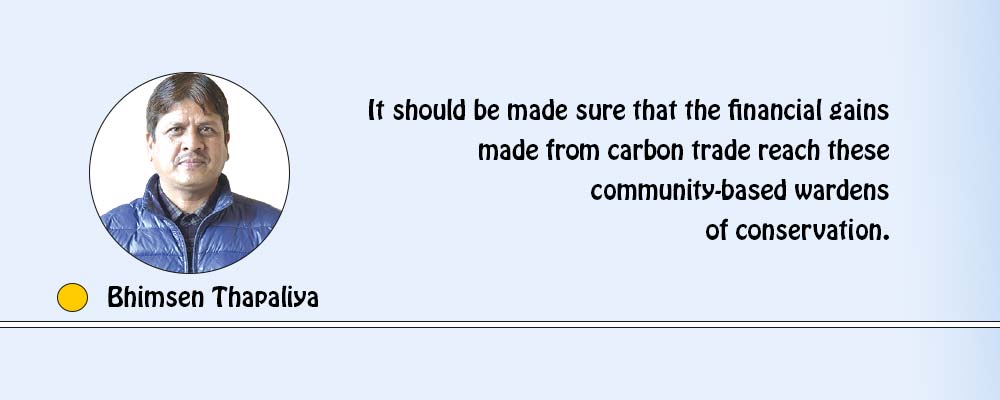
Developed nations need to make a firm commitment to participate in the carbon market, where climate justice is maintained by making polluters pay, while the fund thus generated can be provided to promote carbon absorption through forest conservation and developing and applying clean energy technologies. Nepal's forest conservation efforts through active participation of the grassroots communities have been globally recognised, and it should be made sure that the financial gains made from carbon trade reach these community-based wardens of conservation. So, arrangements have been made to make sure that 80 per cent of the funds generated from the carbon trade will reach the local communities involved in the forest conservation works.
So far, Nepal has made carbon trade earnings of more than 6 billion rupees from forest conservation and renewable energy development initiatives.
Result-based payment
Clean energy projects of Nepal include micro-hydro projects, bio-gas plants, and solar energy projects in which the Alternative Energy Promotion Centre (AEPC) has been working since 2011. These schemes have helped to mitigate the emissions of 6.68 million tons of carbon dioxide, and it has made carbon trade earnings of 36 million US dollars (5.04 billion rupees) under the Clean Development Mechanism (CDM).
Similarly, Nepal received 1.33 billion rupees from the World Bank's Forest Carbon Partnership Facility (FCPF) in November 2025 for reducing 1.88 billion tons of carbon emissions. This carbon absorption was achieved under the Tarai Arc Landscape programme. This was the first result-based payment received for reducing emissions that could otherwise result from deforestation and forest degradation.
(The author is former Editor-in-Chief of this daily.)