- Monday, 8 June 2026

Phewa Lake boundary crackdown sparks fear among fishermen
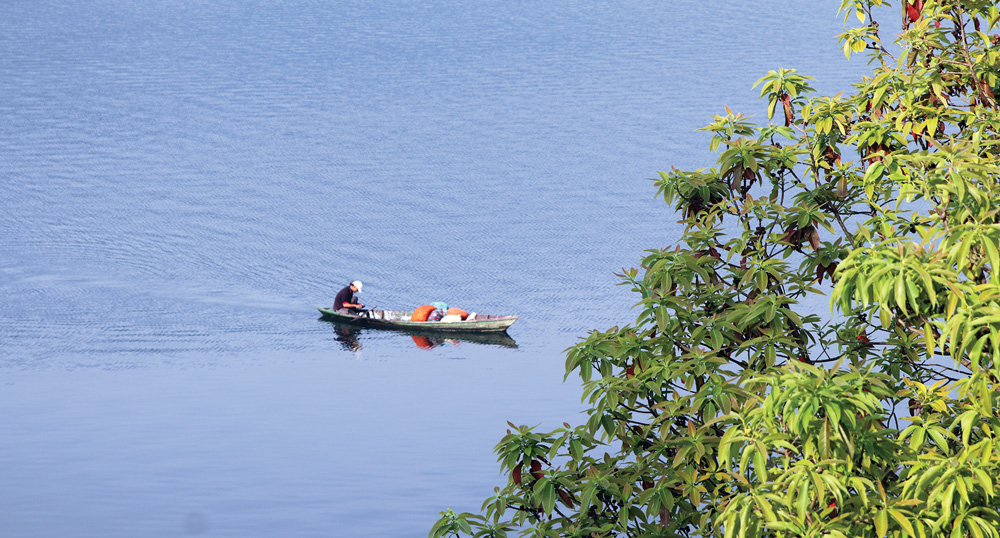
A fisherman returning with his boat after fishing in Phewa Lake.Photo: Phadindra Adhikari\TRN

By Phadindra Adhikari
Lekhnath, Apr. 7: Shanti Jalari of Khapaudi, Pokhara Metropolitan City Ward No.18, Kaski, has been deeply unsettled since Saturday morning.
Until Friday, her concern was the declining fish catch in Phewa Lake. By early Saturday, a new fear started haunting her: the possibility of being displaced.
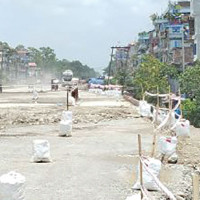
With bulldozers deployed to clear structures within the newly enforced 65-metre boundary from the lakeshore, anxiety has gripped the Jalari (fishermen) community living along the banks.
Shanti, who lives in a makeshift house built on public land by the lakeside, supports her family of four--her husband and two children.
She said they were willing to relocate if it helped preserve the lake. “Our entire family depends on fishing for survival. If that too is taken away, how will we live?” she asked.
“We do not own land elsewhere. If we must move, the government should arrange nearby resettlement.”
Sixty-five-year-old Ramchandra Jalari shares a similar concern. Having spent his entire life by the lake, he describes the bond between the Jalari (fishermen) people and the lake as inseparable. “Just like fish cannot survive without water, we cannot survive without the lake,” he said.
“Resettle us nearby. We want to see the lake restored, unwanted structures removed, walkways built, and beauty enhanced,” he said.
The National Dalit Commission has classified the Jalari as a hill Dalit community. Speaking a Newari dialect, they reside in areas such as Gaighat, Sedi, Baidam, Raatmate, Khapaudi, Phyaure and Pame, with around 100 households in total.
While some younger members have ventured into small businesses or foreign employment, over 90 per cent of the community remains dependent on the lake.
Gyan Bahadur Jalari, chair of the Harpan Phewa Fisheries Cooperative, emphasised that the community cares deeply for the lake.
“No one loves this lake more than we do,” he said. “We are ready to support efforts to expand and beautify it. But displacing us or sending us far away will be unjust. We have grown up alongside this lake, just like the fish.”
A Supreme Court ruling on April 29, 2018 directed authorities to enforce lake boundaries, develop greenery in the area, annul illegal land registrations, and vacate privately held land with compensation.
This directive has also been incorporated into the government’s hundred-point governance reform agenda. Except for 15–20 families, most Jalari households possess land ownership certificates.
Pokhara Metropolitan City Mayor Dhanraj Acharya stated that the government has no intention of forcibly displacing citizens.
He explained that structures built without approval within the designated boundary were being symbolically removed.
“We will not evict the Jalari community without providing alternatives,” he assured.
He also clarified that land belonging to Home Minister Sudan Gurung, located near the Harpan stream within the lake area, falls under irregular registration and will be cleared without compensation.
“We aim to develop Phewa as a model site through coordination among all three levels of government. There will be no injustice based on position or influence,” he says.
Preparations are underway to determine compensation and include it in the next fiscal year’s budget.
The Supreme Court’s decision was based on a 2012 report submitted by a commission led by Bishwa Prakash Lamichhane.
According to him, 81 per cent of the affected land requires compensation, while the remaining 19 per cent falls under encroached land.
The report also proposed measures for resettling the Jalari community and enhancing the lake’s aesthetics.
“We recommended creating a model Jalari settlement near the lake,” Lamichhane recalls.
“We submitted detailed records of polluted, encroached and public land, including parcel data.” Data indicate that Phewa Lake has shrunk by nearly half over the past six decades.