- Wednesday, 29 April 2026

Nepali poets find expression in English
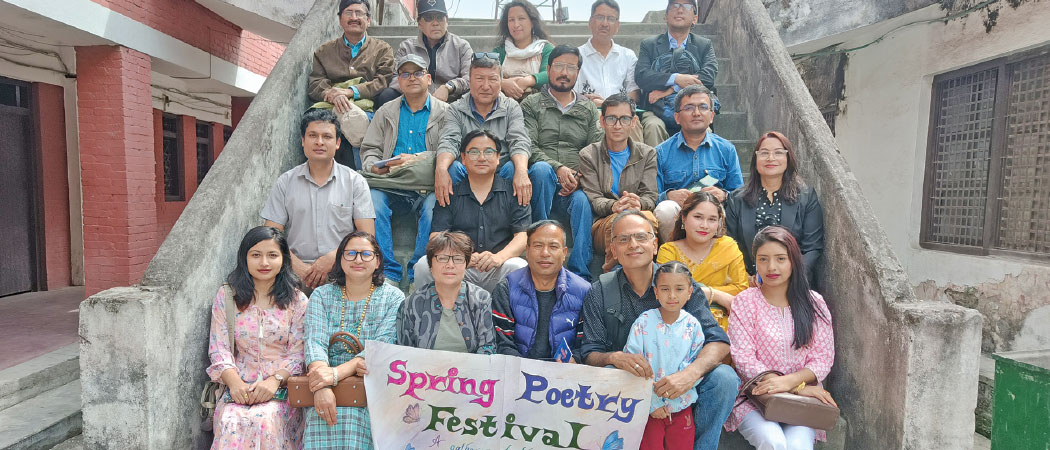

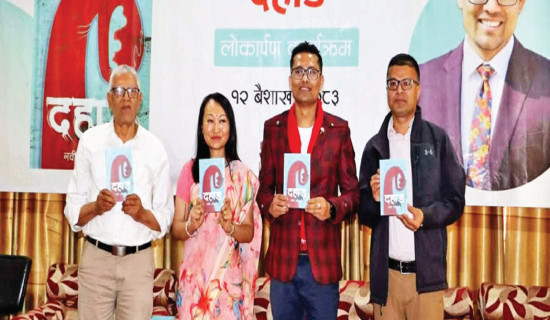
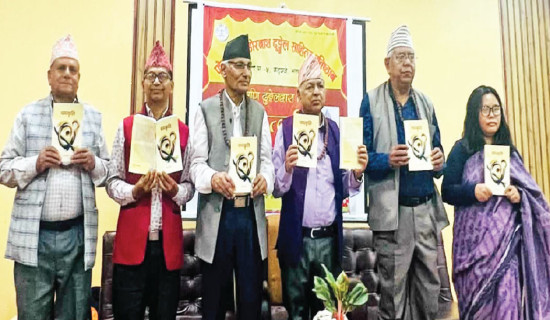
By A Staff Reporter,Kathmandu, Apr. 6: A 'Spring Poetry Festival' featuring Nepali poets reciting in English was held at the premises of Ratna Rajya Laxmi (RR) Campus in the capital on Saturday.
Organised by the 'Bartaman Kabita Samuha,' the festival featured Nepali poets articulating their original emotions and profound sentiments.
Chandra Bahadur Lama, the host and one of the organisers, stated that the primary objective of the event was to take the fragrance of Nepali soil and local experiences to a global audience by utilising English vocabulary.
Opening the session, Bishwa Sigdel shared that ‘Bartaman Kabita Samuha’ is planning to organise similar multilingual programmes in the future, marking this as their inaugural event. He delivered a stinging satire on modern civilisation and political hypocrisy through his poem 'Public Toilet,' depicting the irony of leaders who masquerade as saints after leaving the Parliament. Bhisma Upreti portrayed the sky as a symbol of faith and high aspirations in his poem 'What If the Sky Falls,' while Rajani Mila narrated the story of creative eyes waiting for hope in 'Darkness in Search of Light.' Expressing unfathomable realtion between love and sleep, Avaya Shrestha presented a reflection on the pain of losing love, sleep and homeland and the existential crisis in 'Love: A Meditative Sleep.'
Poet Suman Barsha explored the philosophical side of finding peace by letting go of sensory attachments in the poem 'Lose.' Similarly, Ram Gopal Ashutosh offered an optimistic vision of future equality and justice for marginalised figures in 'One Day the National Anthem Will Be Played For Me Too.'
The theme of resilience was further echoed by Karuna Nepal in 'New Beginning,' expressing the excitement of starting again after a period of despair. Poet Tenzin Emil Izam expressed anger and confusion over how flowers offered for peace are transformed into plumes of smoke and hatred.
Addressing environmental concerns, Subas Singh Parajuli depicted the tragic state of dying rivers and the encroachment of nature by the land mafia in 'Notice for the Loss of River.' Kripa Khanal recited a three-part poem, 'Looking for a Muse,' 'Breathing with the Muse,' and 'Lessons from a Muse'- focusing on urban inspiration and the art of 'flying' through life. Meanwhile, Bhuwan Thapaliya emphasised the cleansing of the soul through nature in the poem 'Spring.'
Anand Bijay Gurung highlighted how urbanisation is eroding natural beauty in 'Motorcycle Sayari.' Amar Aakash drew a raw picture of social injustice and the price of poverty in 'Everybody Knows, Nobody Knows,' and Rami Priya presented a beautiful take on liberating oneself from the enchanted spell of love in 'Enchanted Illusion.'
Moreover, Chandra Bahadur Lama questioned political betrayal and the broken promises of 'comrades' in his poem 'Question.' Dhir Kumar Shrestha reflected on the finality of life’s journey in 'The Call,' and Haris Adhikari shared a story of human grit through the metaphor of a sprout surviving harsh weather.
Following the recitations, the participating poets observed that art transcends language barriers, and English serves as a vital bridge to share Nepali sentiments with the global community.
-original-thumb.jpg)