- Thursday, 30 April 2026

MPs push governance reform
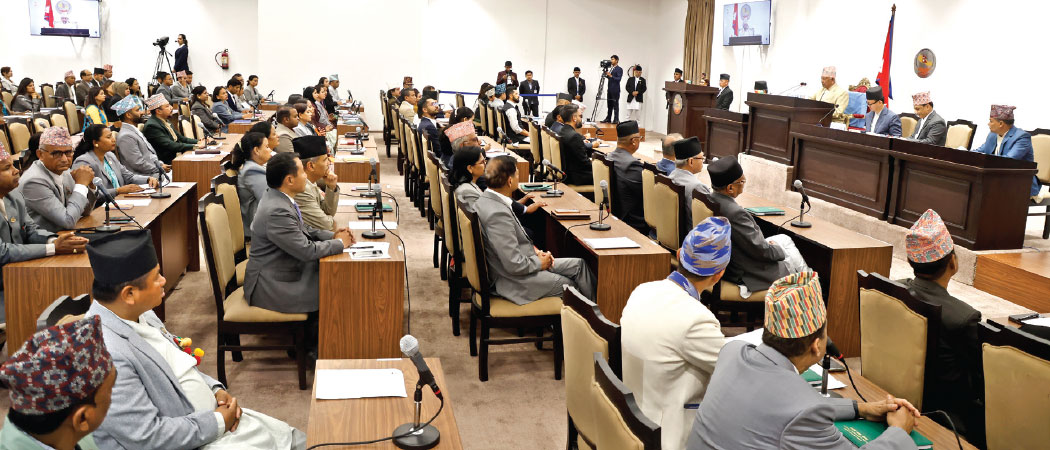

By Pallav Bhusal , Kathmandu, Apr. 3: The first meeting of the newly elected House of Representatives convened on Thursday, with party leaders and an independent MP highlighting governance reforms, accountability, and inclusive development.
Rastriya Swatantra Party President Rabi Lamichhane, addressing the Parliament, pledged a decisive shift from rhetoric to action, stating that the government would prioritise results over promises. “We all share the same goal, the prosperity of the country, and we will focus on that,” he said.
Lamichhane highlighted the public mandate as a clear demand for change and promised that his administration would pursue solutions rather than merely identifying problems. He highlighted that MPs would not face interruptions when raising issues, and that the government would work with urgency, counting seconds rather than days.
Lamichhane invited opposition scrutiny, urging parties to hold the government accountable continuously and warning against arrogance in power. He described the government as born of the Gen Z rebellion, and committed to structural reforms, improved governance, and robust support for the private sector. He assured investors that corruption and the influence of middlemen would be eliminated, with policies no longer treated as commodities.
He pledged equal access to education and employment, zero tolerance to violence against women, strengthened social security for senior citizens, and job creation through effective utilisation of domestic resources.
Lamichhane issued a formal apology to Nepal’s Dalit community for centuries of discrimination, calling caste-based segregation organised crime and promising justice, including compensation. He also acknowledged the sacrifices of Nepalis working abroad, urging them to invest in Nepal and committing to better working conditions at home while cracking down on exploitation and middlemen networks. Highlighting the importance of a strong opposition in a functioning democracy, Lamichhane stressed that Parliament should be a platform for debate rather than revenge. He further pledged to rectify past legal and political missteps and ensure transparency in domestic governance and foreign policy. He said that the government’s actions would speak louder than words.
Similarly, Nepali Congress MP Bhishma Raj Angdambe called for unity, accountability, and renewed public trust as Nepal embarks on a new parliamentary journey. He paid tribute to martyrs of the 1990 People’s Movement, the Maoist conflict, and subsequent uprisings, urging leaders to prevent future bloodshed and averred that, despite political differences, the country remains one.
Angdambe reaffirmed parliamentary democracy as Nepal’s shared path, noting that former opponents now sit together in the House. While congratulating the Rastriya Swatantra Party and Prime Minister Balendra Shah, he committed the Congress, as the main opposition, to support, advise, and caution the government where necessary.
He acknowledged public frustration but rejected claims that no progress has been made, highlighting achievements in roads, electricity, healthcare, communications, and financial services despite conflict, political instability, natural disasters, and the Covid-19 pandemic.
He also raised concerns over the September 8–9 incidents, which involved the destruction of key state infrastructure, urging the government to
conduct transparent investigations and ensure that no guilty party escapes punishment while safeguarding the innocent.
Angdambe called for long-term political stability, good governance, and social harmony to prevent future unrest, pledging constructive support while warning the opposition would challenge actions against the constitution or public interest.
Likewise, CPN (UML) Vice Chairman Ram Bahadur Thapa described his party’s electoral setback as a temporary defeat and a serious lesson, promising a constructive and honest opposition. He raised concerns about the violent incidents of September 8 and 9 during the Gen Z movement, questioning their purpose and alleging they were well-planned.
Thapa called for impartial investigations into public property destruction, arrests of senior leaders, and the use of students in unrest, insisting that accountability be ensured. While congratulating the Rastriya Swatantra Party on its miraculous electoral victory, he also recognised contributions from civil society, state institutions, and the media, paying tribute to martyrs who sacrificed their lives for national sovereignty.
Similarly, Nepali Communist Party Vice Chairman Barshaman Pun reflected on past failures, acknowledging that previous communist governments had not fully utilised strong electoral mandates. He recalled that the Maoist-led government after the 2008 elections, as well as the near two-thirds majority secured in 2017, fell short of meeting public expectations.
Pun urged the ruling party to treat these experiences as lessons, highlighting that electoral victory should not lead to arrogance and defeat should not breed resentment. He called for cooperation between the government and opposition in the national interest.
Pun also made clear that key constitutional achievements, including democracy, republicanism, and inclusiveness, must remain intact. He reaffirmed his party’s role as a constructive yet critical opposition, pledging support for policies promoting social justice, economic development, and job creation while urging the government to act responsibly and protect national independence.
Shram Sanskriti Party Chairman Harka Raj Rai Sampang proposed a transformative approach to governance, promoting the principle of one municipality, one industry; one house, one employment. He urged the government to legislate for public access to services, protect natural and cultural resources, end corruption, and implement transparent policies.
Rai highlighted urgent priorities, including providing legal ownership to landless citizens and squatters, ensuring equal pay for former Gurkha soldiers, and linking education with production, innovation, and technical solutions. He proposed a three-day academic and four-day practical work week for school children.
Rai also demanded accountability for the Gen Z movement incidents and called for investigations into the assets of ministers and MPs. He pressed the government to prioritise peace, security, healthcare, drinking water, and social welfare, including reviewing old age allowances and student organisations.
Stressing on national sovereignty, Rai recommended annulling any treaties detrimental to Nepal’s self-respect and deploying the Nepali Army to safeguard borders. He said that governance must serve all citizens, not only the privileged, urging lawmakers to act responsibly.
Likewise, Rastriya Prajatantra Party MP Gyanendra Shahi stressed that victims of cooperative fraud should be compensated from the property of the criminals responsible, rather than government funds. He called for action against embezzlers, transparent and accountable governance, and adherence to democratic norms.
Shahi demanded timely justice for high-profile cases, youth employment, citizenship rights for non-resident Nepalis, and attention to underdeveloped regions such as Karnali Province.
Similarly, independent MP Mahabir Pun pledged impartiality, describing his role as transcending party politics. Drawing on 33 years of social work and a brief tenure as Education Minister, Pun highlighted challenges in Nepal’s education sector, including politicisation, corruption, and interference.
He advocated depoliticising university leadership, removing the Prime Minister as university chancellor, and appointing qualified academics. He proposed a Science, Technology, Research and Innovation Fund to utilise domestic youth talent, combat corruption, ensure good governance, and allow overseas Nepalis to vote in the upcoming local and provincial elections.
The House meeting is scheduled for 11 am on Sunday, April 5.

-original-thumb.jpg)