- Sunday, 17 May 2026

Materialism, Consumption And Individual Identity

Materialism primarily relates an individual’s state of well-being to the material possessions that they own. It posits the meaning of action for human beings as the sole purpose of acquiring material goods. Materialistic consumerist rhetoric promotes the idea that the acquisition of material goods leads to happiness, thereby incentivising individuals to engage in consumption. Consumption and the act of purchase are directly related to the formation of identity in correlation with the purchased object. When an individual buys something that falls outside of the scope of need or if the purchase made is repetitive in nature, then an identification with the object of purchase can be said to have been made by the individual’s self.
On a psychological level, consumption and materialism can also be a coping mechanism. Such an orientation helps to alleviate anxiety and calm the nerves. Popular methods such as “retail therapy," which relates to the act of shopping to improve one’s feelings or moods, exist, which can be looked at as the outlet of a materialistic value-oriented society. Such value orientation decides the purpose of an individual's life and plays a crucial role in the formation of identity. On the other hand, the act of purchase can also have deeper psychological connotations. Individuals identify themself with the object of purchase, or they utilize the act of purchase to alleviate existing anxieties within themselves.
Objectification of relationship
Furthermore, such individuals are also more likely to engage in acts that are detrimental to the environment and ecology as a whole. On a human level, individuals with materialistic value orientations are more likely to objectify their human relationships. This means that such people are more likely to have a perception of relationships that lead to an end and do not view their relationships as an end in themselves. Ecologically, such people have been reported to have a larger carbon footprint and are also less likely to engage in activities such as recycling, which contribute to the environment’s overall well-being.
While a plethora of research has shown that excessive buying helps to ease negative feelings and entice positive feelings within an individual, it has other grave effects that escape the circumference of the narrative. Compulsive buying, which is an identified form of extreme buying, is found to have negative implications that far exceed the pleasure that buying provides. Such types of buyers are found to have a lower level of self-esteem, comparatively higher levels of depression, polarized mood states, and anxiety reactions. Among all the forms of extreme buying guilt, embarrassment at their low levels of self-control and financial difficulties are some drawbacks that can be traced.
However, despite the drawbacks that human orientation, such as materialism and consumerism, posits, society as a whole has been organised around the functions of materialism and consumerism. Governments around the world are concerned with the level of citizen participation in the general market as it directly corresponds to the flourishing of the economy. The economic health of a country is measured by metrics such as Personal Consumption Expenditures (PCE) and the Consumer Price Index (CPI), which take into account the involvement of the population in the goods and services market.
Taking social aspects of human society into consideration, materialism has been deeply rooted in cultural and social beliefs. Objects that cost more or are viewed as rare have been established as symbols of status, and a judgement heuristic that takes that into account has become ingrained in human beings. Furthermore, the pursuit of wealth has been instituted as one of the major purposes of human existence, and the general pathway of human life (birth, education, work, retirement, death) revolves primarily around the accumulation of wealth and expenditure of the accumulated wealth for goods and experiences.
Value orientation
As such, it is not possible to change such a value orientation of society, and even attempts at such a task are guaranteed to be futile. Ways such as media literacy about advertisement and digital propaganda go a long way in placing human values and society before materialism. The inclusion of media literacy into classroom curriculum would help youth to be aware about how various forms of propaganda function on a societal level. It teaches students not only about materialistic propaganda but also other manners of propaganda, whether they are political or social. On a personal level, there exist multiple ways for regulation for such orientation, which all revolve around the internalization of values and determining the priority of one’s life.
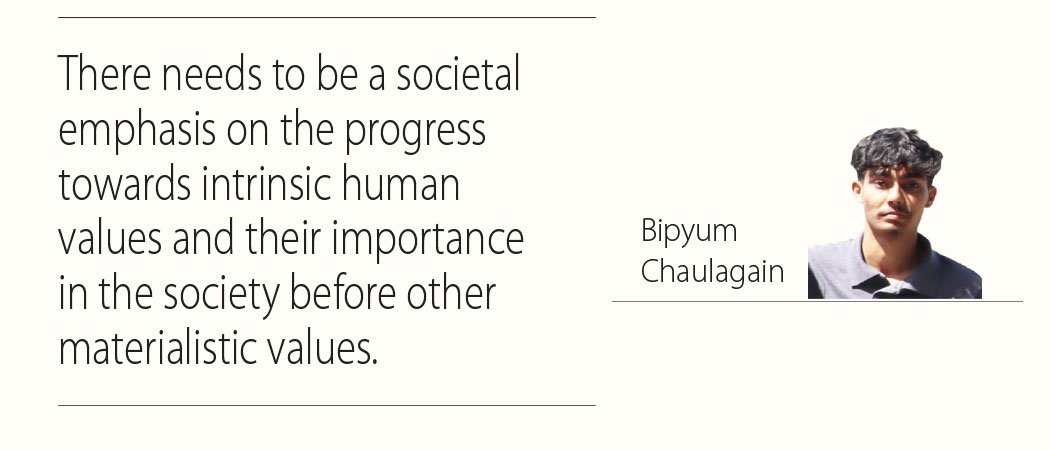
Furthermore, there needs to be a societal emphasis on the progress towards intrinsic human values and their importance in the society before other materialistic values. The moderation of working hours with more emphasis on personal development that is not directed towards the development of self in order to be more appealing to employers or job roles but towards the enrichment of the soul must be attempted by every individual. In essence, what society has offered human beings as the methods for coping with mortality and everyday hassles must be judged before the purpose and the essence of being a human being.
(Chaulagain is a psychology student at St. Xavier's College, Maitighar.)