- Monday, 1 June 2026

Tales From A Living Monument Zone
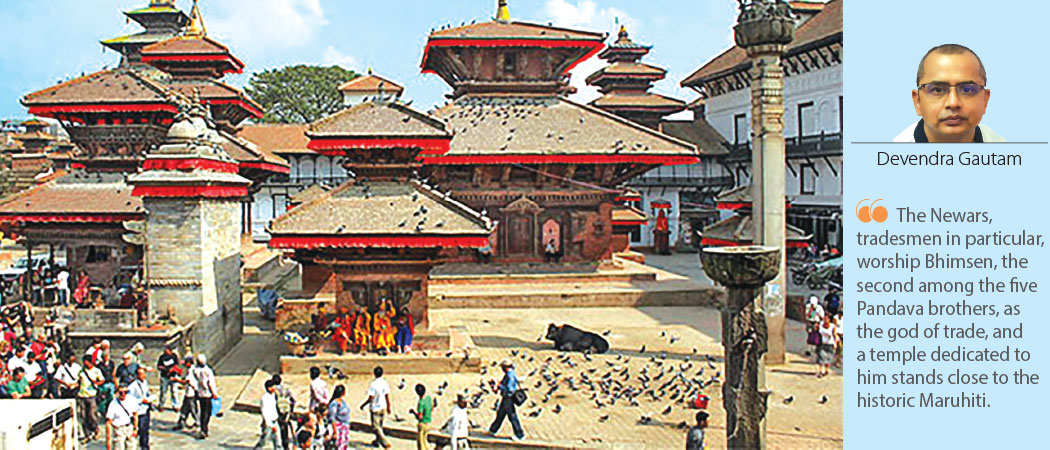

Criss-crossed by the Bagmati, Bishnumati, Manohara, Balkhu, Hanumante, and numerous other rivers and streams, the Kathmandu Valley, which was once a lake, has become one of the most fertile grain baskets and human settlements due to the draining of its waters, a feat attributed to both Manjushri and Lord Krishna, and is renowned globally for its tangible and intangible heritage.
Kathmandu borrows its name from Kasthamandap, a multi-roof mandap (pavilion), also known as Maru Sattal and Gorakhnath Mandir, located at Basantapur Durbar Square, which is a vital part of the valley and one of the four UNESCO World Heritage Sites (WHS) of Nepal—two cultural and two natural WHSs in Nepal. The other three are Lumbini (cultural), Sagarmatha National Park and Chitwan National Park (natural).
Long believed to be from the 12th century, 2015 post-quake excavations and radiocarbon dating have revealed that the foundation dates back to the seventh century. According to legends, Guru Gorakhnath once visited Kathmandu to witness the Machindranath Jatra, which is dedicated to his Guru, Machindranath. A tantric (Lilavajra) recognised Gorakhanth, caught him through his tantric powers, and asked him for a kalpavrikshya (a wish-fulfilling tree) for the construction of a sattal for religious purposes. Gorakhnath, after a bit of meditation, ‘produced’ a sapling and gave it to the tantric with instructions to take good care of it. Pleased, the Tantric and other locals started nourishing and watering the sapling regularly, and in due course of time, the sapling became a giant tree.
Wood carvers worked hard to build the mandap after felling the giant kalpavrikshya on an auspicious day. But it was proving to be a costly undertaking, and even the reigning monarch was unable to offer much help, goes the legend. Amid all this, craftsmen started a strike, demanding that the price of oil be made equal with that of salt so that they could work the nights too for early completion of the monument.
King Laxminarsingh Malla finally completed the pending project in 1596. The superstructure carved out of a tree along a bustling Nepal-Tibet trade route of the time was destroyed in the mag-7.8 Gorkha quake of April 25, 2015; it has since been renovated using Newari craftsmanship and without using nuts and bolts, thereby retaining the originality of the shrine. The monument has a statue of Guru Gorakhnath and idols of the four principal Ganeshas of the valley, including Ashokvinayak (Maru Ganesh), Suryavinayak (Bhaktapur), Jalvinayak (Chobhar), and Chandravinayak (Chabahil).
The divine judge
Bhairav is the enraged manifestation of Shiva, also called Mahadev, which literally means 'the greatest among the Devs (gods)'. The other names of Shiva are ‘Ashutosh’ — the one who becomes happy with devotees with little effort — Kiranteshwar (the god of the Kirants, an ethnic community from eastern Nepal) — and Pashupatinath, the lord of animals, whose ancient temple adorns Kathmandu, pointing towards a strong influence of animism in Nepal. Scriptures indicate that Shiva extends his compassion to all communities, including Dev, Manav (humans), Danav, Asur, and Daitya.
But beware! The kind deity becomes the deadliest force when frustrated. As the fire from his third eye can destroy the world, he is known as the Samharakarta (the destroyer) among the trinity, with Brahma and Vishnu shouldering the responsibility of the creator (Shrishtikarta) and the preserver (Palankarta). A massive image of Kal Bhairav adorns Basantapur, a living museum full of both tangible and intangible heritage. What brings Kal Bhairav to Basantapur? Let’s revisit a bit of history. Before its transformation into a major tourist attraction, this place used to be very much part of a palace, the palace of an empire called Nepal, during mediaeval times. Apparently, the palace in those times used to be the embodiment of the state itself.
Back then, people used to fear gods. During the Malla period (10th-18th century) and the Rana regime (1846-1951 AD), criminals were brought before Kal Bhairav for confessions, based on the belief that false confessions would cause the criminal to vomit blood and die immediately. We too have a compelling divine chief justice to ensure that justice is neither delayed nor denied, like Justitia of the Romans and Themis of the Greeks! The presence of the police HQ adjacent to the temple in olden times showed the rulers knew at least a bit of statecraft. In the course of time, people even found ways to outsmart the all-powerful divine CJ. There are at least two popular tales to this effect dating back to ancient times. One lore goes like this: police nab a man on the basis of some solid proof of his hand in a theft case and bring him to the divine court. Before recording his statement in front of Kal Bhairav and relevant officials, the accused requests that he be allowed to meet his mum one last time.
After their nod, the man rushes home and makes an unusual request to his mother: that she breastfeed him. What option did a mother have in a matter of life and death for her child?
Soon after, the man rushes back to the court and declares before the judge, the jury and the executioner: I swear to Mum that I have not committed any crime since my last suckling session.
And he walks free, safe and sound! In another case, a woman accused of a crime follows a similar tactic and walks free, according to the lore.
Kal Bhairav must have seen numerous instances, like these, of people lying through their teeth. The ingenious ways that people, including public officials, have developed to escape punishment make even the ferocious god smile, from ancient times to the present! Close to Kal Bhairav is a shrine where Swet Bhairav, with features like a jewel-studded crown, glistening teeth, large ears and eyes, makes a commanding presence with staff in attendance. Swet Bhairav also comes with an intriguing story.
In ancient times, the legend goes, a person used to go missing from the local community almost regularly and without a trace. Befuddled, locals suspected that the deity was to blame, and they decided to ‘imprison’ him behind a traditionally carved sun window. To the surprise of local communities, the vanishings stopped, according to the lore. These days, the faithful can meet the Lord, who is now ‘free’, during the daytime; offer Puja; and can even take selfies/wefies with him in the background. During Indra Jatra (Yenya) in September, revellers crowd his place to drink the homemade brew (rice beer) from the mouth of Swet Bhairav, fitted with a bamboo straw, hoping to get blessings, strength, and divine protection. You see, we have our very own Septemberfest, a divine one at that!
Maru Ganesh, living goddess
Ganesh must be worshipped first for any auspicious work to go smoothly. The deity is the son of Shiva and Parvati and the brother of Kumar. Devotees worship the son of Shiva-Parvati and the younger brother of Kumar (aka Kartikeya and Shadanan) as the remover of obstacles, and it is not uncommon to see ‘Shree Ganeshaya namaha' written at the beginning of books and scriptures, offering due respect to the lord. The heavyweight deity endowed with a large belly has a teeny-weeny mouse as his Bahan (vehicle), pointing towards siddhi (accomplishments), indicating that he can appear featherweight notwithstanding his size. According to scriptures, Ganesh penned down the Veda without a pause while Vedvyas (the divider of the Veda) narrated it nonstop after segregating it into four separate tomes: Rigveda, Atharvaveda, Yajurveda, and Samaveda.
In the valley, there are four principal Ganesh temples, and Ashokvinayak (popularly known as Maru Ganesh, located in Maru Tole) is one of them.
'Maru' in Newari means 'without' or 'does not exist', and the temple has no roof. According to lore, a local once saw a white mouse dancing at the base of an Ashok (Saraca asoca) tree in his dream, leading to the discovery of a self-manifested statue of Ganesh. Tuesday is the main day for puja, and an offering of 21 or 108 sesame laddus to the lord is believed to fulfil the devotees’ wishes.
Taleju is the guardian deity of the Malla kings, who ruled Nepal from the 12th to the 18th century. According to legends, Mahendra Malla, then king of Kathmandu, had a temple built for the goddess after the latter instructed him in a dream to build her shrine in the shape of a yantra. The superimposing, multi-roof monument stands on a 12-stage brick plinth, soaring to a height of 35 metres. The king ordered that no building in Kathmandu be taller than the temple. The shrine has withstood major quakes such as the mag-8.4 Nepal-Bihar jolt of January 15, 1934, and the mag-7.8 Gorkha quake of April 25, 2015, which left behind a massive trail of deaths and devastation. It is open to the public only once a year—on the ninth day of Vijaya Dashami.
There’s an intriguing tale about Taleju Bhawani and Jayprakash Malla, the last Malla king of Kathmandu, who ruled intermittently from 1734 to 1768 AD.
Jayprakash Malla was a devotee of Taleju Bhawani, and his devotion pleased the goddess. One day, she appeared to him in a dream and pledged to come every night as an ordinary woman to play pasa (a traditional gamble) with him in absolute secrecy. After that day, the card game went on, giving the king the rarest opportunity to receive divine blessings and advice on statecraft until one fateful day…
On that day, the king could not keep his eyes off the goddess, who was bedecked with jewels and fine clothes and was in all her splendour. Moreover, the king had forgotten to bolt the door, thereby offering Queen Dayavati an opportunity to see what was going on inside. While the queen flew into a rage, the goddess, sensing the ill intention of the king, declared that she will not come to play pasa with him anymore and parted with a curse that he will soon lose his throne.
The king tried hard to appease the goddess with penance, refusing even to take food for days. Moved, the goddess appeared in the king’s dream one day and said, 'As you have breached my trust, I will never come to you again.' Nonetheless, my representative will grace your palace.
You visit the city and look for a young girl from the Shakya clan, who smiles at you when she sees you. Install her as my representative and allow people to see her and worship her as the living goddess.
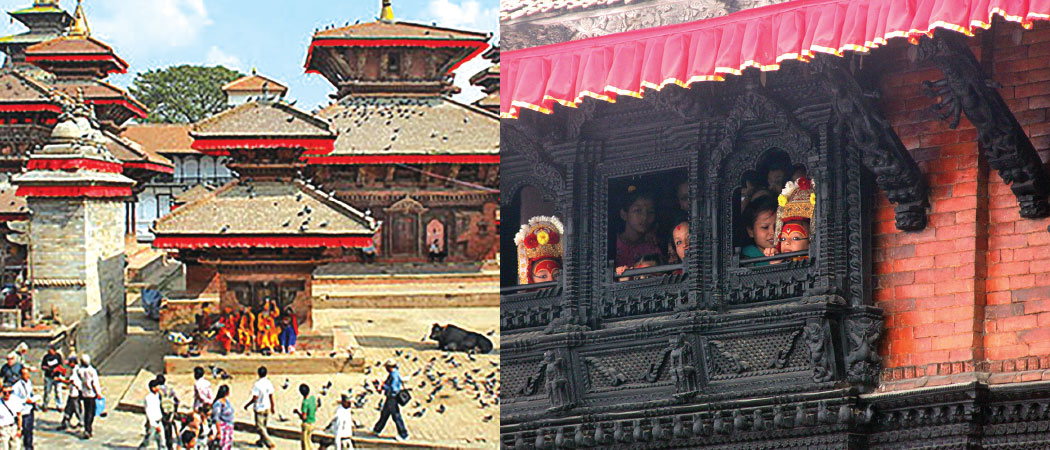
After the dream, the king hardly slept that night, and the very next day, he headed to Swayambhu but had no luck. While returning, however, luck smiled on him a little bit. On an open ground, a group of Shakyas were having a community feast. A young girl giggled at him, and when the king asked her why she was giggling, the girl said, 'You know the reason.'
The king had found the living goddess! He spoke with her parents about his dream and his plans. The parents became thrilled upon learning that the king and people would worship their child as a living goddess. The king built a separate house (Kumari Chhen, meaning 'Kumari House' in Nepal Bhasa) for the goddess at Basantapur and made arrangements for continuing with a tradition which, among others, demands that another girl from the select Shakya clan, whose birth chart is auspicious and in harmony with the birth chart of Nepal, should succeed as the Kumari before the incumbent’s period starts. Let’s conclude this piece with our very own poet king and a demigod of tradesmen.
King Pratap Malla, the ninth king of Kantipur, ruled from 1641 to 1674 AD and gave himself the title of Kavindra (the king of poets). His reign, though beset by personal tragedies like the death of his sons at a young age, marked a high in cultural and economic terms, characterised by extensive construction in and around the Durbar Square, including the Hanumandhoka Palace; installation of the giant statue of Kal Bhairav; construction of Kavindrapur near the Kasthamandap; construction of the Dakshinkali temple; and a trade monopoly with Tibet.
Among other footprints, the poet-king has left behind an intriguing multilingual inscription on a stone dedicated to the goddess Kali. The inscription at a section of the Hanumandhoka Palace features words from 15 different languages, such as Sanskrit, Nepali, Nepal Bhasa, Tibetan, Persian, Arabic, English and French, indicating that he was a polyglot. According to legend, anyone who can read the entire inscription will receive milk from the spout at its center!
The Newars, tradesmen in particular, worship Bhimsen, the second among the five Pandava brothers, as the god of trade, and a temple dedicated to him stands close to the historic Maruhiti. It is no coincidence that Bhimsen adorns a vital section of the trade route with Tibet, protecting national trade interests.
Basantapur—and the Kathmandu Valley—has many more fascinating tales to share, and they want to hear from you too. See you soon.
(The author is a freelancer.)