- Thursday, 30 April 2026

Air pollution remains a major public health issue in Nepal
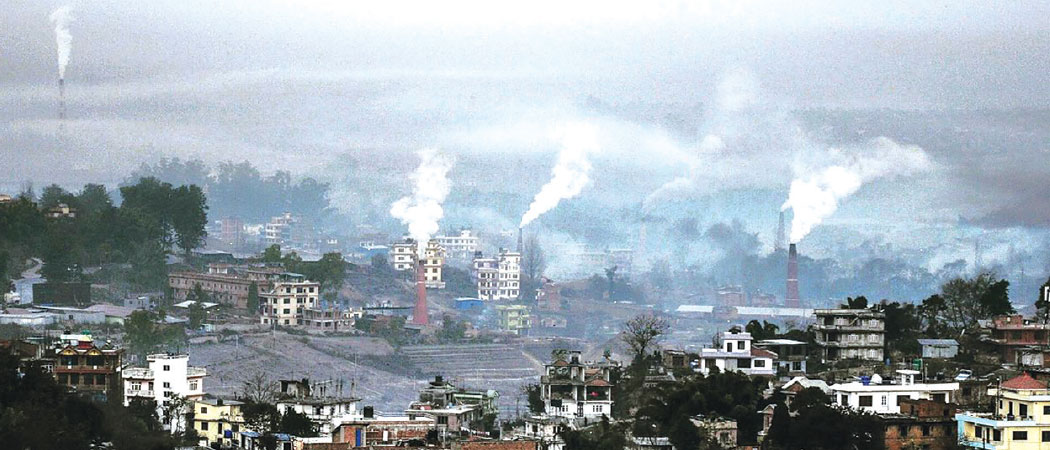

By A Staff Reporter,Kathmandu, Mar. 26: Air pollution continues to be one of the country’s most serious public health challenges, with the country consistently ranking among those with the worst air quality in the world.
According to the World Air Quality Report 2024, Nepal is the seventh most polluted country globally, with air quality levels far exceeding safe limits set by the World Health Organisation.
Key sources of pollution include vehicle emissions, industrial activities, construction work, open waste burning, forest fires and transboundary pollution.
Recent estimates suggested that air pollution is responsible for nearly 19 per cent of all deaths in Nepal, making it a leading risk factor for mortality and disability. The situation has shown little improvement in early 2026, with Kathmandu Valley and other urban areas frequently recording unhealthy to hazardous Air Quality Index (AQI) levels.
By mid-March, Kathmandu’s AQI hovered around 200-210, placing it at times among the most polluted cities in the world.
Health experts warned that prolonged exposure to polluted air can lead to respiratory diseases, impaired lungs development, asthma and other long-term complications. Children, the elderly and pregnant women are particularly vulnerable.
Speaking at a programme organised by Youth Alliance for Environment in collaboration with the Department of Environment and the Clean Air Alliance on Monday, speakers pointed out the severe health impacts of air pollution.
Prakash KC, Environment Inspector at Department of Environment, stressed the need for greater public awareness and long-term solutions.
“Air pollution is a year-round problem, but this season is particularly critical,” he said, adding that the recent rainfall had temporarily improved air quality.
Sagar Adhikari, an air pollution analyst at International Centre for Integrated Mountain Development (ICIMOD), said pollution levels typically rise in March and April due to increased combustion activities and forest fires. He warned that pollution could worsen in the coming weeks as fire incidents peak.
According to him, regional factors also play a role. Pollution from the Indo-Gangetic Plain -- spanning parts of India, Pakistan and Bangladesh -- often drifts into Nepal, worsening local air quality.
Dr. Anup Subedi, an infectious disease specialist at Kritipur Hospital, said that fine particulate matter (PM2.5) can enter the lungs, bloodstream and even the brain, increasing the risk of heart attacks, strokes and other serious conditions.
Air pollution is also linked to reduced life expectancy by up to seven to eight years, as well as increased rates of infant mortality, cognitive impairment and chronic diseases.
He also added that marginalised communities, including the urban poor, are disproportionately affected due to limited access to healthcare. He also stressed the need for stronger public engagement, particularly among young people.
Officials at the Ministry of Health and Population said that multiple factors contribute to the crisis. While advisories have been issued,
experts agree that long-term solutions must focus on addressing the root causes of pollution through stronger policies, enforcement and public awareness.
-original-thumb.jpg)