- Thursday, 30 April 2026

50 years after Argentina's coup, families still search disappeared members

Buenos Aires, Argentina, Mar. 24: Beneath a leaden sky in a municipal cemetery, relatives of Eduardo Ramos and Alicia Cerrotta carry the two urns containing their remains. They lean down to kiss the wooden caskets before resting them in a mausoleum in Argentina's northern province of Tucuman.
"We finally know where they are," one of them whispers.
The burial marked the closing of a 50-year wound. Eduardo, a 21-year-old journalist and poet, and his wife Alicia, a 27-year-old psychologist, were kidnapped by Argentine military forces in the months following the 1976 coup that ushered in a bloody dictatorship. Human rights organizations estimate 30,000 people were disappeared by the regime, while official figures place the number at around 8,000.
Following Argentina's return to democracy in 1983, the state prosecuted those responsible for the crimes. Yet, the search for victims' remains has largely fallen to relatives, activists and forensic experts.
The effort has been further hindered by the military's refusal to provide information about the victims' whereabouts and, more recently, by budget cuts to human rights programs ordered by libertarian President Javier Milei.
"Fifty years after the coup, 'where are they?' remains a very relevant question," said Sol Hourcade, a lawyer for the Centre for Legal and Social Studies representing plaintiffs in crimes against humanity trials.
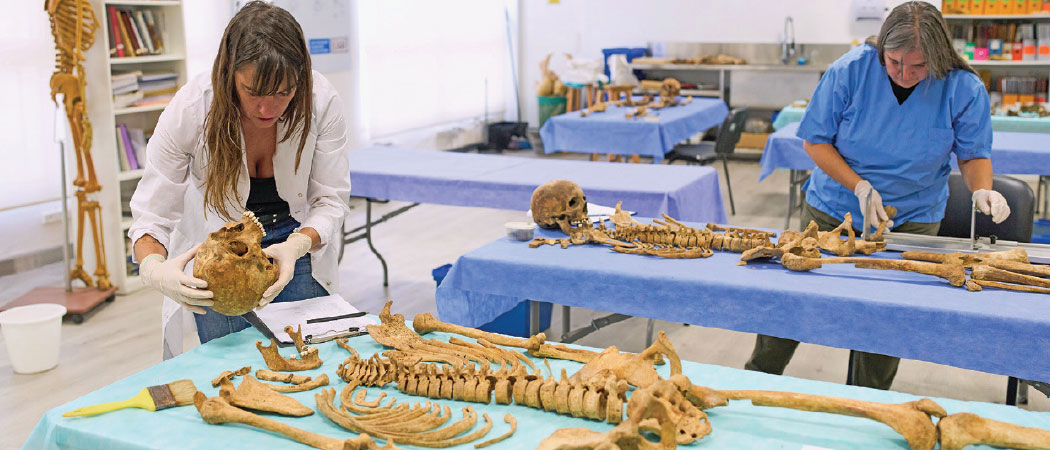
Eduardo and Alicia bore the label of the "disappeared" until 2011, when an independent team of archaeologists discovered their remains together with those of another hundred people in the so-called Pozo de Vargas, a nearly 40-meter-deep (130-foot-deep) pit once used to supply water to steam locomotives.
The military had turned the well into a mass grave, dumping the bodies of students, political activists and rural workers deemed subversive, and covering them with layers of earth, stones and debris.
The exhumation and identification process took years. In early March, authorities in Tucuman handed over the incomplete remains of Eduardo and Alicia to their families.
"When I saw the urns, I realized that for us this means a final farewell," said Ana Ramos, Eduardo's sister. She was 13 when she last saw him and buried him at 63. "People have no idea what it means when the remains are returned. At first, it's very overwhelming, but it's the most liberating thing that has happened to us."
Runaway inflation and escalating political violence by leftist and far-right armed groups paved the way for the coup against President María Estela Martínez on March 24, 1976. Martínez, the third wife of former populist President Juan Domingo Perón, ascended to power following his death, leading a country shaped by the populist movement he founded, Peronism.
A military junta led by Jorge Rafael Videla, Emilio Eduardo Massera and Orlando Ramón Agosti seized power. A defining feature of their rule was the forced disappearance of people deemed subversive.
"There was no other solution: we agreed it was the price to pay to win the war, and we needed it not to be evident so that society wouldn't realize," Videla told journalist Ceferino Reato in his final interview before dying in prison in 2013 while serving a life sentence for crimes against humanity.
Dissidents were abducted and taken to clandestine detention centres, where they were tortured and held in inhumane conditions. Many were later "transferred" — a euphemism for execution by firing squad or so-called death flights, in which prisoners were sedated, loaded onto aircraft and thrown alive into the Río de la Plata.(AP)
-original-thumb.jpg)