- Monday, 1 June 2026

Finance Minister Khanal emphasizes national capital formation
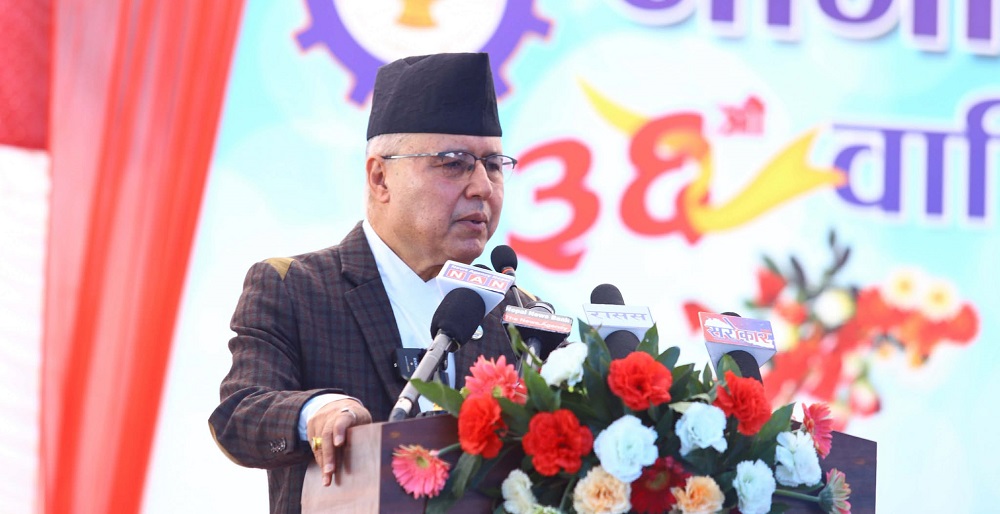
Minister for Finance Rameshore Khanal addresses a programme marking the 36th anniversary the Citizen Investment Trust (CIT). Photo: Keshab Gurung/TRN

Kathmandu, March 18: Minister for Finance Rameshore Khanal has stressed the need to mobilize liquidity into productive sector to build national capital.
Addressing a programme marking the 36th anniversary the Citizen Investment Trust (CIT), Minister Khanal said that there is plenty of liquidity in banking sector due to falling interest rates and thus pressed for channelizing liquidity into productive sector.
Highlighting the need to accelerate the large-scale infrastructure and long-term investment projects, Khanal informed that efforts were underway to promote mega projects such as Budhi Gandaki Hydropower Project through Public- Private Partnership (PPP) model.
He viewed that the idle capital should also be mobilized into productive sector.
Stating that ongoing tensions in the Middle East region could disrupt Nepal's supply chain, the Minister cautioned against the disruption could lead to inflation. Hence, he called for timely actions to reduce such risks.
Finance Minister Khanal noted, "At present, both the balance of payment and current accounts are in surplus and the government revenue has increased compared to previous fiscal year."
While economic indicators are improving, he highlighted the need to ensure that investors can easily access capital.
Calling for laws on alternative financing, he viewed that the taxation on various retirement funds should be reconsidered including lowering taxes on similar type of income and social security funds.
On the occasion, he lauded the notable business success achieved by the CIT at a time when many state-owned enterprises were facing operational challenges.
He advocated for seeking appropriate alternatives in accordance with the government's policy guarantee to recovery loans provided by the Fund to the Nepal Airlines Corporations.
Minister Khanal suggested that the CIT should be aware about risk management while considering investments. He added that it is necessary to issue long-term bonds for assets-liability management of various retirement funds.
Also addressing the programme, Tulasi Prasad Ghimire, Chairperson of CIT, mentioned that the CIT has been playing a vital role in promoting high and sustainable economic growth.
He also shared that the CIT has been successfully implementing various saving schemes and attributed the CIT's success to the guidance of regulatory bodies and the dedication of its employees.
Likewise, Parbat Kumar Karki, Executive Director of CIT, echoed the need to diversify the Trust’s investments.
He said that the funds collected by the Trust have been invested across various sectors: about 50 percent in fixed deposits in banks and financial institutions, around 22 percent in lending and loans and the remaining in shares of different organizations.
He warned that declining interest rates could reduce the CIT’s profits from fixed deposits. He also highlighted the risk of lower returns if investments are not further diversified.
Karki called for government support in expanding investment in infrastructure and other productive sectors. He informed that the CIT has expanded digital services to improve service delivery across all provinces.
He further stated that the CIT aims to establish itself as a sustainably profitable entity by strengthening internal governance, ensuring transparency and updating its accounting systems.
He also pointed out challenges in recovering around Rs 22 billion in loans provided to the Nepal Airlines Corporation, citing that these loans were issued under a government guarantee.
Similarly, Santosh Koirala, Chairperson of the Nepal Bankers' Association, advised the CIT to diversify its investments further.
He suggested exploring alternative financial instruments, such as bonds, instead of relying heavily on fixed deposits, which, he added, are affected by fluctuating interest rates.
Koirala presented the facts that the banking sector currently holds around Rs 7,700 billion in deposits, while bad loans amount to about Rs 5,800 billion.
In the current fiscal year 2025/26, the expansion of the banking sector is just around 3.9 percent and banks have recently been facing increasing difficulties in recovering loans. (RSS)