- Monday, 1 June 2026

Madhesi women prone to violence lack basic services
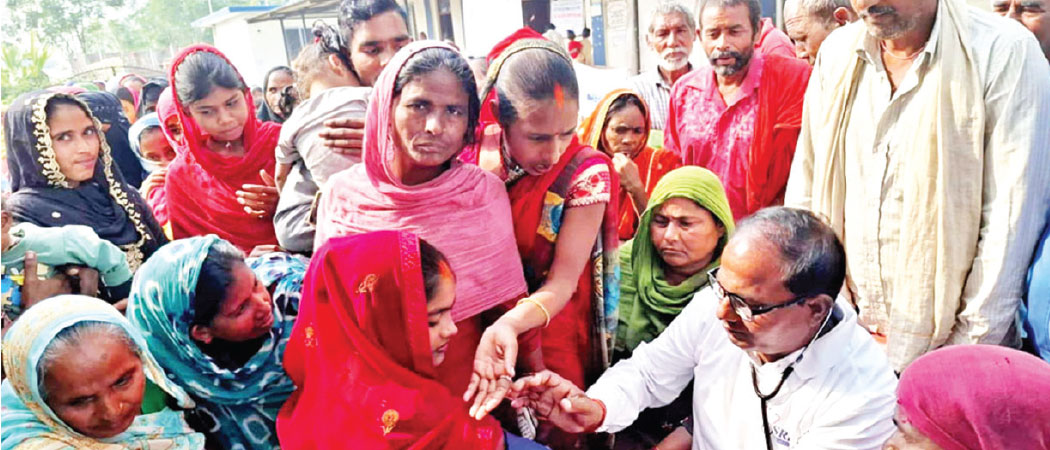
Madhesi women seen seeking health check-up service in this file photo.

BY LAXMI CHAUDHARY,Janakpurdham, Mar. 18: Although the law guarantees equal rights and freedoms to all citizens, women are still unable to fully exercise their rights in daily life due to social structures and traditional mindsets. As a result, not only women but also their dependent children are increasingly being deprived of basic services such as citizenship, birth registration, education, health care, and nutrition.
Vibha (name changed), a 37-year-old woman from Sarlahi, was married at the age of 15. Although her relationship remained normal for a few years after marriage, she later began experiencing increasing domestic violence. Because she did not have citizenship, she faced difficulties even in pursuing legal action to seek justice. It was only through the initiative of women’s rights activists that she was finally able to obtain citizenship and register the births of her children.
Similarly, Shanti (name changed) from Dhanusha, who was married at the age of 16, faced increasing violence after giving birth to three daughters in a row. Due to the lack of citizenship, she also encountered difficulties in filing a legal case to seek justice.
These incidents are just examples of the violence faced by women in Madhes Province. Many women like them continue to be deprived of their fundamental rights.
According to data made public by the Women’s Rehabilitation Centre in Madhes Province, a total of 183 cases of violence against women were recorded in the province during the three months from October to December 2025. Among them, the highest number, 141 cases, were related to domestic violence. In addition, there were 26 cases of social violence, eight cases of sexual violence, five murders, two cybercrimes, and one case of another type of violence.
According to OREC, most incidents of violence occur within the home and are committed by family members. Major causes include dowry-related issues, marriages arranged under family pressure and discrimination due to the birth of daughters.
The data also show that women affected by violence are deprived not only of physical and psychological safety but also of fundamental rights and basic services. According to the report, 107 women have been deprived of citizenship rights, 92 women have been deprived of marriage registration, 39 children have been deprived of birth registration, and 17 women have been deprived of basic nutrition and food support.
The centre stated that in the Madhes region, the practice of issuing citizenship to women only after marriage still persists. As a result, women affected by violence often remain excluded from legal protection, social identity, and access to justice.
Bina Kumari Singh, the provincial coordinator of the centre in Madhes Province, said that it would be difficult to control violence against women unless discriminatory attitudes toward women and harmful traditional practices were eliminated. According to her, although laws guarantee equal rights for women, these rights have not been effectively implemented in practice.
She also pointed out that when women lack citizenship and marriage registration, their children are unable to obtain birth registration as well. This directly affects access to basic services such as education, health care, and social security.
Singh emphasised that practices such as the dowry system, child marriage, mismatched marriages, and other traditional social practices are major causes of violence against women. She stressed the need for the state to take effective initiatives to end these practices.
She said, “Even though the law guarantees equal rights, social structures are preventing women from exercising those rights in practice. Therefore, the state must take active and effective measures to eliminate the root causes of violence and inequality.”