- Tuesday, 14 April 2026

Eagle Has Landed, Die Is Cast

Latest opinion polls indicate that only a quarter of the American public supports the war that their president has launched in coordination with Israel against Iran on February 28. Now just into the third week of the war in West Asia, the United States’ President Donald Trump finds his popularity dipping sharply, according to the latest public approval ratings.
The American public, including many Republican and Trump loyalists, has turned grim, as the joint US-Israel operations, codenamed “Epic Fury,” have not achieved their anticipated outcome. In desperate anger, Trump threatened the Tehran regime with the certainty of death and “annihilation” of stupendous scale.
In response, Iranian rulers have hit back with promises of serious “consequences” and rained missiles on US bases in Bahrain, Kuwait, the United Arab Emirates, Qatar and Saudi Arabia, among others, in West Asia. Fears that the attacks could widen and deepen in scale and territories have intensified. One of the immediate consequences has been a sharp spike in fuel prices.
There is a backlash, which worries Republican Congress people facing mid-term election in November for 535 seats in the House of Representatives and one-third seats in the 100-member Senate.
Very few nations have dared to speak openly against the war Washington ignited. Most of the traditional allies of the US remain vague in commenting on Washington’s war, which means they do have reservations but do not wish to incur the US president’s displeasure, publicly expressed with snide remarks that he is so familiarly known for.
Massive miscalculation
A critical Gulf energy source has been disrupted by a high-precision missile attack on a Saudi oil refinery. NATO and EU member Spain is not happy with the war breakout. Russian President predictably protested in strong words. China, too, thinks the attack flouts international law. The British House of Commons, the European Parliament, and the US Congress have witnessed their members criticising the attack on a sovereign, independent country against the United Nations Charter and other international laws.
As many American novels down the ages tell you, any plan or heist can go wrong with unexpected events and unforeseen twists to unfolding events. Trump’s miscalculation on a massive scale has backfired. Should the US get dragged in deeper, quite a few Republican leaders might choose to desert him during crucial voting in Congress. They fear defeat in the November mid-term elections. Losing the Congress majority in both chambers is a prospect that sends shudders down the spines of political careerists.
A nation of 90 million population and possessing the world’s fourth-largest oil reserves, Iran had withstood 45 years of Western sanctions imposed on Tehran’s alleged efforts at developing nuclear weapons. Despite the exalted image Israel projects for itself as an invincible “defence” system in the whole of West Asia—an “oasis of democracy” in a region of authoritarian regimes and semi-democracies, as Israel’s close allies would like others to assess—Iran has been able to respond with strikes and counterstrikes.
Hosting military bases of big powers is not without peril. Tehran, having targeted American military bases in other independent states, has created new fears for the countries leasing their territories for foreign military powers to operate.
The US maintains about 850 military bases in more than 80 countries across the globe on all continents—all for its sense of security and world peace. The government in Iran holds on and is drawing empathy among populations in its neighbourhood and elsewhere. In Pakistan, whose 30.5 million population out of a total of 250 million are Shia Muslims, tens of thousands of people held rallies the very next day after the war was triggered. In Kashmir and Yemen, too, similar sympathy is expressed.
The longer the staying power accompanied by matching firepower, Iran can expect to attract open respect from others for putting up with a superpower that four years ago pulled out in humiliating haste from neighbouring Afghanistan after 20 years of fighting. This would not bode well for the world’s No. 1 military power in every respect and, concurrently, the top global economy, too.
Trump’s deputy, JD Vance, was hyperactive in reiterating whatever Trump says and does and has said, with the hope of securing the president’s blessing for his quest for the Republican Party presidential ticket to the White House in 2028, has met with an early jolt: Trump’s sinking public approval. On display is a David-and-Goliath battle whose script, which invokes sympathy for a seemingly weak individual who handles a precarious task intelligently, is too clear for elaboration here.
Expanded parametres
The parametres of the war have expanded. Americans intensely fear body bags coming from the battlefields. Vietnam told a telling tale of this aspect of their public psyche. That is why presidents are against “boots on the ground”. Casualties are recorded in aerial strikes and naval battles, too, but engaging ground forces means meeting the enemy right in their home.
How far will Trump go in desperation if Iran manages to stretch the fighting for long, whatever its losses? Israel’s Prime Minister Benjamin Netanyahu, who has been hobbling for being questioned several times under investigation on corruption charges, too, will find his political ground shaking violently if the calculations that led him to convince Trump about going to war with Tehran claim too many American and Israeli deaths in addition to attacks on their infrastructures.
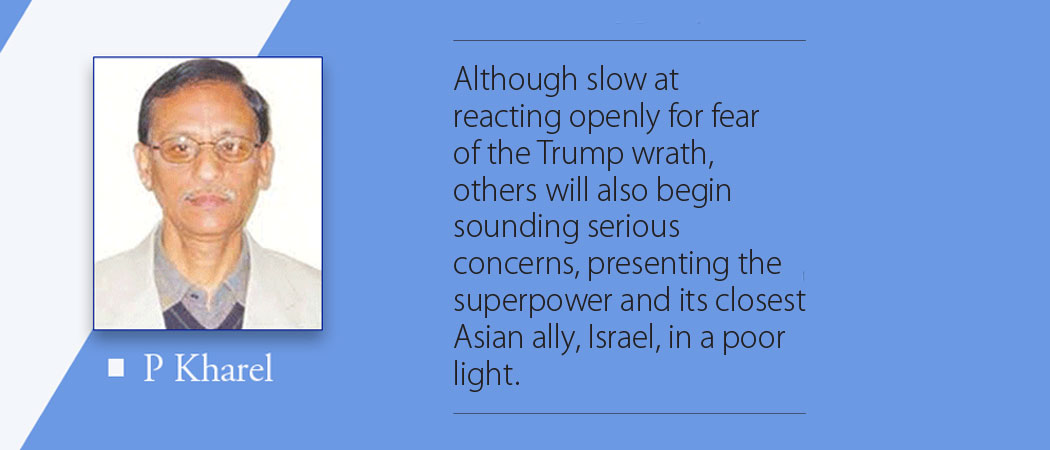
With the arrival of reports of setbacks and body bags, American public anger will rise. They will begin questioning whose war you are fighting and why, with what results? Empathy for the Iranians is growing in the Muslim world and elsewhere. In a stunning announcement on March 2, the UAE refused to give any airspace to the US to launch missile attacks on Iran. Although slow at reacting openly for fear of the Trump wrath, others will also begin sounding serious concerns, presenting the superpower and its closest Asian ally, Israel, in a poor light. If the setbacks are a series of humiliations for the military might of the US calibre, the sight would be pathetically long-lasting.
(Professor Kharel specialises in political communication.)