- Saturday, 2 May 2026

Morang mustard farmers facing losses
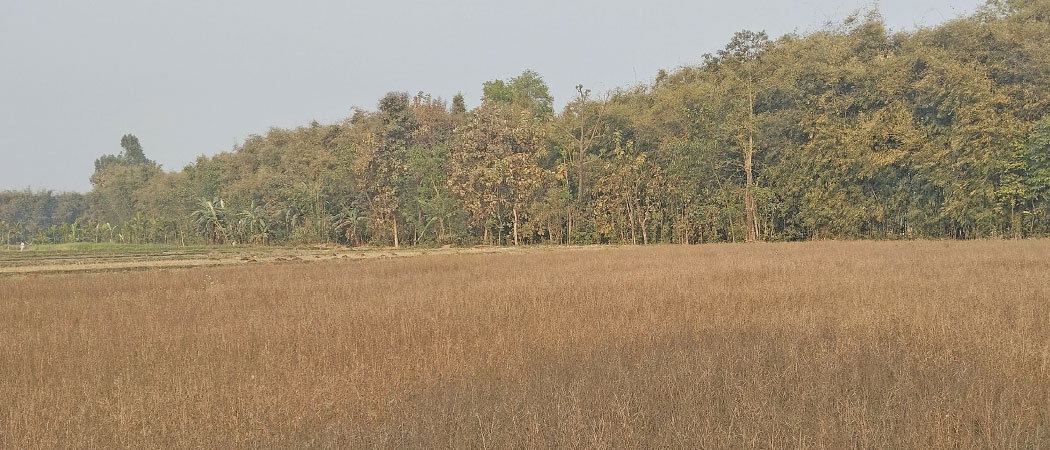

By Our Correspondent,Urlabari, Mar. 7: Farmers in Morang who cultivate mustard were unable to recover even their investment costs this year. After unseasonal rain in mid-October, farmers planted mustard late, resulting in a decline in production.
Mustard is intensively cultivated in Ratuwamai, Sunbarshi, Rangeli Municipality and Kanepokhari, Dhanpalthan Rural Municipality of Morang.
According to the Koshi Province Agriculture Directorate, farmers' interest in mustard cultivation has increased in Morang over the last three years. Both the cultivation area and productivity have been rising.
In fiscal year 2023/24, mustard was cultivated on 11,205 hectares of land in Morang. With a productivity of 1.20 tonnes per hectare, about 13,446 tonnes of mustard were produced.
In fiscal year 2024/25, mustard farming covered 11,214 hectares, and productivity increased to 1.30 tonnes per hectare, resulting in a total production of 14,578 tonnes.
In the previous fiscal year, the cultivation area increased by 10 hectares to 11,224 hectares. Productivity reached 1.31 tonnes per hectare, and total production rose to 14,704 tonnes.
As farmers began earning better income from mustard compared to wheat and pulses, governments at all three levels introduced subsidy programmes targeting mustard farmers in Morang.
However, this year farmers could barely harvest their crops.
Due to rainfall until mid-October 2025, the fields could not dry, which delayed planting, said Bharat Kumar Baral, a farmer from Kanepokhari Rural Municipality-6.
“Even the seeds could not be saved. Normally, about 12 mans (480 kg) of mustard would be produced from 12 kattha of land, but this year it’s not even worth mentioning,” he.
Baral spent Rs. 6,500 on fertiliser, seeds, and ploughing for cultivating mustard on 12 kattha of land.
Jarman Murmu, a farmer from Kanepokhari Rural Municiplaity–3, also suffered a major loss in mustard farming.
Murmu planted mustard on 15 kattha of land. Last year he produced 16 mans of mustard and sold it directly from the field at Rs. 5,500 per man. This year, however, he harvested only 5 mans of mustard.
“The fields were low-lying and the water had not dried up. After waiting for a long time, I was able to sow mustard only after mid-November,” he said.
According to him, even the investment could not be recovered after paying the landowner’s share under the sharecropping system.
In previous years, city residents used to visit farmers’ fields before the mustard even ripened to arrange advance purchases.
This year, however, Hem Chandra Bhandari of Kanepokhari–3 had agreed to supply 25 mans of mustard in advance, but he said even the seed could not be saved.
“Planting was delayed, and in December the fog damaged the crop before the grains developed,” he said.
Bhandari, who planted mustard on two bighas of land, said he suffered a loss of about Rs. 40,000 from mustard farming this year.

-square-thumb.jpg)