- Friday, 29 May 2026

Bridges To Nowhere: Monuments To Corruption

Nepal is perhaps the only country where bridges are built sans approach roads. This is the height of corruption, and the height of condonation. In other words, it is a mirror reflecting how corruption is entrenched in Nepal. Blaming politicians, bureaucrats, and constructors alone would be an injustice. The complicity of the people is unmistakable. Corruption survives not only because it is engineered from above, but because it is tolerated from below.
Nepalis have ransacked and burned government secretariats, courts, media houses, business enterprises, vital installations, and even private residences of ministers and senior party leaders—but have rarely staged sit-ins or sustained protest programmes against large-scale corruption scandals. Rage erupts swiftly, but it rarely settles on graft. Public fury finds targets, yet corruption somehow escapes becoming its central focus.
Financial misconduct
Some may point to the September 8, 2025, demonstration as a protest against corruption. Yet corruption was neither its sole nor its clear agenda. Sociologically speaking, Nepalis appear to have accepted corruption as an unavoidable factor of life. With as many student unions as political parties, and students traditionally regarded as the ‘aware’ segment of society, one must ask: why has overt corruption never sparked an organized movement? Why does moral indignation dissipate when confronted with financial misconduct?
Thanks to eroding ethics among politicians, bureaucrats, and businesspeople, combined with deep-rooted social acceptance and the tokenism of the Commission for the Investigation of Abuse of Authority (CIAA), corruption in Nepal has been flourishing almost unchecked. If trends continue, Nepal risks climbing even higher on global corruption rankings. According to Transparency International’s 2025 Corruption Perceptions Index, Nepal scored 34 in 2025—unchanged from the previous year—ranking 109 out of 183 countries. Stagnation itself speaks volumes.
In August 2022, a concrete bridge over the Daraundi River in Gorkha District, Gandaki Province, made national headlines. Intended to connect Ward No. 3 of Gorkha Municipality with Ward No. 5 of Siranchowk Rural Municipality, the bridge lacked approach roads on either side. Built at a cost of 53.9 million rupees, this structure stands as both a literal absurdity and symbolic indictment. A bridge without roads is not infrastructure; it is a theatre — an expensive performance staged with public money.
Soon after the news broke, the CIAA opened an investigation, as it often does when media exposure leaves little choice. Yet its record suggests a pattern: cases involving powerful figures frequently stall, and files gather dust. Investigations without convictions risk becoming rituals — procedural gestures that reassure the public while preserving the status quo.
Next come the two concrete bridges in Kathmandu — Teku-Kalimati and Min Bhawan-Tinkune. In 2014, Pappu Construction Pvt. Ltd. was awarded contracts under two separate packages to build four bridges in Kathmandu: Teku and Dallu under one package, and Tinkune and Bijulibazaar under another. All were to be completed by 2017.
Deadlines passed. Extensions followed. The Bijulibazaar Bridge opened in 2019. The Dallu Bridge followed in 2021. But the Teku Bridge ran into serious trouble. Kamala Bridge, incomplete for 14 years, tops the list. Government inspections found substandard materials, rendering the structure unsafe for vehicular movement. The bridge was closed over structural concerns, and vehicles remain barred. Authorities are still undecided whether to repair or demolish it — a hesitation that itself reflects institutional paralysis.
The core question lies here: if defects were so glaring, why did the Department of Roads not intervene at the outset, as it later did with the Tinkune Bridge? Why was construction allowed to proceed? Accountability cannot stop with the contractor alone. Officials who approved, overlooked, or ignored aberrations must also be held responsible. Public funds lost to defective projects should be recovered. Without visible consequences, corruption becomes a low-risk, high-reward enterprise.
The Tinkune Bridge presents an even bleaker picture. Contracted in 2014, it suffered from flawed design and negligent construction from the beginning. The Department of Roads halted work after identifying serious structural problems. Construction stopped in 2020 and has not resumed. Portions were demolished due to quality concerns. Today, two pillars and fragments of concrete stand exposed — monuments not to progress, but to administrative laxity.
These skeletal remains are more than eyesores; they are dangers. On October 1, 2023, a motorcyclist lost his life after falling into an open trench at the Tinkune site. Who bears responsibility for that death — the contractor, supervising engineers, or government authorities who allowed a hazardous site to persist? When negligence costs a human life, corruption ceases to be abstract; it becomes fatal.
Substandard works
Pappu Construction cannot evade responsibility for substandard works, repeated delays, and the economic losses imposed on the public through congestion and inefficiency. Yet the issue extends beyond one company. In a televised interview, the contractor claimed that payments had to be distributed from ministers down to local intermediaries, leaving only 25 per cent of allocated funds for actual construction. If even partially true, this reveals a chain of extraction that corrodes projects from inception.
If corruption operates vertically — from decision-makers to implementers — then scapegoating a single contractor does not solve the problem. The rot is systemic. It is embedded in procedures, normalized in practice, and shielded by silence.
A bridge is meant to connect two points. But these bridges connect something else: power and profit, negligence and impunity, public funds and private gain. They are not bridges to development; they are bridges to nowhere — suspended between promise and betrayal. Concrete pillars rise, yet institutional foundations sink. Until accountability becomes real, until public outrage focuses not on spectacle but on systemic theft, more such monuments will rise across the country.
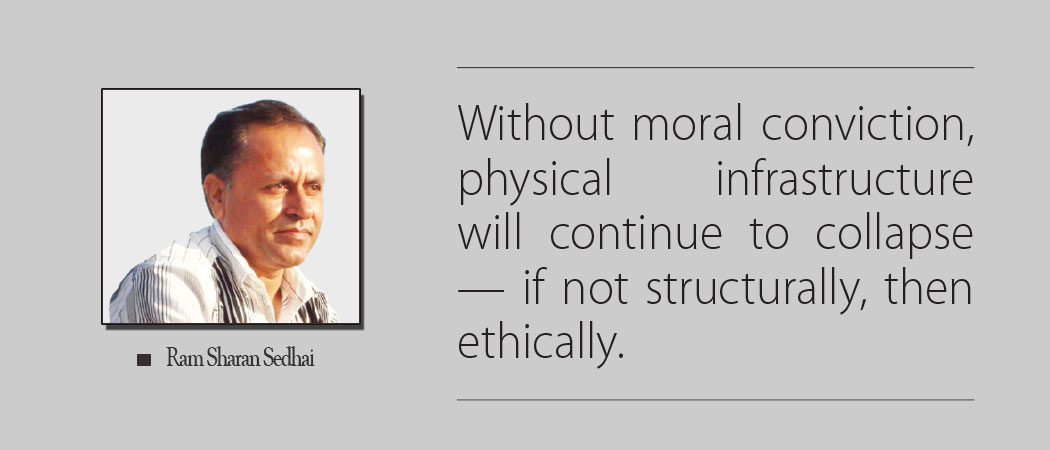
Nepal does not merely need stronger cement; it needs a stronger conscience. Without moral conviction, physical infrastructure will continue to collapse — if not structurally, then ethically.
(The author is a freelance writer.)