- Saturday, 6 June 2026

Why Voting Wisely Is Crucial In This Election

What happens when a generation decides that the elected government is no longer enough to bring change? That is what happened on Bhadra 23 and 24, 2082 BS, in Nepal—when an elected government was overthrown through the Gen Z movement, placing the nation at a critical juncture in its history. The country is now in a parliamentary election mode. This election has come at the cost of many young lives and the destruction of billions of dollars of property. In this context, the movement carries important messages for this election—calling for justice, leadership change, prosperity, good governance, the eradication of corruption, and other reforms.
Given this backdrop, it is high time for us to think seriously about whom to vote for. Franklin Delano Roosevelt, the 32nd president of the United States, famously said, “Democracy cannot succeed unless those who express their choice are prepared to choose wisely.” As Roosevelt said, the election season is when we vote wisely. This election cannot and should not be treated as casually as past elections. We must approach it with heightened caution and a critical mindset.
Election manifestos
At this stage, political parties have released their election manifestos, once again promising that, if elected, they would accomplish a long list of things. Likewise, candidates are sharing big dreams and hopes without actionable and feasible agendas. It appears that most political parties have agendas on health, education, security, employment, brain drain, industrialisation, agricultural development, improving bureaucracy, corruption, sports, environmental conservation, ethnic and gender issues, social justice, and inclusion. However, this list is not new or particularly innovative since all of these areas already appear in the constitution.
Therefore, one of the most important things for the public to consider is whether the parties’ agendas are genuinely actionable or merely lip service. We should not be swayed by popular ideas, emotional speeches, or catchy slogans. Instead, we must critically examine whether the proposed agendas are realistically achievable within the nation’s economic strength, labour capacity, and institutional capability—and within the time frame the elected candidates will serve.
What concrete strategies and processes do they have to address the major scams that have emerged over the years, including the recent cooperatives scandals? If processes are missing, we must recognise that they are simply trying to persuade us for votes, without any genuine vision and strategies. Similarly, did they explain how they will accomplish their goals—consulting available experts and engaging the public, identifying priorities, securing resources, implementing programmes effectively, and ensuring results through regulations and accountability? If none of these elements are articulated, then their agenda is not a roadmap—it is merely rhetorical manipulation and populist rhetoric.
Likewise, we need candidates and party members who value civility and humility, not those who use incivility, intolerance, character assassination, and mockery as their weapons. Such candidates are driven more by ego, hostility, and a punitive mindset than by creativity and collaboration. Many today focus on mocking, attacking, spreading intolerance, and circulating misinformation. There are respectful ways to show disagreement, but although many are literate, they do not seem literate since they do not practice honest discussion, and candidates often spend more energy cursing opponents than offering solutions. Do you want to vote for them, or for those who are decent, tolerant, respectful, humble, and difference-friendly?
Moreover, simply creating employment, providing health services, offering education, establishing industries, and increasing the nation’s wealth will not automatically make people happy. We must ask: What actually makes a nation happy? The slogan should not only be about making the country rich, but also about building an ethical society, establishing peace and stability, and ensuring the well-being of individuals. Do they have a vision to revive our ancient knowledge and practices, or are they simply promoting Western materialistic dreams?
Furthermore, promising that the state will do everything for everyone is unrealistic and, even if possible, not always desirable. What matters is how the government helps people become independent, responsible, ethical, civil, and accountable human beings. Do the candidates have strategies for this? Until we improve our civility, no matter what efforts leaders make, they cannot succeed, and we cannot build a just and peaceful country.
In addition, prosperity and development without social justice are not development at all. Building streets, hospitals, schools, courts, and playgrounds is essential, but not enough. Almost all parties raise the issue of social justice and inclusion. However, do they have strategies to promote social justice and inclusion in a real sense for the people who need it most? We must carefully judge their current and past actions in it. In the name of inclusion, they might create discourse led by elites and validate only their needs.
Geopolitics
Beyond domestic concerns, Nepal finds itself in a position where global geopolitics directly affects the nation. We need leaders capable of balancing geopolitical pressures, maintaining a farsighted vision, taking principled stances, and defending the country’s interests without fear or greed. Therefore, we must carefully examine who can truly balance these relationships. If we cannot maintain effective diplomacy, the country can easily be pulled into instability.
Reflecting on leadership, James Freeman Clarke wrote, “A politician thinks of the next election. A statesman of the next generation.” Now we need statesmen and must vote for them, even if we philosophically align with a different party. As responsible citizens, we should vote with discernment. If we believe they can genuinely represent the public, amplify ordinary voices, and act as vigilant watchdogs in Parliament, they deserve our vote. Yet we must recognise that only a few leaders meet this standard.
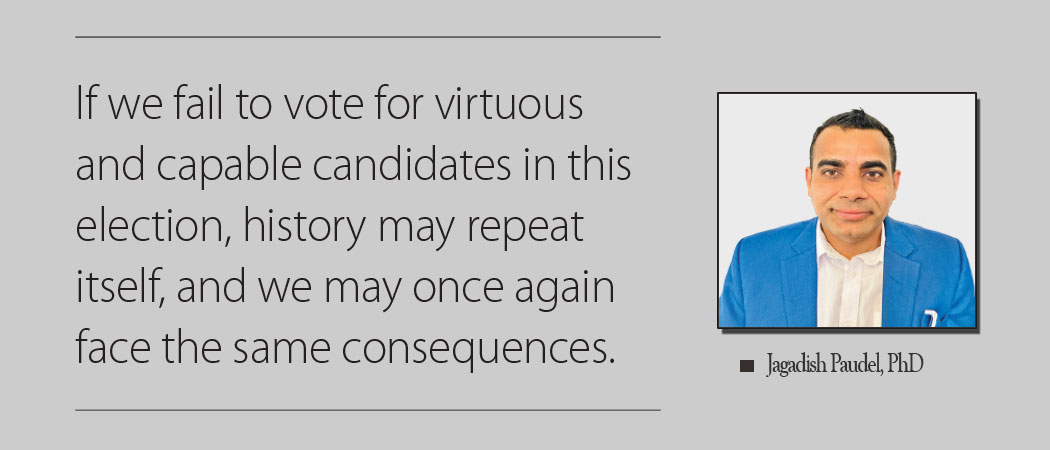
If we fail to vote for virtuous and capable candidates in this election, history may repeat itself, and we may once again face the same consequences. Do we want to repeat the mistakes of the past and continue to suffer, or do we want to build a more hopeful and prosperous future for our country? The choice is ours.
(The author is a Postdoctoral Fellow in the English Department at Clemson University, SC, US.)