- Saturday, 2 May 2026

Agriculture At The Poll

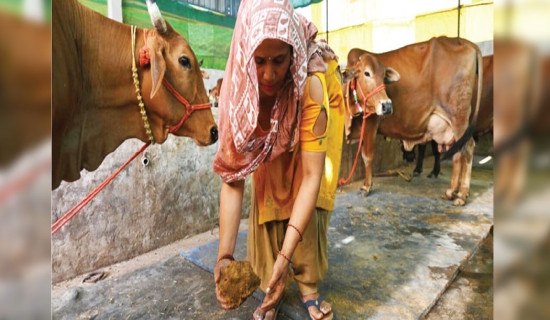
Nepal is an agrarian country with over 50 per cent of its population engaged in agriculture. Yet, the agricultural sector (agriculture, forestry, and fisheries) contributes less than 25 per cent to the gross domestic product. This stark disparity shows deep structural weaknesses in what remains the primary occupation of the Nepali people. Lack of irrigation facilities, unavailability of fertilisers during the planting season, dependence on traditional farming methods, and a shortage of farmworkers are the main problems plaguing the sector. Successive governments over the past four decades have emphasised the development of the agriculture sector in budget speeches, yet no substantial improvement has been achieved.
Although agriculture is the main occupation, it provides only partial employment to a large section of farmers. A country that exported food grains until the late 1980s now imports them to feed its people, mostly exceeding the country's total export. According to the annual trade statistics of the Department of Customs, the country imported agricultural products worth Rs. 394.86 billion in the last fiscal year (2024/25) alone, while the import amount was Rs. 256.75 billion in the fiscal year 2023/24. Irrigation facilities have covered only 43 per cent of the total 3.5 million hectares of cultivable land, and merely 17 per cent of that enjoys year-round irrigation facilities.
As the country heads towards elections to the House of Representatives, major political parties have once again pledged to modernise agriculture and make the country self-reliant in food production in their manifestoes. From the Nepali Congress to the CPN-UML, the Nepali Communist Party, the Rastriya Swatantra Party and the Ujyalo Nepal Party, all of them have promised to transform farming, achieve food self-sufficiency and restore dignity to those who till the land. The Nepali Congress, the oldest party of Nepal, has proposed an 'Agricultural Investment Decade', pledging fixed budget allocations across the three tiers of the government, establishment of a fertiliser factory in the Tarai, buffer stocks, land banks and concessional credit. Its manifesto highlights storage facilities, cold chains and market stability.
The CPN-UML stresses commercialisation through large-scale agribusiness led by entrepreneurial youth, supported by subsidised public land leases, agro-processing zones and export-oriented organic branding. Likewise, the Nepali Communist Party prioritises legal restructuring and irrigation expansion, targeting 80 per cent irrigation coverage and completion of national pride irrigation projects. The Rastriya Swatantra Party (RSP) has framed agriculture as the backbone of economic reform, promising policy stability, transparent subsidies, reliable insurance systems and technology-driven productivity. Meanwhile, the Ujyalo Nepal Party has advocated direct digital grants, free irrigation electricity, and a rapid shift towards organic farming, backed by guaranteed procurement at premium prices.
These manifestoes clearly show that party leaders understand the sector's problems. Three of these parties have alternated in power for more than a decade and a half without delivering meaningful reform in agriculture. Farmers still depend on monsoon rains to cultivate their lands, and fertiliser shortages remain a recurring crisis. Year-round irrigation facilities, timely availability of fertilisers, and mechanisation could transform the sector. The solutions are neither new nor mysterious. Election after election, political parties make lofty promises to woo voters, only to abandon them once in office. The Nepali farmers want an end to this trend so as to realise their dream of a prosperous Nepal.