- Tuesday, 26 May 2026

Dalit Issues In Election Manifestoes
 Sushil Darnal
Sushil Darnal
Sushil Darnal
There is an election atmosphere in the country. The country is engrossed in preparation for the House of Representatives (HoR) election scheduled for March 5. Most of the political parties participating in the election have made public their election manifestos. A total of 68 political parties are in the fray. With the country all set to hold the election, almost all political parties have included Dalit issues in their manifestos.
The major political parties - Nepali Congress (NC), CPN-UML, Nepali Communist Party (NCP), Rastriya Swatantra Party (RSP) and Rastriya Prajatantra Party (RPP) - have all repeated the slogans of 'Dalit representation' and 'end of untouchability'. These sound great, but they are repeated ones. These issues are lifted as they were from the previous manifestos. In its 'resolution paper', the oldest and largest Democratic Party, the NC, mentioned, "Dalit people will have representation in and access to the party and in each state mechanism along with social justice." It was what the party wrote in its previous manifesto in 2079 BS.
In a sheer mockery of the election manifesto, the NC had only five Dalit leaders in the dissolved HoR. Worryingly, no Dalit leader was allowed to be a minister either. Elimination of untouchability was the issue that got space in the manifestos in the elections of 2064 BS and 2070 BS. While the verbal commitment of the party on Dalit rights stated such, the nation did not cease recording inhuman cases of Dalit rights violations.
Since the enactment of the Caste Discrimination and Untouchability (Crime and Punishment) Act, 2068BS, 17 Dalit persons were killed for using the drinking water that the so-called upper caste consumed and for doing inter-caste marriage. This data was maintained by the Samata Foundation, an organisation working in the sector of Dalit rights, including research and publication. The apathy of State and the political actors alike have forced Dalits' displacement and exclusion.
Similarly, the UML's election manifesto stated that Dalits would be protected, their rights to a dignified life ensured and caste discrimination and untouchability would be ended with the promotion of social justice. These were mentioned in its previous election manifestos. Against the written pledges, the UML limited Dalit members' entry to a single seat in the last HoR. It failed to ensure a Cabinet ministry to Dalit leader of its party. The last Cabinet representation from the party was no different for the NCP either, for it too practiced contradictory behaviour.
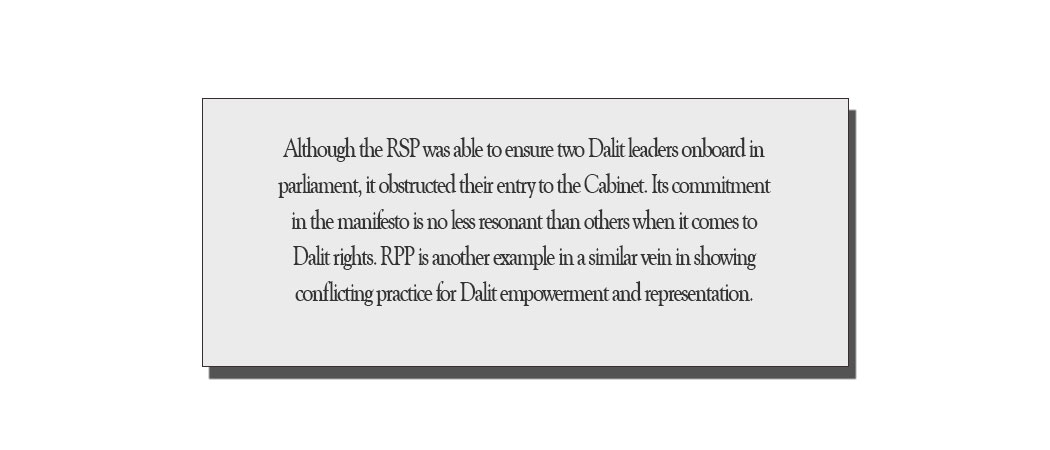
Although the RSP was able to ensure two Dalit leaders onboard in parliament, it obstructed their entry to the Cabinet. Its commitment in the manifesto is no less resonant than others when it comes to Dalit rights. RPP is another example in a similar vein in showing conflicting practice for Dalit empowerment and representation.
It is worth noting that there are six Dalit leaders in the National Assembly at present, while 16 in the dissolved HoR, 30 in province assemblies combined, 2.11 per cent in civil service, one per cent each in the judiciary and foreign relations service. Such representation is 4-9 per cent in political parties. However, the Dalit people make up 13.4 per cent of the country's total population. Still, 42 percent of Dalit people are below the poverty line. Don't these facts expose the gap between promises and implementations on Dalit rights? It is now time to translate words into action. Are our parties ready for it?