- Tuesday, 26 May 2026

Youths Push For Intergenerational Justice

The public debate about the weight of youths and their Thymotic desire for the recognition of intergenerational justice is shifting Nepali politics from privilege to concern. With every watershed political change across various phases of Nepali history, youths have shown indefatigable courage in speaking and acting against the regime and have played a frontline role in advancing democratic progress. But the serendipity of youthful energy for political change soon dissipated after the top leaders of political parties assumed the commanding height of politics and held the reins of power through the stratagem of various kinds —formation of united front, building coalition government, electoral adjustment for winning game, control of all-party committees in command and control of governance and construction of personalised syndicate rule without adequate deliberation in the party’s central committees.
This stratagem has dashed the hope of young leaders to climb toward dignified space. Now Nepali youths require civic maturity to prevent the downward plunge of their achievements into capricious politics, unable to address profound challenges on nearly every side and acquire the art of governance, not to foster elite privileges of pre-revolt status and impunity. The recent government change following the youth revolt moved politics beyond the constitutional status quo. Yet the habit to rear national polarisation among those favouring elections and those opposing it stays.
Deep fissures
As a result, it bred deep fissures between the government and various forms of opposition, rancorous disagreements and disillusionment in the political parties of all hues, thus creating a suffocating milieu for leadership transition. Circulation of aspiring leaders in the political power of every generation is vital to bridge generational divides and terminate the state of state-society disequilibrium. The reappearance of youth in politics has marked the beginning of flux in party politics of left, right and centre, shifting loyalties of voters’ party line and growth of new parties representing youth and spectacle of leadership changeover. It has smoldered a commotion in the social and political landscape.
What is untouched and common in the flux is rightward consensus on consumerist economic policies, which is not compatible with the social spirit of the constitution, nature’s resilience, the public-spirited nature of people and the need of ordinary folks to satisfy their livelihoods. The striking resurfacing of Nepali youths in the political sphere has drawn national and international attention and appealed to a broad swath of multi-partisan Nepalis. But it has hardly helped them to form a coordinated, tangible common identity, solidarity, common ground on rightful public policies and elections and resolve the dilemma of effective cooperative action in matters of vital national interests.
Youths, riven by division and dissonance, have barely shown how to lay a coherent intellectual groundwork of a re-imagined Nepal with nationwide outreach, harness the rich heritage of social and natural capital and educate rural people into active citizens. Though hardly occupying vital government positions, they are divided between those conforming to the government’s policy to hold parliamentary elections on March 5 and those who demand the immediate fulfillment of their demands of rooting out grand corruption and penalisation of the culprits for killing youths and leaving vital infrastructures in ruins.
Their inability to build associations might put them in the original position when they started their revolt, notwithstanding their incessant struggle for bargaining with the government for reconsideration of their legitimate concerns to shape a spotless national future. Though parliamentary elections can provided a veneer of legitimacy for leadership and majority rule of government to be formed after the national election, the acrobatic nature of leadership without any sense of long-term vision for nation building other than flamboyant oratory, catchphrases and unachievable goals can easily inflame the emotion of cadres and the general public, not stabilise their conduct for a sane order founded on cognition, prudence and reason, not only emotion, instinct and passion.
The links of Nepalis to multiple channels of communication and alternative institutions of political participation outside the frame of political parties, from civic activism to associational solidarity and social movement of cause groups has expressed the torrent of demands and politicized Nepalis, turning them assertive and articulate. The disappearance of fear has prompted Nepali youths to assert popular sovereignty. They are less conditioned to expect an undesirable outcome of governance. The penchants of leaders to demonstrate unthinking crowd and collusion with interest groups against the power of digital platforms shaped by the inexorable acceleration of science, technology, innovation and information, personal political consciousness and multiple network- based participation have unfathomable effects on the political life of Nepal.
Skill-based technological change has snowballing gust on the behaviour and institutions of people. At a time when senior leaders of political parties are torn between the necessity of electoral alliance to win elections and the history of betrayal of each other, the reality of politics unveils that they only tumble down on one another. This is defying the possibility of electoral adjustment and turning the electoral outcome uncertain. Given Nepal’s proportional election system and fragmentation of the electorate, it may impose discomfort for any party to score a majority or form a future coalition government able to optimally satisfy the causes of the reappearance of youth in muscular form. Several considerations are attached to it.
First, the strong reappearance of youths in politics has corroded the political base of old leaders, founded on disproportional resource allocation to electoral constituencies to increase their competitive advantages against potential new leaders. Second, the revolutionary ideological posture of old leaders has lost its appeal. It bred its counterrevolutionary platform, where each cancelled the efficacy of the other and provided space for pragmatic politics. Third, the power lust of leaders beyond performance and the spirit of the constitution have turned politics personality-oriented and caused institutional dysfunction in terms of promoting fairness, sharing values and promoting national unity.
Fourth, the politics of patronage competing for spoils has frustrated the patience and hope of aspiring youths for leadership positions. Fifth, leaders blurred the boundary with business, interest groups, deep state agencies and civil society, thus intensifying the anguish and disapproval of youths who demanded freedom, anti-corrupt governance and justice. Finally, partisan allocation of all constitutional and public posts among the government partners affected their autonomy, integrity, credibility and impartiality in serving the people beyond self and generalized trust of Nepalis in governance.
Subversive radicalism and affinity to visible grand bazaars of “invisible hand” rooted in rugged egoism only hoarded profits from politics and failed to exonerate Nepalis from their alienation from national sovereignty. They have successfully clientalised youth to the lure of the global labour market and opened the door to postmodern identity politics. Collusion with organised interest groups has dehumanised the poor, devoid of the national life of “we citizens”, motivated to support public goods. Both represent the elite revolt against the egalitarian impulse of democracy, the solidarity of the demos and national self-determination.
Nepali constitutional vision of freedom, justice and dignity of people, equal rights for all under law, basic education, health and work, etc., and civic competence for political participation in voting and decisions have thus suffered a reverse gear. Perfection of the civilised life of Nepalis requires the peaceful art of living and action, not the crisis socialisation of youths for their irrational action. The political task for Nepali leaders is to create possibilities within the nation for a fulfilling life. Growing awareness of the critical mass about the desolated life of people and the upswing of anomic forces set a litmus test of stellar stewardship. If they do not show will, power and courage to self-reform and re-democratize and remain alienated from their tasks, their battle for better electoral and political outcomes becomes uphill.
The social media platforms have increasingly exposed the malfeasance of public administration and politicians. It has provided background conditions for youths to demand the transformation of political structures and political culture. Social media often detonates strident debates on the patrimonial character of polity. This partisanisation of state institutions continues to expose the state in crisis. The growth of autonomous institutions operating outside the rule of law poses security dilemmas to their immediate neighbours. When politics becomes thoughtless, meaningless and normless, its emotive contents can easily cripple the connecting fabric of society and national unity, thus sapping the stable future of the nation.
The resurfacing of youths, thus, is motivated by a desire to change the quality of Nepali politics by practicing it without prior socialisation, supervision and acculturation. They took it not as a vocation but carried along by feeling it, which is essential to keep the sanity of democracy, rooted in freedom, social accountability and personal psychic balance. Shared ideals to remove the vices of Nepali institutions and actors matter in their synchronised national action.
National responsibility
Resurfacing of youths in politics with national responsibility and civic duty can energise a national society torn by inertia and muster the output legitimacy of governance. Their efforts to change institutions and political culture responsive to people’s needs largely depend on how they formulate, craft, advance and sustain a national agenda, build their coalition and pressurise for reforms in every aspect of life. They also have to restore the crippling cultural springboard of national independence, synchronise the feelings, faiths, rights and aspirations of diverse Nepalis and pull them back to the upswing of hope.
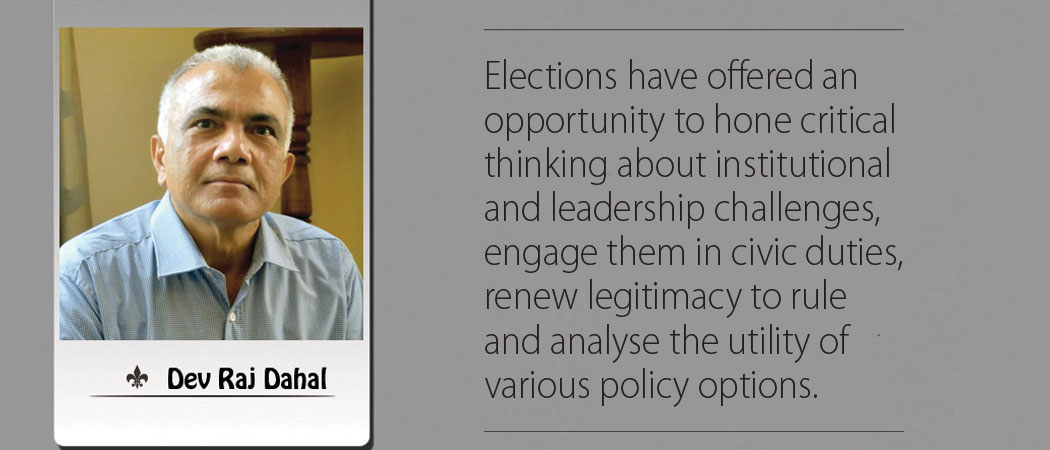
Elections have offered an opportunity to hone critical thinking about institutional and leadership challenges, engage them in civic duties, renew legitimacy to rule and analyse the utility of various policy options formulated and propagated by political parties, individual candidates and citizens engaged in the vast ferment of incremental and inclusive transformation. Sustainable democratic progress requires not just the zeal and spirit of youths but their overlap with practical skill, sagacity and experience of each generation of people craving for transformational change. Cicero is right when he says, “Not to know what happened before you were born is always to remain a child.” Civic maturity of youths is, therefore, vital to steer the nation on a peaceful path.
(Former Reader at the Department of Political Science, TU, Dahal writes on political and social issues.)