- Saturday, 6 June 2026

Path To Healthy Mind

Patrick De Vleeschauwer
Human psychology is characterised by a paradoxical structure: The same species that wages war, destabilises ecosystems, and creates collective threats also develops moral systems, empathic abilities, cultural innovations, and an increasing desire for internal harmony. This article focuses on learning to see through the nature of our vulnerability.
The human species is remarkably duplicitous. On the one hand, humans are responsible for unprecedented destruction, including war, ecological depletion, technological overshoot, and systemic polarisation. On the other hand, we have an exceptional ability to empathise, cooperate, transmit culture, and imagine morality.
This tension lies at the core of our inner struggle. It is not a random anomaly but rather a fundamental aspect of our human condition. The question is not why we are paradoxical, but rather, how this paradoxical tendency functions psychologically and what developmental opportunities it creates.
The paradoxical nature of our inner struggle is evident in the world news. We can no longer look away. While arms factories operate at full capacity, teams of highly trained healthcare professionals work tirelessly to repair the unprecedented physical and emotional damage caused by these factories.
From an evolutionary perspective, the human mind is the result of two unequal evolutionary processes. Our ancient neurobiological system, formed in contexts of scarcity and danger, optimises rapid threat detection, territorial defence, and in-group/out-group differentiation. In contrast, our young cultural system is developing exponentially faster and enables symbolic thinking, moral reflection, empathic extension, and institutional cooperation.
These two systems operate simultaneously, often in conflict with each other. A paradox arises when an evolutionarily ancient mind confronts a world that it created but cannot oversee.
From a phenomenological perspective, humans experience themselves as both vulnerable and full of potential. This dual experience gives rise to two fundamental existential movements. The first is contraction, which is an inward movement focused on protection, control, and security. The second movement is expansion, which is an outward movement focused on connection, meaning, and resonance.
These movements are not opposites that mutually exclude each other. Rather, they form a dynamic field of tension that structures human experience. Rather than being opposites, fear and desire are complementary responses to the same existential openness.
The human mind consists of three interactive processes. Our emotional processes form the primal layer. This layer is mostly automatic, defensive, and focused on survival. It produces rapid evaluations, images of enemies, territorial reflexes, and accumulation behaviour. In modern contexts, this can lead to militarisation, ecological exploitation, and polarisation.
The meaning process happening in our mind is the second layer, or the reflective layer. This layer enables empathy, moral reasoning, symbolic representation, and long-term planning. It is the foundation of culture, art, ethics, and our democratic institutions.
The third layer is the integrative process between, or our capacity for wisdom. This layer is not innate, but rather a developmental possibility. It encompasses the ability to tolerate paradoxes, regulate emotions, embrace complexity, and act with maturity rather than reflexively.
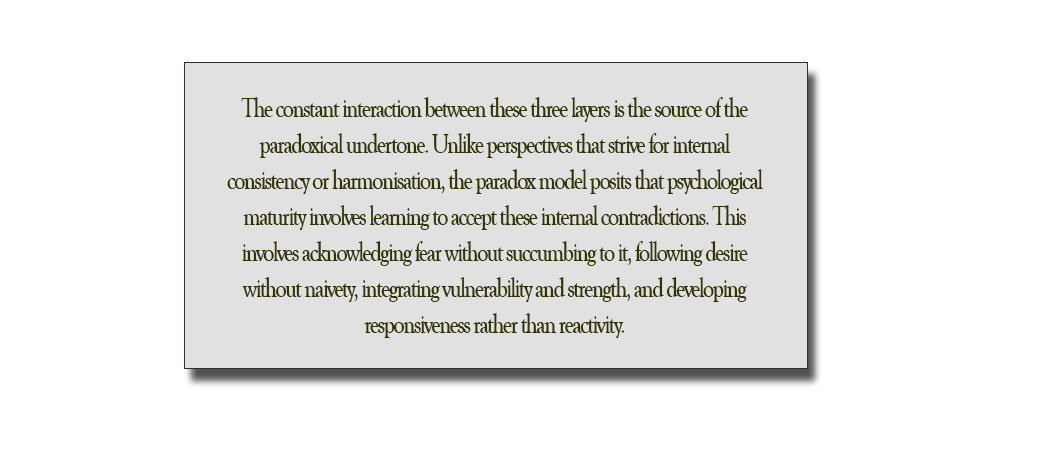
The constant interaction between these three layers is the source of the paradoxical undertone. Unlike perspectives that strive for internal consistency or harmonisation, the paradox model posits that psychological maturity involves learning to accept these internal contradictions. This involves acknowledging fear without succumbing to it, following desire without naivety, integrating vulnerability and strength, and developing responsiveness rather than reactivity.
Paradoxical maturity is a type of inner ecology, or a dynamic balance between contraction and expansion. The paradoxical undertones of human psychology have direct consequences for social dynamics. Societies that institutionalise contractive movements through politics of fear, militarisation, or economic accumulation reinforce destructive tendencies.
Conversely, societies that cultivate expansive movements through education, art, care, and ecological responsibility promote integration. The challenge of the 21st century is developing collective structures that support the integrative layer.
Human beings are not paradoxes that need to be resolved; rather, we are beings of tension who must learn to live with our dual heritage. The paradoxical nature of human psychology is the source of both our destructive tendencies and our capacity for meaning, empathy, and wisdom.
Recognising our inner tension is a necessary and transformative step toward individual and collective maturity—a crucial step in human evolution. This inner struggle is becoming a pivotal moment in our development as a species, and it will shape our future. Will the wound deepen, or will we learn from it?
-Psychology Today