- Friday, 5 June 2026

Democracy In The Age Of AI

The Nepali nation is celebrating Democracy Day today. This year’s democracy day is special for the fact that the nation is poised to elect the new democratic government in two weeks. Though the poll is being held to respond to the exigency of the unusual political circumstances engendered due to the Gen Z movement, it is a meaningful democratic exercise in which sovereign citizens would choose their representatives to rule them. This democratic election has its novelty and uniqueness. It pits new-generation political forces against those with a long and enduring stint in the country's politics.
It is very difficult to conjecture as to which side of the political fence the outcome will lend its weight, but it shall definitely herald a new shift in the political direction of the country. The interesting characteristic of this democratic franchise is that, unlike the previous ones, information technology has shaped its format and design. Political parties, their leaders, and candidates are using social media platforms, including artificial intelligence (AI), to convey their political messages, produce new pledges and promises to the voters. The sharp political battlelines are drawn on social media platforms.
Digital democracy
Moreover, AI has been used to design political messages, manipulate and malign opponents to project them in a negative light. The use of digital technology has become defining and domineering in the practices of democracy, especially in the realm of political mobilisation and campaigning. It is called the digital democracy in which citizen-state interfaces, political communication between voters and party leaders are mediated by information technology.
The advent of AI has heralded both creative and disruptive dimensions in human conditions, including the practices of democracy. It has become powerful and enmeshed in human affairs -political, social, and economic. The AI processes are so unpredictable and disruptive that they may send human history in a dangerous direction if they are not handled wisely. AI executes the tasks that produce results approximating and sometimes surpassing those of human intelligence.
Journal of Democracy, a publication of the National Endowment for Democracy (NED), a US think tank organisation close to the State Department, recently carried almost half a dozen well-researched articles written by the world’s leading experts discussing the potential of AI to improve human conditions while also recognising the risks it poses for democracy as well. This short piece draws on the key observations from the articles authored by Tom Davidson, Sarah Kreps, and Doug Kriner, focused on the wider ramifications of AI in institutions of democracy and representation.
AI such as ChatGPT is trained on vast amounts of data to understand text and generate original content. The spotlight on the incredible capabilities of ChatGPT and other AI systems, and the challenges they pose to the democratic system, has raised an interest in how to govern and regulate AI. AI experts worry that humans could lose control of runaway AI systems in the next five to twenty years if they are not regulated properly. This is not the first time that humanity has needed to simultaneously address serious current and future risks posed by a single technology. Other innovations—in energy, medicine, and agriculture—had presented similar challenges and risks during the previous eras.
Democracy, as Robert Dahl wrote in 1972, requires “the continued responsiveness of the government to the preferences of its citizens.” For elected officials to be responsive to the preferences of their constituents, they must first be able to discern and properly account for those preferences. Public-opinion polls afford elected officials a window into their constituents’ preferences. But most citizens lack basic political knowledge, and levels of policy-specific knowledge are likely lower still.
In an era of generative AI, however, the signals sent through electronic communications about pressing policy issues may be severely misleading. Technological advances allow malicious actors to generate false “constituent sentiment” at scale by effortlessly creating unique messages taking positions on any side of issues. In a field experiment conducted in 2020 in the United States, advocacy letters were composed on six different issues, and those letters were used to train what was then the state-of-the-art generative AI model, GPT-3. These randomised AI- and human-written letters were sent to 7,200 state legislators.
Then the response rates were compared to the human-written and AI-generated correspondence to assess the extent to which legislators were able to discern and therefore not respond to machine-written appeals. On three issues, the response rates to AI- and human-written messages were statistically indistinguishable. On three other issues, the response rates to AI-generated emails were lower but only by 2 per cent on average. This suggests that a malicious actor capable of easily generating thousands of unique communications could potentially skew legislators’ perceptions of which issues are most important to their constituents, as well as how constituents feel about any given issue.
Democratic representation
In the same way, generative AI could strike a blow against the quality of democratic representation by rendering obsolete the public comment process through which citizens can seek to influence the actions of the democratic state. AI can be used to create spam sites and to flood sites with fake reviews. The proliferation of social media platforms allows the effortless dissemination of misinformation, including its efficient channelling to specific constituencies.
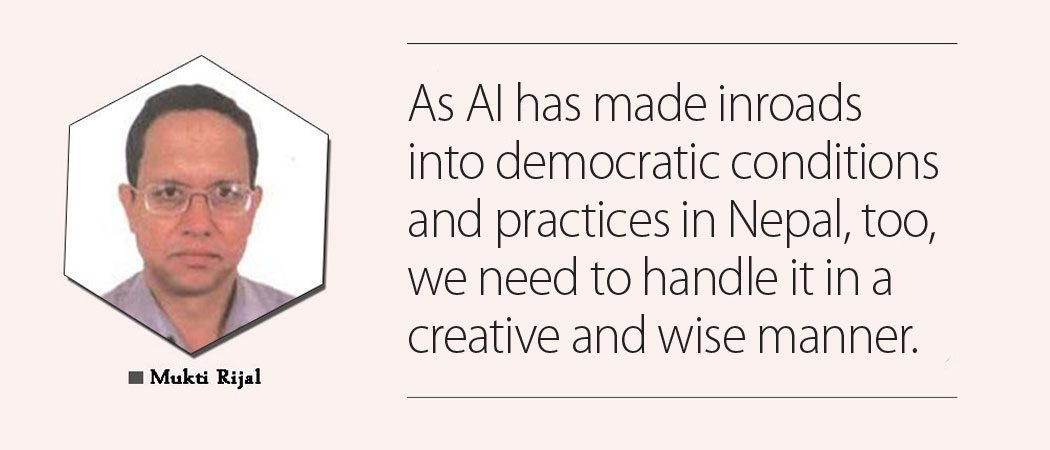
Research suggests that readers across the political spectrum cannot distinguish between a range of human-made and AI-generated content, especially in a polarised political landscape. The late Henry Kissinger, therefore, cautions, "Our task will be to understand the transformations that AI brings to human experience, the challenges it presents to human identity, and which aspects of these developments require regulation or counterbalancing by other human commitments”. As AI has made inroads into democratic conditions and practices in Nepal, too, we need to handle it in a creative and wise manner.
(The author is presently associated with Policy Research Institute (PRI) as a senior research fellow. rijalmukti@gmail.com)





-original-thumb.jpg)