- Sunday, 7 June 2026

Minister Khanal for public disclosure of information on ministers' property
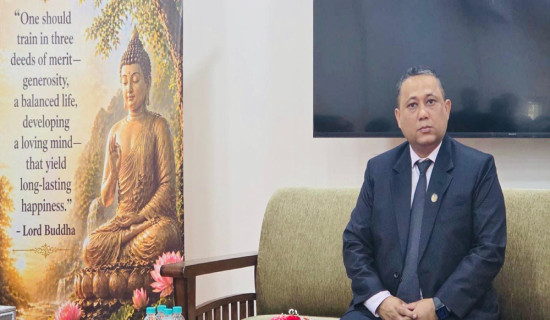
Kathmandu, Feb 13: Minister for Finance Rameshwor Khanal said making public the information on ministers' assets is a good practice.
Minister Khanal said it during an interaction themed 'Use of RTI in media: Practice and challenges' jointly organized by the Federation of Nepali Journalists (FNJ) and the National Information Commission in the federal capital on Thursday.
"Although there is a practice of collecting the details of the ministers' asset, there is no practice of making them public," the Minister said, calling for reconsidering such practice. Kanal opined that it would be better if such details were disclosed in the way the Cabinet decisions are made public.
The Minister stressed that the right information and transparency are essential to steer country's economy forward. He argued that the right to information was not only meant for the journalists but also for all citizens.
Noting the instances of non-journalists misusing the information obtained through the exercise of RTI, Minister Khanal observed that the citizens could truly be well-informed if accurate information would reach them.
Furthermore, the Minister asserted that accurate information is crucial for proper functioning of the national economy; and making information public was mandatory to ensure equal rights in business and economic activities.
Also speaking in the interaction, Chairperson of Press Council Nepal, Dr Kumar Acharya, mentioned that the Council has been consistently at work to implement the RTI. He said that broader discussions among the stakeholders could be held on this issue to strengthen its application.
Chief Information Commissioner, Dr Suresh Acharya, informed that the Commission often receives application for review on the cases where requested information is denied by authorities. Acharya shared that the Commission was working on amending the laws related to RTI that conflict with the Constitution.
He echoed the concern of Minister Khanal over the misuse of information obtained through the use of RTI law.
Shedding light on the objectives of the interaction, FNJ President Nirmala Acharya said that the interaction aimed to assess the current status of RTI use and whether it is being properly exercised or not. The interaction also seeks to help reduce the spread of false and misleading information, she added.
Also presenting views in the interaction, Chairperson of the Public Service Broadcasting, Dr Mahendra Bista, viewed that by seeking information that authorities are reluctant to provide and by proactively disclosing them would significantly contribute to promoting the transparency and reducing misinformation.
Likewise, former President of FNJ, Taranath Dahal, was of the opinion that 80 per cent of information should be freely accessible while 20 per cent should require formal requests. He urged the journalists to request for the information which are hidden so that citizens would be informed well.
Similarly, an RTI expert Yakraj Pathak presented a working paper on 'RTI: Media and Practices' observed that despite prevailing culture of hiding information, the practice of seeking information is gradually increasing.
However, he pointed out rising concerns surrounding RTI, such as low information seeking, limited public awareness, insufficient exposure of irregularities, inadequate use of information as a tool against corruption and lack of systematic data management and insufficient fact-based investigative journalism.
In his working paper, he unveiled the facts and figures regarding the status of RTI use, according to which, during the fiscal year 2081/82 BS, 42.21 percent of the RTI applications were registered at the local levels.
Also, 21.10 per cent similar appeal were filed on education, health and sports followed by 15.20 percent in administration and 7.73 percent in banks and financial institutions.(RSS)