- Saturday, 6 June 2026

Heavyweights changing constituencies
By Pallav Bhusal
Kathmandu, Jan. 23: As Nepal heads towards the House of Representatives election scheduled for March 5, a striking feature of the campaign season has been large-scale reshuffling of constituencies by senior political leaders. From established party presidents to former prime ministers and emerging figures, the decision to abandon long-held electoral bases has reshaped the political map and intensified debate over strategy, risk and national leadership.
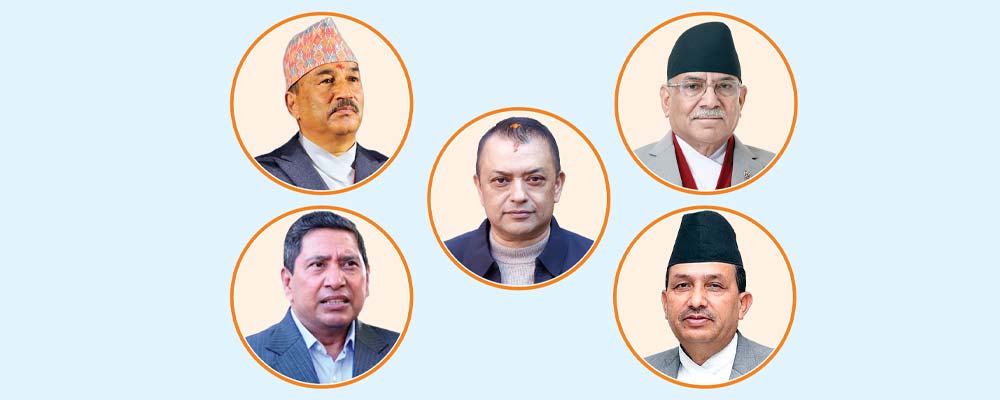
The most closely watched move has been that of Nepali Congress President Gagan Kumar Thapa, who has left Kathmandu-4, his constituency for three consecutive elections, to contest from Sarlahi-4 in Madhes Province. Kathmandu-4 was widely regarded as a relatively safe seat for Thapa, especially after he consolidated control of the party through a special general convention. His decision to move has therefore been interpreted less as an electoral necessity and more as a political statement.
Analysts say Thapa’s shift signals an attempt to reclaim the Congress’s traditional base in Madhes, a region where the party once dominated but later lost ground to Madhes-centric parties. Political commentator Mumaram Khanal argues that a national leader cannot remain confined to one urban constituency.
“Leadership at the national level requires the courage to take risks and to reconnect with regions that feel politically mistreated. Thapa’s move to Madhes seems to be his way of giving message that politics is important outside Kathmandu as well,” he said, describing Thapa’s move as both symbolic and strategic.
Congress leaders in Sarlahi claim the decision has energised cadres across the province. With Madhes accounting for more than 2.9 million voters across 32 constituencies, party strategists believe Thapa’s presence could boost both direct and proportional representation votes beyond Sarlahi itself. The constituency has historically leaned towards the Congress, and local leaders insist organisational unity will allow Thapa to spend much of the campaign period travelling nationwide.
Thapa is not alone in redrawing his electoral boundaries. CPN (Maoist Centre) coordinator Pushpa Kamal Dahal ‘Prachanda’ has left Gorkha-2 to contest from Rukum East, a district considered the ideological source of the Maoist movement.
Prachanda’s electoral history spans Kathmandu, Rolpa, Siraha, Chitwan and Gorkha, making him one of the most mobile leaders in Nepal’s recent political history. He contested 2008 Constituent Assembly election from Rolpa-2 and Kathmandu-10, won from both constituencies with big margins. In 2013, he contested the second CA poll from Kathmandu-10 and Siraha-5. He lost in Kathmandu but won with a small margin from Siraha. In 2017, he was elected from Chitwan-3 and from Gorkha-2 in 2022. This time, party insiders say, the choice of Rukum is aimed at consolidating a secure base while reinforcing emotional ties with former Maoist strongholds.
“Prachanda’s decision appears to be guided more by electoral strategy than by broader political considerations, particularly given the relatively small voter base of the constituency he has chosen,” said Khanal.
He added that such a choice reflects a calculated approach to maximising winnability rather than a departure from national-level politics.
Other senior figures have followed similar paths. UML Secretary Bhanubhakta Dhakal has shifted from Morang-3 to Tehrathum after losing his previous seat in 2022, while Maoist leader Devendra Poudel has moved from Baglung-2 to Nawalparasi West. Congress leader Prakash Sharan Mahat, who previously contested from Kathmandu-5, is standing from Nuwakot-1, his home district, for the first time.
The trend is visible beyond the traditional parties. Rastriya Swatantra Party (RSP) leader Sobita Gautam has left Kathmandu-2 for Chitwan-3, while party leader Balendra Shah, is contesting from Jhapa-5, against UML chairman and former prime minister KP Sharma Oli after resignining from the mayoral position of Kathmandu Metropolitan City.
RPP leader Kamal Thapa has also joined the trend, changing both his constituency and election symbol this time.
After contesting from Makwanpur in previous elections, Thapa has shifted to Kathmandu-5, a move seen as an effort to revive his political fortunes from a high-profile urban constituency.
Narayankaji Shrestha, senior leader of Nepali Communist Party, has also shifted to Sarlahi from Gorkha. He lost 2017 election to Baburam Bhattarai in Gorkha-2. He had lost 2013 CA election to UML in Makwanpur-2.
Defending the practice, political observers argue that national leaders should have the freedom to seek a popular mandate from any part of the country. Political commentator Geja Sharma Wagle said the growing tendency of senior figures to contest outside their traditional constituencies reflects a broader national outlook. “It sends a message that such leaders are not thinking only in terms of their home constituencies, but about the country as a whole. This approach can also open space for new leadership to emerge in areas long dominated by the same figures,” he said. Sharma added that leaders such as Gagan Thapa and Balendra Shah are taking calculated political risks by challenging senior rivals in their traditional strongholds, thereby reinforcing the idea of open, nationwide political competition rather than politics confined to fixed territorial bases. Critics, however, say frequent constituency changes reflect insecurity and weaken accountability to local voters.
“The Constitution and existing election laws allow any citizen to contest from any constituency in Nepal,” said senior political analyst Bipin Adhikari. “However, when leaders frequently change their electoral bases, voters begin to question their long-term commitment to the area. People tend to place greater trust in candidates with deep roots in their constituencies, and this growing trend of contesting from unfamiliar areas risks weakening the emotional connection and credibility that leaders need to build with voters,” he added.
Adhikari said the trend can succeed only because of the strong organisational hold of political parties and their cadres. “Changing constituencies purely to secure electoral victory is not a sustainable long-term practice. Such tendencies weaken democratic accountability, and the existing policies should be reviewed, with clearer criteria set on where and how candidates can contest elections,” he said.
With nominations finished filing across all 165 constituencies, the Election Commission reports an uptick in last-minute shifts, rebel candidacies and party defections. Whether these calculated moves will translate into electoral gains, or provoke voter backlash, will become clear only when ballots are cast. For now, the scramble for favourable ground has become one of the defining narratives of Nepal’s election season.
-square-thumb.jpg)


-original-thumb.jpg)
-original-thumb.jpg)