- Saturday, 6 June 2026

Restore Functional Efficacy Of State

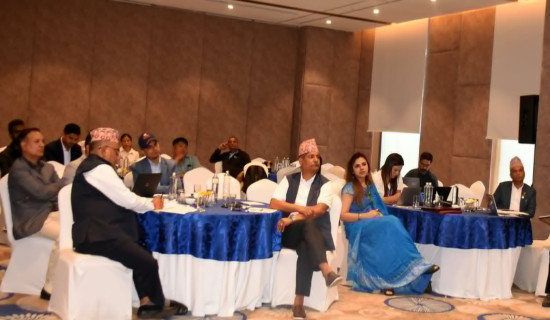
As a policy researcher, this author had the opportunity not long ago to discuss issues related to the implementation of federal governance with provincial assembly members and local government authorities in certain provinces of the country. One of the major problems pointed out by the authorities and stakeholders pertained to the ever-rising tendencies to create parallel agencies, allocate resources to unproductive works, and commit to duplication of mandates, thus reducing efficiency and effectiveness.
As a result, resource leakage and inefficiency have been a nagging problem across the tiers of the government. Take, for example, the case of the health sector, where district public health offices and local government health units feud and flex their muscles over their tasks and functions. Moreover, the issue relating to the procurement of medicines has become a persistent problem. As a result, neither the medicines required to be made available to the people are supplied in time, nor is their quality properly ensured.
Effective results
Practically, the agencies fail to collaborate and implement actions to produce effective results in delivering basic health services to the people. Similarly, in the education sector, too, federal agencies of the local governments give rise to jurisdictional overlaps and mandate conflicts. These duplications have not only hemorrhaged resources but also dulled the capacity of sub-national agencies.
At a time when the national economy is mired in crisis for want of expendable public revenue and resources, the government needs to implement cost optimisation and rationalisation measures. To this end, the government should take steps and even go to the extent of pruning the size of the state structures from the federal to the local level.
When the interim government took over the reins following the Gen-Z movement, it announced that the governance reform would be its major priority. It had committed that the several apparatuses and agencies controlled and managed so far by the federal government would be repurposed or transferred to the purview of the sub-national governments - provinces and local bodies - for resource efficiency, effective undertaking and management. However, the constitutional arrangements premised upon the principle of subsidiarity have not been implemented, as evidenced by the huge bureaucratic apparatus at the federal level.
Moreover, the ad hoc bodies and agencies at different levels have imposed undue pressure on public expenditures. As a result, there are several programmes, projects, and activities operated and handled by the governments that have allegedly outlived their mission and objectives, duplicate efforts and resources, or operate below peak efficiencies. This wasteful spending has been a contributing factor to the deteriorating fiscal health and discipline in the country.
Hence, there is a need to review the patterns of public expenditure in the country. In this context, it would be appropriate to outline some of the applicable standards on which broad action to maximise utilisation of taxpayer money should be based. In order to stop wasteful and unnecessary spending, all government programmes should have a direct, clear, and immediate purpose. Likewise, all government spending should provide a necessary public service, and serve a clearly defined need, demands and interest of the citizens.
All public spending should fund its intended purpose and reach the targeted recipient. In fact, there should not be any improper payments that result in monetary loss to the public exchequer. The government should be frugal and strive to avoid overpaying to finance materials, projects and activities. The government should spend only the amount necessary to achieve its intended objectives and goals.
Using the above-mentioned guidelines, public spending should be geared to restrain and refocus taxpayer resources. The government should eliminate all the duplicating and overlapping agencies, projects and programmes scattered across the three tiers of governments. The programmes and projects that do not yield intended results and outcomes should be either avoided or repurposed and eliminated. All illegal, improper and irrational payments need to be revoked for proper utilisation of the public resources.
Moreover, an effective oversight of public spending should be conducted to minimise and eliminate wasteful expenditures. The most important measure for eliminating wasteful expenditure is to stop hasty and unwise end-of-financial year spending. Public Expenditure Review Committees (PERCs) formed by the government during the previous years, in their report, had made recommendations to reduce overlap, duplication, and fragmentation in the programmes. The PERC reports identify opportunities for cost savings and more effective and efficient service delivery for the people by addressing several types of gross inefficiencies in government.
Reform
When more than one government agency, or more than one component within an agency, is involved in the same broad area of national need, there are opportunities for reform towards improving service delivery and addressing the needs of the citizens. When multiple agencies or programmes across the tiers of the government have similar goals, engage in similar activities or strategies, or target similar beneficiaries, the overlapping agencies need to be revoked.
The government should address many of these inefficiencies by reforming, reducing the funding for, and in some cases, eliminating these programmes. These measures would allow the public programmes, projects, and activities to meet and address the expectations of the people and save resources to support the needy people.
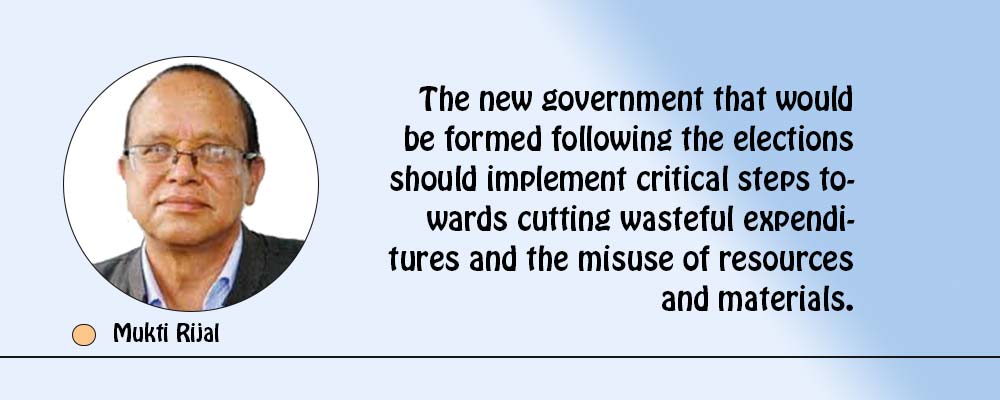
As the incumbent interim government is preoccupied with its task of holding elections, the new government that would be formed following the elections should implement critical steps towards cutting wasteful expenditures and the misuse of resources and materials at the federal, province and local levels to ensure resource efficiency and maximise effectiveness of service delivery across all levels. This can alone restore the trust of the people in the sanctity of the state.
(The author is presently associated with Policy Research Institute (PRI) as a senior research fellow. rijalmukti@gmail.com)